- Animals
- ›Chordates
- ›Vertebrates
- ›Mammals
- ›Therians
- ›Placental Mammals
- ›Afromammals
- ›Proboscideans
- ›Elephants
- ›Mammuthus
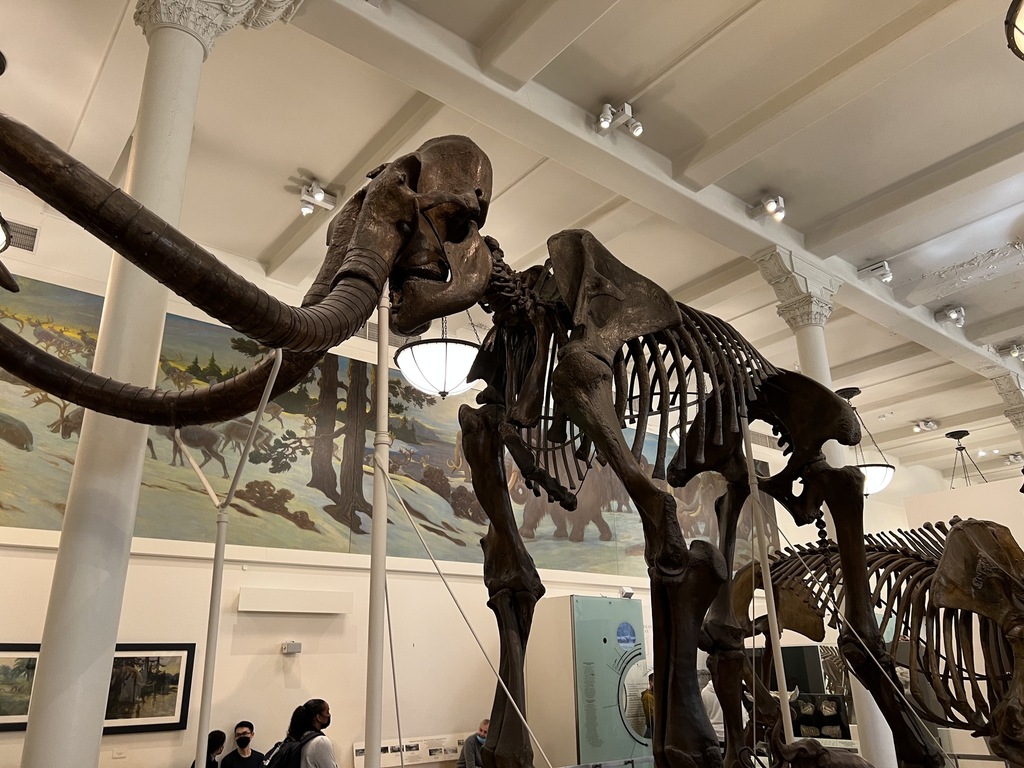
Woolly Mammoth
Mammuthus primigenius
The woolly mammoth (Mammuthus primigenius) is an extinct species of mammoth that lived from the Middle Pleistocene until its extinction in the Holocene epoch. It was one of the last in a line of mammoth species, beginning with the African Mammuthus subplanifrons in the early Pliocene. The woolly mammoth began to diverge from the steppe mammoth about 800,000 years ago in Siberia. Its closest extant relative is the Asian elephant. The Columbian mammoth (Mammuthus columbi) lived alongside the woolly mammoth in North America, and DNA studies show that the two hybridised with each other. Mammoth remains were long known in Asia before they became known to Europeans. The origin of these remains was long debated and often explained as the remains of legendary creatures. The mammoth was identified as an extinct elephant species by Georges Cuvier in 1796.
The appearance and behaviour of the woolly mammoth are among the best studied of any prehistoric animal because of the discovery of frozen carcasses in Siberia and North America, as well as skeletons, teeth, stomach contents, dung, and depiction from life in prehistoric cave paintings. It was roughly the same size as modern African elephants. Males reached shoulder heights between 2.67 and 3.49 m (8 ft 9 in and 11 ft 5 in) and weighed between 3.9 and 8.2 t (3.8 and 8.1 long tons; 4.3 and 9.0 short tons). Females reached 2.3–2.6 m (7 ft 7 in – 8 ft 6 in) in shoulder heights and weighed between 2.8 and 4 t (2.8 and 3.9 long tons; 3.1 and 4.4 short tons). A newborn calf weighed about 90 kg (200 lb).
From the article Woolly mammoth on Wikipedia (CC BY-SA), quoted section by section
Description
The average shoulder height for males of the species has been estimated at 2.8–3.15 m (9 ft 2 in – 10 ft 4 in) with a weight of 4.5–6 t (9,900–13,200 lb), with females being smaller like living elephants, with a shoulder height of 2.3–2.6 m (7 ft 7 in – 8 ft 6 in) and a weight of 2.8–4 t (6,200–8,800 lb). This size is comparable to the largest living elephant species, the African bush elephant (Loxodonta africana), but is considerably smaller than the earlier Mammuthus meridionalis and Mammuthus trogontherii and the contemporary Mammuthus columbi. A newborn calf would have weighed about 90 kg (200 lb). The woolly mammoth exhibited size variation throughout its range, with individuals from Western Europe being considerably larger (with adult males estimated to be on average 2.99–3.31 m (9 ft 10 in – 10 ft 10 in) tall and 5.2–6.9 t (11,000–15,000 lb) in weight) than those found in Siberia (with adult males of this population being estimated on average 2.66–2.94 m (8 ft 9 in – 9 ft 8 in) tall and 3.9–5.2 t (8,600–11,500 lb) in weight). One of the largest recorded woolly mammoths is the Siegsdorf specimen from Germany, estimated to be 50 years, with an estimated shoulder height of 3.49 m (11 ft 5 in) and an estimated body mass of 8.2 t (18,000 lb).
Few frozen specimens have preserved genitals, so the sex is usually determined through examination of the skeleton. …
Range & habitat
The habitat of the woolly mammoth is known as "mammoth steppe" or "tundra steppe". This environment stretched across northern Asia, many parts of Europe, and the northern part of North America during the last ice age. It was similar to the grassy steppes of modern Russia, but the flora was more diverse, abundant, and grew faster. Grasses, sedges, shrubs, and herbaceous plants were present, and scattered trees were mainly found in southern regions. This habitat was not dominated by ice and snow, as is popularly believed, since these regions are thought to have been high-pressure areas at the time. The habitat of the woolly mammoth supported other grazing herbivores such as the woolly rhinoceros, wild horses, and bison. The Altai-Sayan assemblages are the modern biomes most similar to the "mammoth steppe". A 2014 study concluded that forbs (a group of herbaceous plants) were more important in the steppe-tundra than previously acknowledged, and that it was a primary food source for the ice-age megafauna.
The southernmost woolly mammoth specimen known is from the Shandong province of China and is 33,000 years old. The southernmost European remains are from the Depression of Granada in Spain and are of roughly the same age. DNA studies have helped determine the phylogeography of the woolly mammoth. …
Wikipedia: “Distribution and habitat”
What it does
Food at various stages of digestion has been found in the intestines of several woolly mammoths, giving a good picture of their diet. Woolly mammoths sustained themselves on plant food, such as forbs, grasses and sedges, which were supplemented with herbaceous plants, flowering plants, shrubs, mosses, and tree matter. The composition and exact varieties differed from location to location. Woolly mammoths needed a varied diet to support their growth, similar to modern elephants. A 2014 study examined coprolites (fossil dung) of woolly mammoths and other Ice Age mammals and found they consisted of about 63% forbs, and about 27% grasses. Coupled with other methods, these researchers concluded that the Arctic was dominated by forbs much of the last 50.000 years instead of grasses, as was long thought. Only from 10.000 years ago did forbs decline and woody plants and grasses became predominant.
An adult of 6 tonnes would need to eat 180 kg (400 lb) daily and may have foraged as long as 20 hours every day. The two-fingered tip of the trunk was probably adapted for picking up the short plants of the last ice age (Quaternary glaciation, 2.58 million years ago to present) by wrapping around them. In contrast, modern elephants curl their trunks around the longer grass of their tropical environments. …
Wikipedia: “Diet”
In human culture
The lifespan of mammals is related to their size. Since modern elephants can reach the age of 60 years, the same is thought to be true for woolly mammoths, which were of a similar size. The age of a mammoth can be roughly determined by counting the growth rings of its tusks when viewed in cross-section, but this does not account for its early years, as these are represented by the tips of the tusks, which are usually worn away. In the remaining part of the tusk, each major line represents a year, and weekly and daily ones can be found in between. Dark bands correspond to summers, so determining the season in which a mammoth died is possible. The growth of the tusks slowed when foraging became harder, for example, during winter, during disease, or when a male was banished from the herd (male elephants live with their herds until about the age of 10). Mammoth tusks dating to the harshest period of the last glaciation 25–20,000 years ago show slower growth rates. Woolly mammoths continued growing past adulthood, like other elephants. Unfused limb bones show that males grew until they reached the age of 40, and females grew until they were 25. The frozen calf "Dima" was 90 cm (35 in) tall when it died at the age of 6–12 months. At this age, the second set of molars would erupt, and the first set would be worn out at 18 months of age. …
Wikipedia: “Life history”
Listen
Looking for field recordings…
Where it lives
Recorded sightings
—
geo-referenced records in GBIF, from museums, herbaria and field observers.
Drag the globe to turn it. Dots are where records exist, not a range map; darker means more records.
In the stacks
Searching the stacks…
Every page naming Mammuthus primigenius in the Biodiversity Heritage Library →
This page is assembled live from iNaturalist, GBIF, Wikipedia, the Source Library and the Internet Archive. It is not yet part of the hand-edited codex. iNaturalist taxon 317775.