On eBird ↗
Island Imperial-Pigeon
Live sightings near you, the range map, bar charts of when it is seen, and Macaulay Library photos and recordings.
Island Imperial Pigeon
Ducula pistrinaria
The island imperial pigeon or floury imperial pigeon (Ducula pistrinaria) is a species of bird in the family Columbidae. It is found in the Bismarck Archipelago and the Solomon Islands archipelago, living in primary and secondary forests and mangroves. The International Union for Conservation of Nature (IUCN) has assessed it as a least-concern species.
From the article Island imperial pigeon on Wikipedia (CC BY-SA), quoted section by section
Description
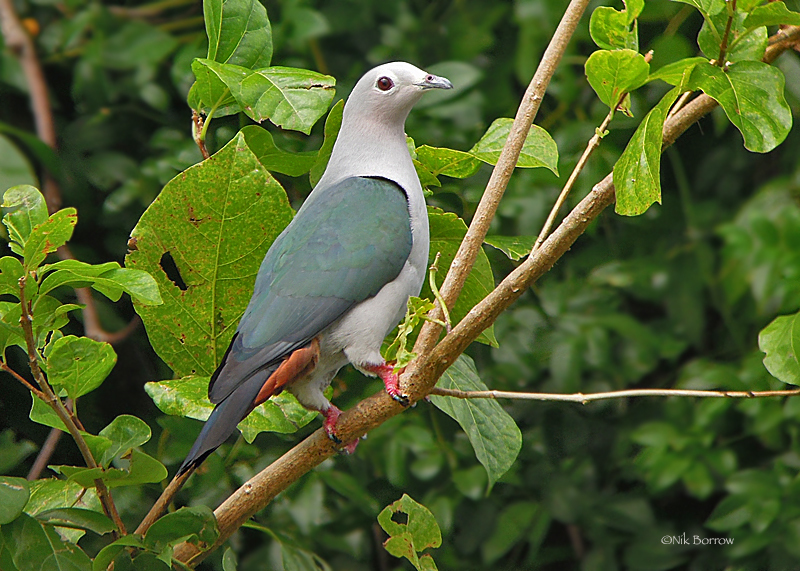
The island imperial pigeon is about 39–45 cm (15–18 in) long and weighs 470–500 g (17–18 oz). The head and neck are pale grey, and there are white spectacles. The upperparts are glossy. The wing coverts and tertials are grey-green, and the primaries and secondaries are blackish. The back is grey-green. The uppertail is dark blue-green, and the undertail is chestnut. The throat is vinous, the breast is greyish-vinous, and the belly is greyish-fawn. The beak is slaty-blue, having a black tip. The eye is dark red or brownish, and the feet are red. The juvenile bird is duller and buffier. The subspecies have different sizes and glosses.
Range & habitat
This pigeon is found in the Bismarck Archipelago, the Solomon Islands archipelago and small islands to the north and east of New Guinea. Its habitat is coastal primary forest, old secondary forest, mangroves and some disturbed habitats.
Wikipedia: “Distribution and habitat”
What it does
One or two birds and small flocks are usually found; large flocks are occasionally seen. The pigeon flies swiftly and directly. It plucks fruits from branches in the canopy, and it flies across the sea to search for food. Its calls include a rising and repeated c-wooooohooo given when the bird is upright, a loud series of descending coos while bobbing up and down, and a high-pitched crrrrrurrr. In display, it flies up at an angle of 70° and then glides. Breeding has been observed from June to September and in March. The nest is built at the end of a branch and made of twigs. One egg is laid.
Wikipedia: “Behaviour”
Listen
Looking for field recordings…
Where it lives
Recorded sightings
—
geo-referenced records in GBIF, from museums, herbaria and field observers.
Drag the globe to turn it. Dots are where records exist, not a range map; darker means more records.
In the stacks
Searching the stacks…
Every page naming Ducula pistrinaria in the Biodiversity Heritage Library →
This page is assembled live from iNaturalist, GBIF, Wikipedia, the Source Library and the Internet Archive. It is not yet part of the hand-edited codex. iNaturalist taxon 3183.