- Animals
- ›Chordates
- ›Vertebrates
- ›Reptiles
- ›Snakes and Lizards
- ›Lizards
- ›Iguanas and Allies
- ›Dragons and Chameleons
- ›Dragons
- ›Bearded Dragons, Water Dragons, and Allies
- ›Ctenophorus
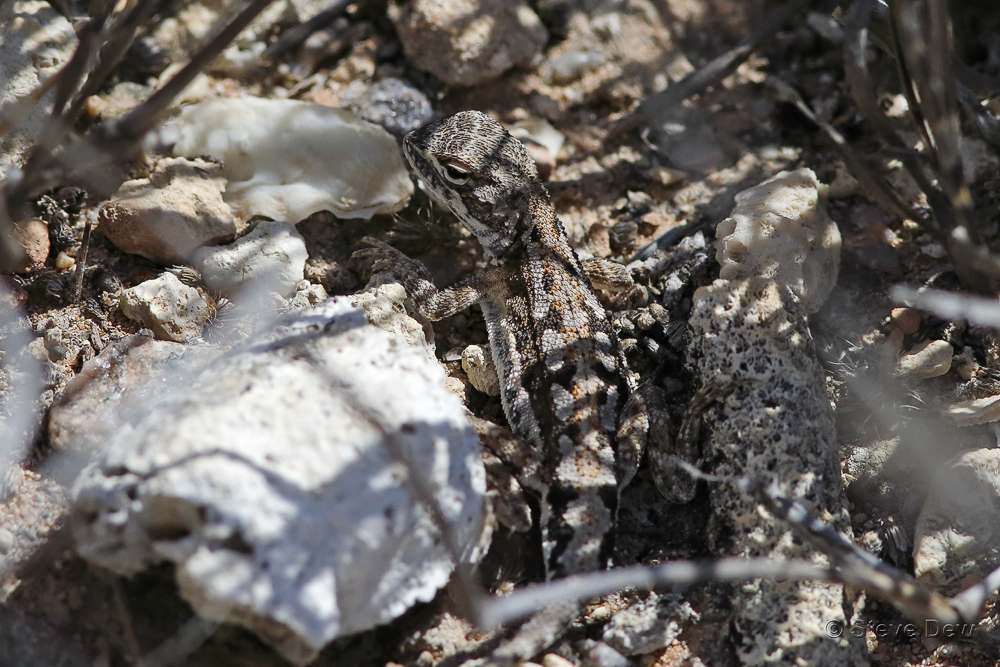
Gnaraloo Heath Dragon
Ctenophorus parviceps
Ctenophorus parviceps, commonly known as the Gnaraloo heath dragon or northwestern heath dragon is a species of agamid lizard occurring in pale coastal sands and shell grit with open heaths and beach spinifex, between the North West Cape and Carnarvon, Western Australia and on Bernier Island. The Gnaraloo heath dragon (Ctenophorus parviceps) is a lizard that can be found along the coast of Western Australia between Exmouth Gulf and Shark Bay, and is also known as the northwestern heath dragon. It is native to Australia and usually inhabits sandy coastal dunes. The species' longevity is 3–50 years and its population density is extremely low. The Gnaraloo heath dragon is a member of the Agamidae family, which contains 15 genera. The lizard is under the Ctenophorus genus which has up to 33 species. This genus shows the most morphological and ecological diversity out of the three large agamid genera. 83% of the lizards in this genus lack a crest, while 17% possess crests. They are smaller than most agamids but do have relatively large heads. The Gnaraloo heath dragon can be differentiated from related species by a series of spines on the tail's base, a pale-grey brown broad vertebral band along its back, and hour-glass bars extending upwards to meet the pale vertebral band. It is usually 45mm in terms of length, measuring from snout to vent.
From the article Ctenophorus parviceps on Wikipedia (CC BY-SA), quoted section by section
Description
The Gnaraloo heath dragon is a relatively slender lizard with a small head and a neck narrower than its head. Its flanks and sides are darker brown and its scales are strongly keeled. The hindlimb is roughly 70% of the snout-vent length and the tail is about 150%. The body shape of this terrestrial lizard, like the rest of its taxa, is made for fast movement and foraging open areas. The Gnaraloo heath dragon has a dark pattern and numerous pores, usually 24–36. Male and female lizards can be distinguished by the number of pores. Males have 8-10 pre-anal pores and females have 16-25 femoral pores. Within the Ctenophorus genus, each species' male and female lizards can also be distinguished by colour patterns. Intricate patterns are found more in males as these patterns correlate with selection for male sexual signals. Their colour also often varies with age, seasonal or temperate changes. It is a terrestrial diurnal reptile and occupies hummock grassland, low open shrubland, tall shrubland and sandy coastal dunes. Most Ctenophorus lizards do not burrow to retreat, but instead retreat to rock crevices. The Gnaraloo heath dragon reproduces via oviparity. This process, egg-laying, is an inherited mode of reproduction for all vertebrates. …
Range & habitat
The species of Gnaraloo heath dragon are mostly found in Southwestern Australia - along the coast between Exmouth Gulf and Shark Bay - within Canavron Bay. Western Australia's coastal areas are known for its biodiversity and as a fast growing urban and agricultural region. However, the distribution of the Ctenophorus parviceps in the North of Shark Bay has led to its geographical isolation. This species is geographically limited by the sandy region along the coast which runs up until the Northwest Cape. The sandy region reduces the distribution of reptile and frog species that are equipped for sandy terrains. The sandy dunes of Western Australia have temperate mediterranean climate. The relatively damp and island-like refuge is surrounded by ocean and dry lands. Western heath dragons are small but specialists of this terrestrial habitat. Although there is a possibility that this lizard species is not only endemic to south-western Australia, their particularity in habitat has separated them from related species in other regions. They are an eminent component of the Western Australian region. They are plentiful, have detectable social behaviour and complex vivid patterns.
Wikipedia: “Distribution and habitat”
What it does
The species has enigmatic behavioural patterns and has only been recently recognised, Hence, this has contributed to the lack of literature concerning their ecology, biology and natural history. Lizards are not known for emitting vocal sounds. It is a rarity for a lizard species to make noises. Most Ctenophorus species are territorial and defend their areas from rocks or termite mounds. However, many Ctenophorus lizards communicate through head-bobbing as it is a determinant of species.
Wikipedia: “Behaviour”
Where it lives
Recorded sightings
—
geo-referenced records in GBIF, from museums, herbaria and field observers.
Drag the globe to turn it. Dots are where records exist, not a range map; darker means more records.
In the stacks
Searching the stacks…
Every page naming Ctenophorus parviceps in the Biodiversity Heritage Library →
This page is assembled live from iNaturalist, GBIF, Wikipedia, the Source Library and the Internet Archive. It is not yet part of the hand-edited codex. iNaturalist taxon 318666.