On eBird ↗
Nuku Hiva Imperial-Pigeon
Live sightings near you, the range map, bar charts of when it is seen, and Macaulay Library photos and recordings.
Nuku Hiva Imperial-Pigeon
Ducula galeata
The Nuku Hiva imperial pigeon (Ducula galeata), also known as the Marquesan imperial pigeon or Upe, is a pigeon which is endemic to Nuku Hiva in the Marquesas Islands of French Polynesia, now restricted to some valleys in the western part of that island; following successful reintroductions of birds in 2000 and 2003, there is now an established population on Ua Huka. With its small distribution, scientists now believe it has probably never been common, but its small population (estimated at c. 300 as of 2023) has marked it as an endangered species since 2008.
From the article Nuku Hiva imperial pigeon on Wikipedia (CC BY-SA), quoted section by section
Description
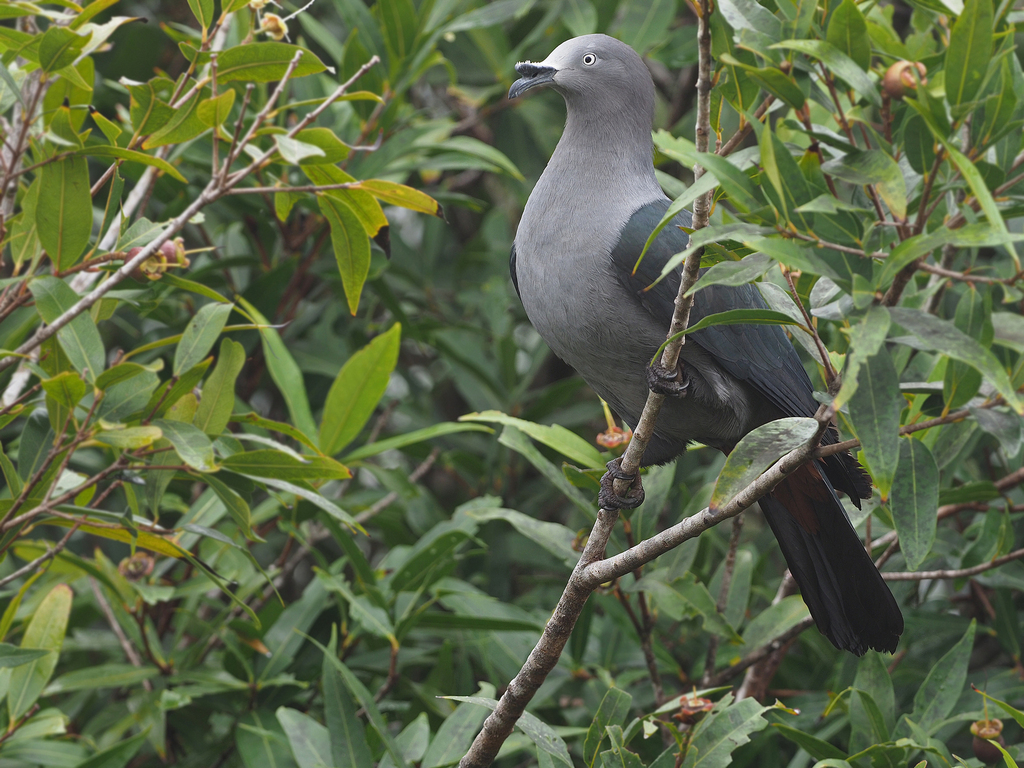
This is the largest pigeon outside of the crowned pigeons, as it weighs approximately 900 g (2.0 lb). Females, at 50 to 53.5 cm (19.7 to 21.1 in) long, are slightly smaller than males, at 55 cm (22 in) in length. Among standard measurements, the wing chord is 27.8–32.1 cm (10.9–12.6 in), the tail is 18.1–23.1 cm (7.1–9.1 in), the bill is 1.9–2.7 cm (0.75–1.06 in) and the tarsus is 3.9–4.6 cm (1.5–1.8 in). This species is heavily built with a large bill and long, broad tail. The wings are broad and rounded in shape. The Nuku Hiva imperial pigeon is sooty-gray on the head, throat and breast, with a white band just behind the bill that can be seen from some distance. The belly is slightly browner in color than the rest of the underside. The upperparts, wings and tail are glossy green with a bluish tint. The underside of both the tail and the wings are black. The bill is black, with a swollen cere that gives the face a unique sloping look just above the bill. This bird has an cooing advertising call that consist of a loud, deep, guttural 'neah-ah, neah-ah, neah-ah, neah-ah or naw-aw, naw-naw or uh-wah, uh-wah, uh-wah. This call is so deep in timber that it is sometimes described as cow-like. A call, probably consisting of an excitement call, has been described as a crow-like krawk, krawk.
Range & habitat
This was originally distributed throughout its native island, which at one time was almost completely covered in forest. Now it is basically restricted to woodland from 200 to 1,500 m (660 to 4,920 ft) above sea-level. A few on the island may still turn in sea-level forested groves and woods surrounded banana and orange plantations. Before ancient Polynesian settlers arrived there, subfossil bones show there was also a population of this bird on Henderson Island in the Pitcairn Islands.
Wikipedia: “Habitat”
Listen
Looking for field recordings…
Where it lives
Recorded sightings
—
geo-referenced records in GBIF, from museums, herbaria and field observers.
Drag the globe to turn it. Dots are where records exist, not a range map; darker means more records.
In the stacks
Searching the stacks…
Every page naming Ducula galeata in the Biodiversity Heritage Library →
This page is assembled live from iNaturalist, GBIF, Wikipedia, the Source Library and the Internet Archive. It is not yet part of the hand-edited codex. iNaturalist taxon 3191.