- Animals
- ›Chordates
- ›Vertebrates
- ›Ray-finned Fishes
- ›Spiny-rayed fishes
- ›Blennies, Damselfishes and Allies
- ›Damselfishes
- ›Typical Damselfishes and Anemonefishes
- ›Acanthochromis
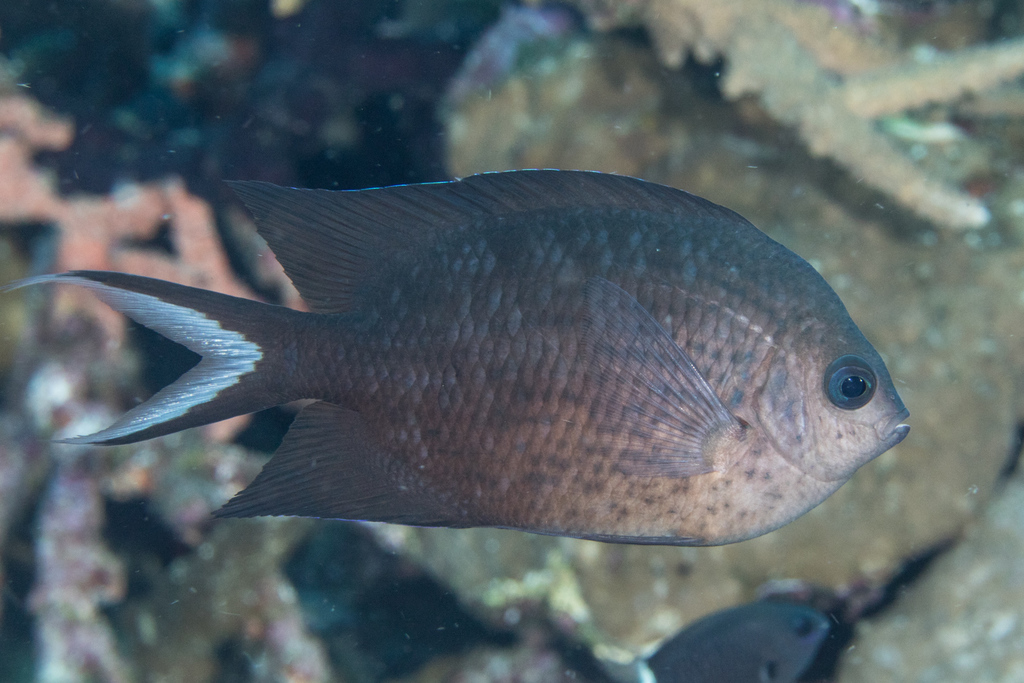
Spiny Chromis
Acanthochromis polyacanthus
The spiny chromis (Acanthochromis polyacanthus) is a species of damselfish from the western Pacific. It is the only member of the genus Acanthochromis.
From the article Spiny chromis on Wikipedia (CC BY-SA), quoted section by section
Description
Spiny chromis individuals can grow up to a maximum size of 14 centimetres (5.5 in) as adults. Its fins have 17 dorsal spines, 14 to 16 dorsal rays, 2 anal spines, and 14 to 16 anal rays. This species occurs in a wide range of colour variations, depending on geographic location. It is thought this is due to the lack of a pelagic larval phase and sedentary behaviour of adults, resulting in little genetic connectivity between populations and thus divergent evolution. It is currently unclear whether or not all these variations are truly the same species, or whether they constitute a species complex. Juveniles typically display a yellow stripe along their flanks.
Range & habitat
The spiny chromis is found in the western Pacific Ocean. It is found in western and central Indonesia, Papua New Guinea, northern Australia, and all the islands in the Philippines except Luzon. They are also found in Melanesia. This fish usually lives in coral reefs. This fish is found at a depth range of 1 to 65 metres (3.3 to 213.3 ft) but is usually found at a depth range of 4 to 20 metres (13 to 66 ft).
Wikipedia: “Distribution and habitat”
What it does
This fish is planktivorous and algivorous, and steals algae from algae-farming species of damselfish. Juveniles consume mucus secreted from their parent's skin, similar to the behaviour of young discus.
Wikipedia: “Diet”
Where it lives
Recorded sightings
—
geo-referenced records in GBIF, from museums, herbaria and field observers.
Drag the globe to turn it. Dots are where records exist, not a range map; darker means more records.
In the stacks
Searching the stacks…
Every page naming Acanthochromis polyacanthus in the Biodiversity Heritage Library →
This page is assembled live from iNaturalist, GBIF, Wikipedia, the Source Library and the Internet Archive. It is not yet part of the hand-edited codex. iNaturalist taxon 319335.