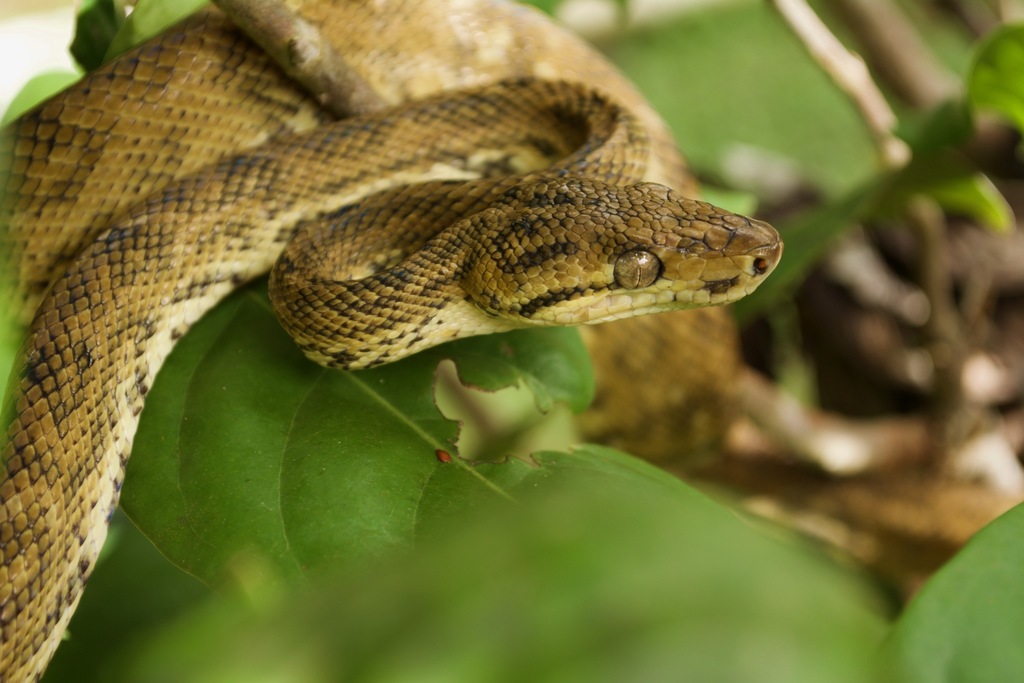
Dormilona
Corallus ruschenbergerii
Corallus ruschenbergerii, commonly known as the Central American tree boa, common tree boa, and Trinidad tree boa, is a boa species found in lower Central America and northern South America. No subspecies are currently recognized. Like all boas, it is not venomous.
From the article Corallus ruschenbergerii on Wikipedia (CC BY-SA), quoted section by section
Description
Corallus ruschenbergerii is one of the largest members of the genus Corallus with adults reaching up to 2 metres (6 ft 7 in) in total length (including tail). The colors are typically shades of yellow, brown or gray, although populations on Trinidad and Tobago are often a patternless pure bronze.
Range & habitat
Corallus ruschenbergerii is found in Lower Central America in southwestern Costa Rica (south of 10° N) and Panama, including Isla del Rey, Isla Contadora, Isla de Cébaco and Isla Suscantupu. In South America it occurs in Colombia east of the Andes, north of the Cordillera Central and north of the Cordillera Oriental, northern Venezuela north of the Cordillera de Mérida and in the drainage of the Río Orinoco, north and west of the Guiana Shield, east of the Orinoco Delta. It is also found on Isla Margarita, Trinidad and Tobago. The type locality given is "Panama".
Wikipedia: “Geographic range”
What it does
The primary diet of C. ruschenbergerii consists of rodents (such as squirrels, mice and porcupine rats) and other small mammals (such as bats, mouse opossums and introduced Javan mongoose), as well as lizards, frogs and birds.
Wikipedia: “Feeding”
In human culture
The specific name, ruschenbergerii, is in honor of William Ruschenberger, who was a United States Navy surgeon.
Wikipedia: “Etymology”
Where it lives
Recorded sightings
—
geo-referenced records in GBIF, from museums, herbaria and field observers.
Drag the globe to turn it. Dots are where records exist, not a range map; darker means more records.
In the stacks
Searching the stacks…
Every page naming Corallus ruschenbergerii in the Biodiversity Heritage Library →
This page is assembled live from iNaturalist, GBIF, Wikipedia, the Source Library and the Internet Archive. It is not yet part of the hand-edited codex. iNaturalist taxon 32085.