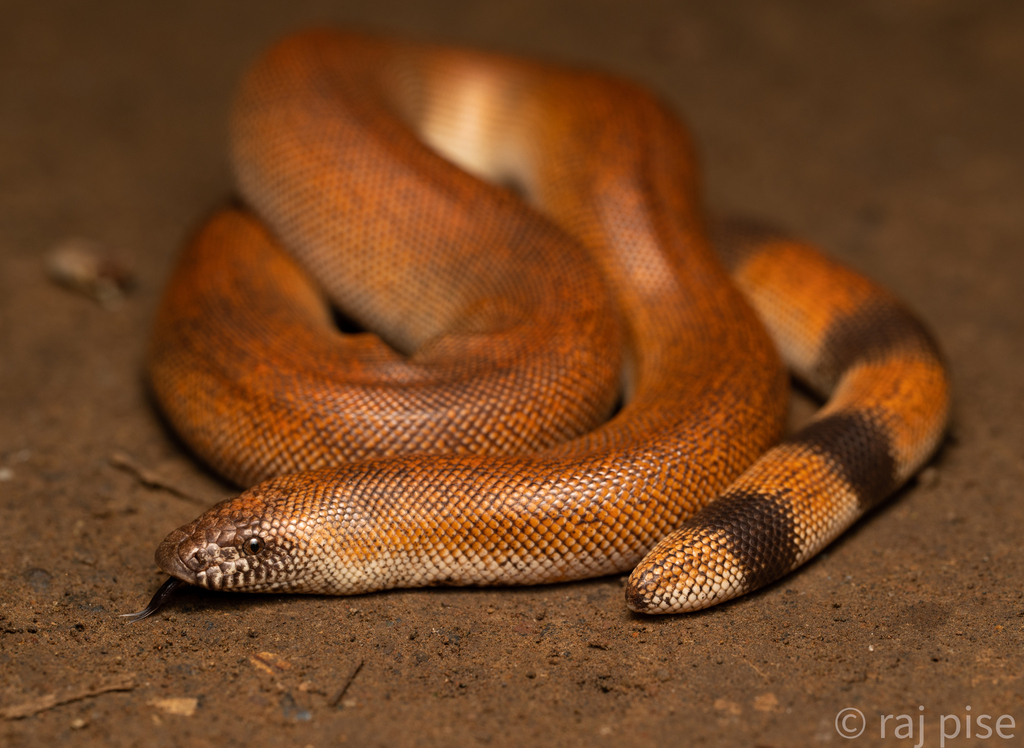
Red Sand Boa
Eryx johnii
Eryx johnii is a species of nonvenomous snake in the subfamily Erycinae of the family Boidae. The species is native to Iran, Pakistan, and India. There are no subspecies which are recognized as being valid. Common names include: Indian sand boa, John's sand boa, iruthalai nagam, mannuli pambu, red sand boa, and brown sand boa.
From the article Eryx johnii on Wikipedia (CC BY-SA), quoted section by section
Description
Adults of E. johnii rarely exceed 2 feet (61 cm) in total length (including tail), although they sometimes reach 3 feet (91 cm). Adapted to burrowing, the head is wedge-shaped with narrow nostrils and very small eyes. The body is cylindrical in shape with small polished dorsal scales. The tail, which is blunt, rounded, and not distinct from the body, appears truncated. Coloration varies from reddish brown to dull yellow-tan.
Range & habitat
E. johnii is found from Iran through Pakistan into western, southern, and northwestern India. The type locality given is "Tranquebar" (Tanjore, Trichy, southeastern Tamil Nadu, India). It is found in Indian desert. In western India, specifically in the state of Maharashtra, it is known as a Mandul snake (Marathi: मांडूळ साप).
Wikipedia: “Geographic range”
What it does
The diet of E. johnii consists mainly of mammals such as rats, mice, and other small rodents that are killed by constriction. Some specimens have apparently fed exclusively on other snakes.
Wikipedia: “Diet”
In human culture
The specific name, johnii, is in honor of German naturalist Christoph Samuel John (1747–1813), who was a missionary in India from 1771 until his death.
Wikipedia: “Etymology”
Where it lives
Recorded sightings
—
geo-referenced records in GBIF, from museums, herbaria and field observers.
Drag the globe to turn it. Dots are where records exist, not a range map; darker means more records.
In the stacks
Searching the stacks…
Every page naming Eryx johnii in the Biodiversity Heritage Library →
This page is assembled live from iNaturalist, GBIF, Wikipedia, the Source Library and the Internet Archive. It is not yet part of the hand-edited codex. iNaturalist taxon 32227.