- protozoans
- ›slime molds
- ›true slime molds
- ›Columellomycetidae
- ›Stemonitidia
- ›Stemonitidales
- ›Stemonitidaceae
- ›Stemonitis
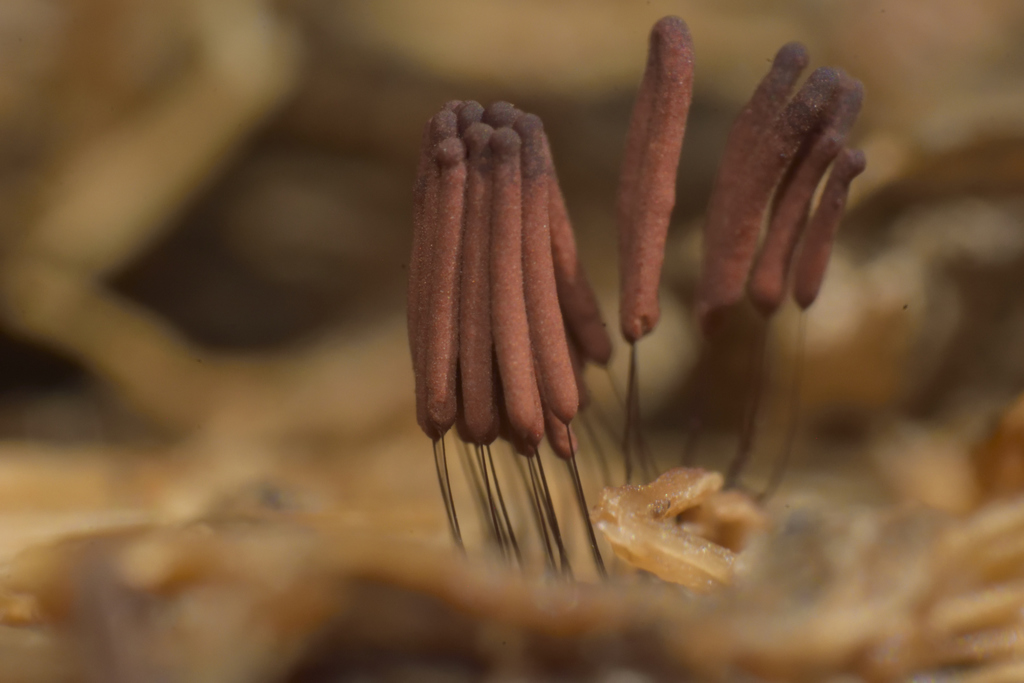
Stemonitis axifera
Stemonitis axifera is a species of slime mold. It fruits in clusters on dead wood, and has distinctive tall reddish-brown sporangia, supported on slender stalks.
From the article Stemonitis axifera on Wikipedia (CC BY-SA), quoted section by section
Description
The erect, stalked cylindrical sporangia are arranged into bundles or clusters that are 7–15 mm (0.3–0.6 in) tall. Each sporangium is supported by a thin, shining, black stalk that is 3–7 mm (0.1–0.3 in) long. The bright rusty brown color of mature sporangia lightens to a pale brown after the spores have been dispersed. Spores measure 5 by 7 μm and have a smooth to minutely punctate surface texture.
What it does
The slime mold grows on decaying wood. When the fruit bodies consist of milky white sporangia, they are a favoured food source for Philomycus slugs (mantleslugs), such as P. carolinianus and P. flexuolaris. The slugs emerge at night from under flaps of bark and migrate to more exposed areas at the top of wet logs, bypassing more mature, pigmented fruit bodies for the younger white ones. The slugs eat the sporangia stalks from the top down. The feeding preference of Philomycus slugs for immature white sporangia is not seen in other slug species. One adult of the pleasing fungus beetle Aporotritoma pulchra was recorded to be associated with this slime mold, which would be a rather unusual food for these beetles; however, the single record does not imply that the beetle actually feeds regularly on slime molds.
Wikipedia: “Ecology”
Where it lives
Recorded sightings
—
geo-referenced records in GBIF, from museums, herbaria and field observers.
Drag the globe to turn it. Dots are where records exist, not a range map; darker means more records.
In the stacks
Searching the stacks…
Every page naming Stemonitis axifera in the Biodiversity Heritage Library →
This page is assembled live from iNaturalist, GBIF, Wikipedia, the Source Library and the Internet Archive. It is not yet part of the hand-edited codex. iNaturalist taxon 322311.