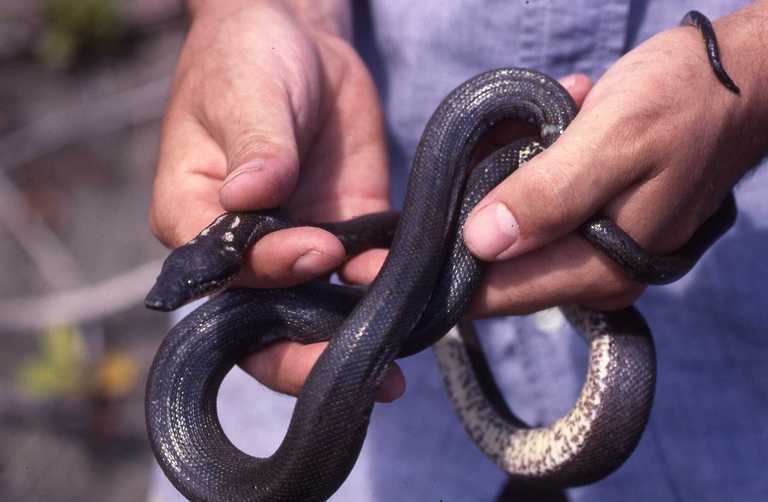
Round Island Boa
Casarea dussumieri
The Round Island boa (Casarea dussumieri), also known commonly as the Round Island keel-scaled boa and the Round Island ground boa, is a species of nonvenomous snake in the monotypic genus Casarea in the family Bolyeriidae. The species is endemic to Round Island, Mauritius. No subspecies are currently recognized.
From the article Round Island boa on Wikipedia (CC BY-SA), quoted section by section
Description
Adults of C. dussumieri are slender and reach a maximum total length (including tail) of 150 cm (5 ft). The males have slimmer, more pointed heads and have shorter bodies than the females. The body is covered in small keeled scales that give the species one of its common names. The genus is unique among extant vertebrates as it has a split jaw (intramaxilliary joint that separates anterior and posterior bones), an adaptation that may be advantageous in catching its main prey of geckos and skinks. The colour pattern is dark brown dorsally, the belly being lighter with dark spots. Over a 24-hour period the boa has a shift in colour, changing from "dark" during its relatively inactive day time period to "light" in the early evening through to dawn when it is most active. This effect is created through polychromatic skin cells.
Range & habitat
C. dussumieri is known to survive on Round Island, but has been recorded on the islands of Gunner's Quoin, Flat Island, Ile de la Pas, and on mainland Mauritius (as subfossil remains). The type locality is "I'île ronde, près de Maurice" (Round Island, Mauritius). Between 11 and 31 October 2012 the boa was reintroduced into Gunner's Quoin as part of a joint collaborative project involving the Durrell Wildlife Conservation Trust, the Mauritian Wildlife Foundation, and the National Parks and Conservation Service of Mauritius.
Wikipedia: “Geographic range”
What it does
In C. dussumieri, breeding begins during April, although young have been observed throughout the year. A clutch of up to 12 soft-shelled eggs may be laid amongst leaf litter or in hollow palm trunks, and is sometimes attended by the female. Incubation is unusually long for a snake, lasting about 90 days. The young are bright orange at birth and weigh less than 5 grams (0.18 oz).
Wikipedia: “Reproduction”
In human culture
The specific name, dussumieri, is in honor of Jean-Jacques Dussumier, a French merchant, ship owner, and collector of zoological specimens.
Wikipedia: “Etymology”
Where it lives
Recorded sightings
—
geo-referenced records in GBIF, from museums, herbaria and field observers.
Drag the globe to turn it. Dots are where records exist, not a range map; darker means more records.
In the stacks
Searching the stacks…
Every page naming Casarea dussumieri in the Biodiversity Heritage Library →
This page is assembled live from iNaturalist, GBIF, Wikipedia, the Source Library and the Internet Archive. It is not yet part of the hand-edited codex. iNaturalist taxon 32271.