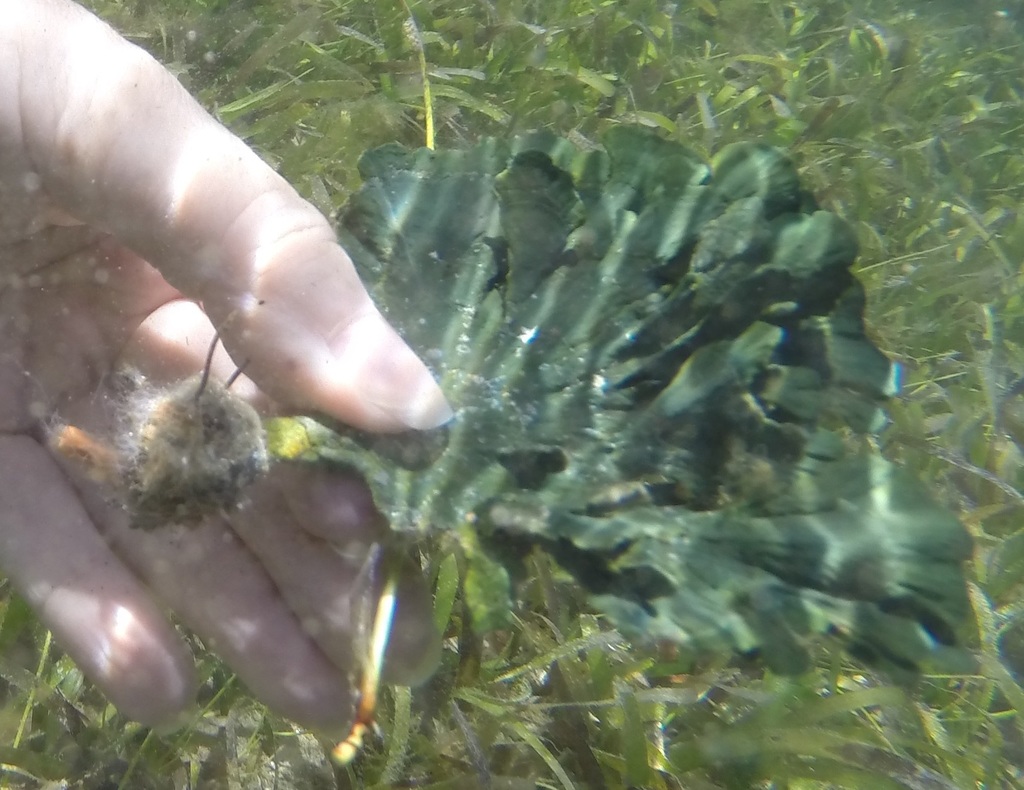
mermaid's-fan alga
Udotea flabellum
Udotea flabellum is a species of photosynthetic macroalgae. It is commonly found in shallow waters around Florida and Belize in sandy areas, sea grass beds, and coral reefs. It is known for its antimicrobial properties and is also being used in cancer treatment studies.
From the article Udotea flabellum on Wikipedia (CC BY-SA), quoted section by section
Description
Udotea flabellum is a green macroalgae. It attaches to the ground and has a thallus which grows in a fan shape, hence its nickname—mermaid's fan algae. The algae attaches to sand or mud with a system of rhizoids, root-like structures that form a hold fast. It lacks a stem, leaves, roots and a vascular system, but does have a stem-like feature called a stipe. The thallus is often lobed, and the lobes are thick, leathery, and moderately calcified. The stipe is also often calcified.
Range & habitat
Species of the Udotea genus are found in tropical to subtropical locations. U. flabellum is found in waters of North America, the Atlantic islands, Mexico, the Caribbean, South America, the Indian Ocean, Africa, Australia, New Zealand and Asia. These algae are often found in coral reefs. They also grow on sandy coastlines and in sea grass beds. They can be found in depths of up to 23 meters. Since their thallus and stipe are calcified, when U. flabellum dies, it improves sediment nutrients and contributes to sediment production, which can help the reefs in the area to continue growing. Algae such as U. flabellum are also the base of reef food webs. The photosynthetic plants contribute to primary production, which is the synthesis of organic compounds, mainly carbohydrates in algae, from carbon dioxide. U. flabellum provides a food source for marine herbivores.
Wikipedia: “Distribution and ecology”
Where it lives
Recorded sightings
—
geo-referenced records in GBIF, from museums, herbaria and field observers.
Drag the globe to turn it. Dots are where records exist, not a range map; darker means more records.
In the stacks
Searching the stacks…
Every page naming Udotea flabellum in the Biodiversity Heritage Library →
This page is assembled live from iNaturalist, GBIF, Wikipedia, the Source Library and the Internet Archive. It is not yet part of the hand-edited codex. iNaturalist taxon 322734.