- Animals
- ›Chordates
- ›Vertebrates
- ›Ray-finned Fishes
- ›Carps, Characins, Catfishes and Allies
- ›Catfishes
- ›Siluroidei
- ›Thorny Catfishes
- ›Doradinae
- ›Oxydoras
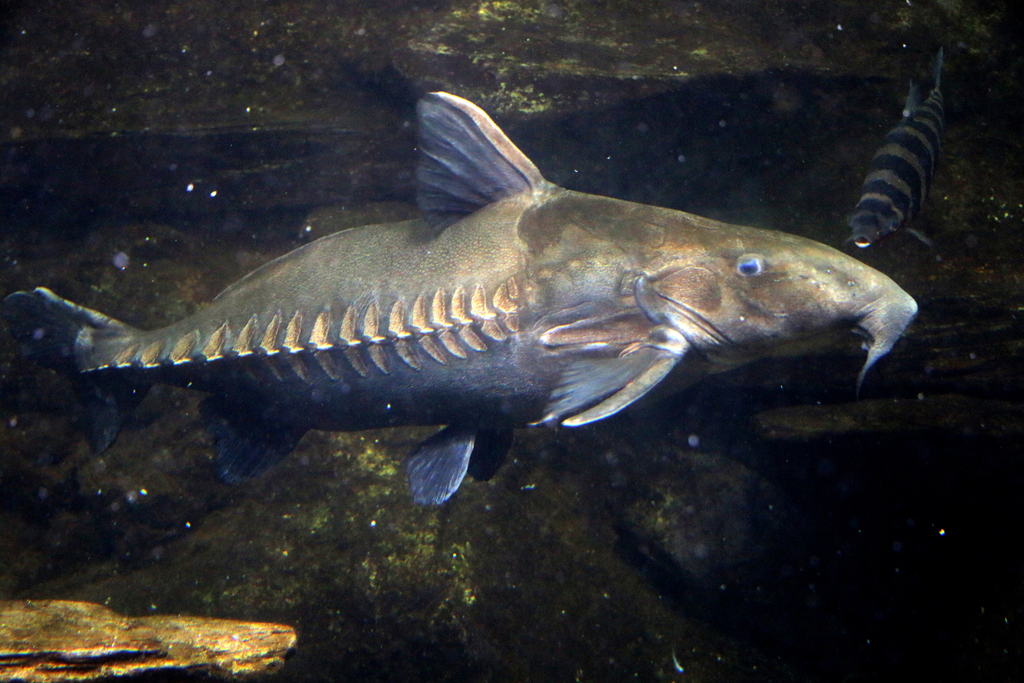
ripsaw catfish
Oxydoras niger
Oxydoras niger, commonly known as the ripsaw catfish or cuiu cuiu, is a species of thorny catfish native to the Amazon, Essequibo, and São Francisco river basins in Bolivia, Brazil, Colombia, Ecuador, Guyana, Peru and Venezuela. It is the largest member of the family Doradidae. It grows up to a length of 100 centimetres (3 ft 3 in) and weighs up to 13 kilograms (29 lb).
The species forms a minor part of local commercial fisheries. It has lateral thorns that can injure predators and human handlers. It feeds by sifting through sand and detecting edible items using taste receptors in the roof and floor of its mouth.
From the article Oxydoras niger on Wikipedia (CC BY-SA), quoted section by section
Description
O. niger has barbels typical of a catfish and bony scutes along its body. These scutes have thorn-like projections along both sides and serve a defensive function. The species is sometimes called a "talking catfish" because it can produce sounds. It produces these sounds through stridulation, by moving its pectoral spines against parts of the pectoral girdle. Stridulation is not unique to catfishes and also occurs in insects, in which hard body parts are rubbed together to produce sound. In O. niger, ridges on the pectoral spine rub against the cleithrum in the pectoral girdle. Different sounds may be produced during adduction and abduction movements. These sounds are thought to have different functions, such as warning predators and communicating with other individuals, depending on the frequency. The mouth is inferior, or downward-facing, allowing the fish to feed from the substrate. The dorsal surface is dark-coloured, while the underside is lighter. The species can be distinguished from related fishes by its relatively narrow body near the pectoral girdle, where the body width is less than the head length. Its eyes are positioned on the sides and posterior part of the head, rather than on top. It also has up to 40 scutes on each side of the body, compared with around 15–25 in some related taxa. …
What it does
Oxydoras niger has been recorded in waters with temperatures ranging from 24–29.8 °C, a pH range of 5–9, and an alkalinity range of 42–142. It feeds on detritus, chironomid larvae, ephemeropteran larvae, and crustaceans. The species is known to form schools. It typically inhabits muddy streams and lakes. During the rainy season, ripsaw catfish often migrate to large freshwater lakes and flooded basins, returning to their main river channel as floodwaters recede. Its wide distribution across the Amazon River is facilitated by the extensive river system and seasonal expansion of flood habitats.
Wikipedia: “Ecology”
Where it lives
Recorded sightings
—
geo-referenced records in GBIF, from museums, herbaria and field observers.
Drag the globe to turn it. Dots are where records exist, not a range map; darker means more records.
In the stacks
Searching the stacks…
Every page naming Oxydoras niger in the Biodiversity Heritage Library →
This page is assembled live from iNaturalist, GBIF, Wikipedia, the Source Library and the Internet Archive. It is not yet part of the hand-edited codex. iNaturalist taxon 322823.