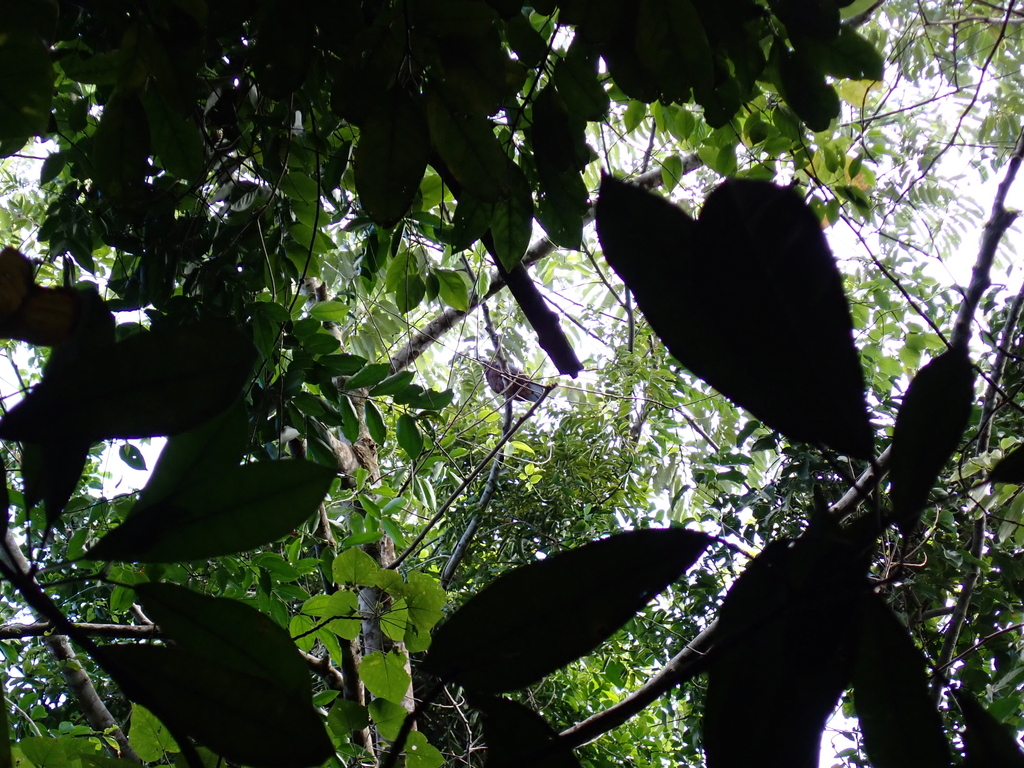
On eBird ↗
Baker's Imperial-Pigeon
Live sightings near you, the range map, bar charts of when it is seen, and Macaulay Library photos and recordings.
Vanuatu Imperial Pigeon
Ducula bakeri
The Vanuatu imperial pigeon or Baker's imperial pigeon (Ducula bakeri) is a species of bird in the family Columbidae. It is endemic to Vanuatu and lives in forests. It is threatened by forest clearing, and although it has a restricted range the International Union for Conservation of Nature (IUCN) has assessed it as a least concern species.
From the article Vanuatu imperial pigeon on Wikipedia (CC BY-SA), quoted section by section
Description
The Vanuatu imperial pigeon is about 40 cm (16 in) long. The head and nape are sooty blue-grey, and the neck is dark purplish-maroon. The mantle, back and wing coverts are sooty-grey and have a steely sheen. The underwing coverts are chestnut, and the flight feathers are rufous. The throat is dark grey. The breast is dark purplish-maroon with a slight gloss, and the belly is deep chestnut. The uppertail coverts are black, and the undertail coverts are rufous. The eyes are yellow, the beak is black, and the feet are pinkish-red. The female is a little smaller and duller than the male. The juvenile bird has much duller plumage with no gloss.
Range & habitat
This pigeon is endemic to Vanuatu, occurring on several larger islands. Its habitat is mostly montane forests, and it also occurs in lowlands. On Santo, it lives in forests above 500 m (1,600 ft) in elevation.
Wikipedia: “Distribution and habitat”
What it does
The Vanuatu imperial pigeon is usually found singly or in pairs in the canopy; small parties are sometimes found. It is a wary bird that is not easily found. A frugivore, it eats fruits of trees, shrubs and vines, and it moves within islands to search for food. Its call is a powerful repeated twoo-too-too-too-too. Its breeding biology is unknown.
Wikipedia: “Behaviour”
Listen
Looking for field recordings…
Where it lives
Recorded sightings
—
geo-referenced records in GBIF, from museums, herbaria and field observers.
Drag the globe to turn it. Dots are where records exist, not a range map; darker means more records.
In the stacks
Searching the stacks…
Every page naming Ducula bakeri in the Biodiversity Heritage Library →
This page is assembled live from iNaturalist, GBIF, Wikipedia, the Source Library and the Internet Archive. It is not yet part of the hand-edited codex. iNaturalist taxon 3236.