- Animals
- ›Chordates
- ›Vertebrates
- ›Reptiles
- ›Snakes and Lizards
- ›Lizards
- ›Iguanas and Allies
- ›Dragons and Chameleons
- ›Chameleons
- ›Trioceros
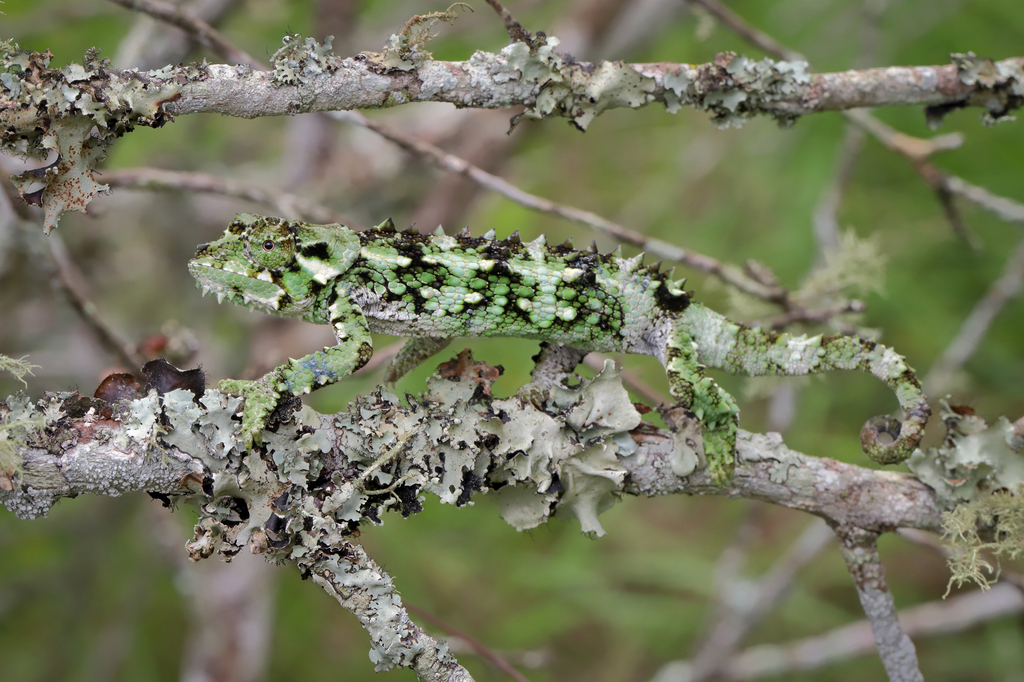
Spiny-flanked Chameleon
Trioceros laterispinis
The spiny-flanked chameleon (also known as the spiny-sided chameleon), Trioceros laterispinis, is a species of chameleon endemic to the United Republic of Tanzania, East Africa. It was first described in 1932 by Arthur Loveridge.
From the article Spiny-flanked chameleon on Wikipedia (CC BY-SA), quoted section by section
Range & habitat
Trioceros laterispinis is only found in one mountain range, the Udzungwa Mountains, part of the Eastern Arc Mountains in the United Republic of Tanzania, East Africa. The type locality is Kigogo, Udzungwa Mountains, Tanzania, and another is Kibau Iyaya in the southwestern Udzungwa Mountains. It is currently found mostly in the vicinity of Mufindi and Kigogo, but its range covers a total area of 11,529 km2 (4,451 sq mi). T. laterispinis is collected for the international pet trade industry. The true population of the species is unknown and no trend has been found. Its habitat is forests and dense woodland and it seems to have a preference for shrubs and small understorey trees rather than towering giants. Much of the forest is fragmented into small patches and it is threatened by a high rate of destruction of its habitat for agricultural purposes. The International Union for Conservation of Nature (IUCN) classed this species as Endangered and it is listed in Appendix II of the CITES treaty. This species gives birth to live young.
Wikipedia: “Distribution and habitat”
Where it lives
Recorded sightings
—
geo-referenced records in GBIF, from museums, herbaria and field observers.
Drag the globe to turn it. Dots are where records exist, not a range map; darker means more records.
In the stacks
Searching the stacks…
Every page naming Trioceros laterispinis in the Biodiversity Heritage Library →
This page is assembled live from iNaturalist, GBIF, Wikipedia, the Source Library and the Internet Archive. It is not yet part of the hand-edited codex. iNaturalist taxon 32833.