- Animals
- ›Chordates
- ›Vertebrates
- ›Reptiles
- ›Snakes and Lizards
- ›Lizards
- ›Iguanas and Allies
- ›Dragons and Chameleons
- ›Chameleons
- ›Calumma
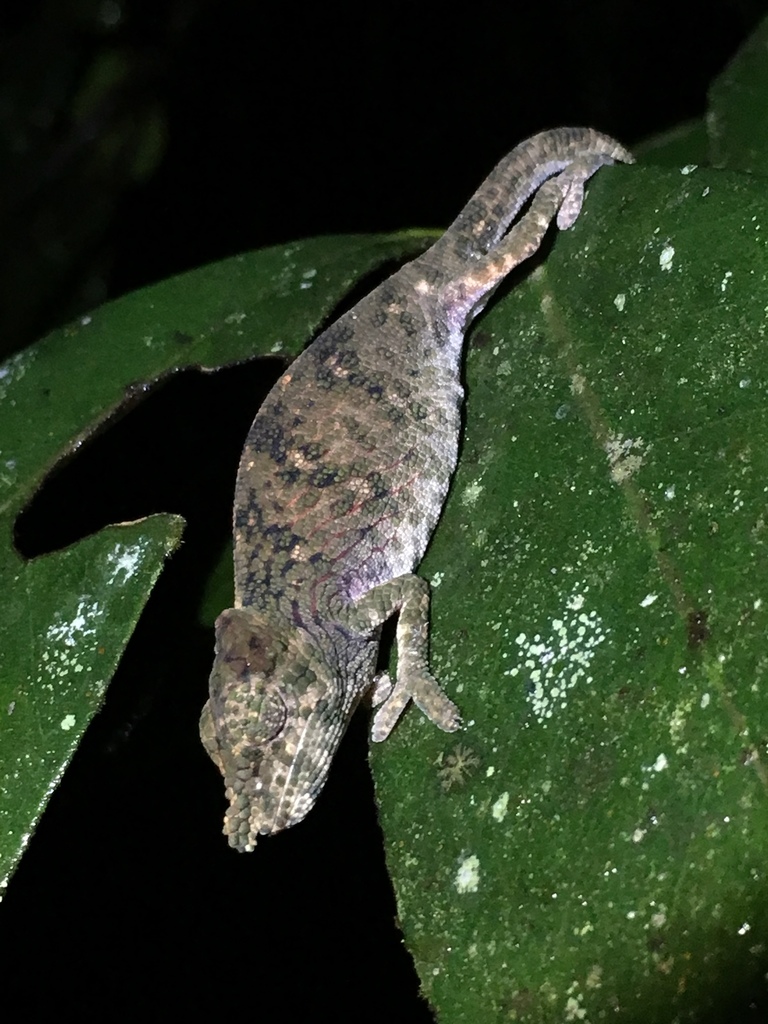
Deceptive Chameleon
Calumma fallax
Calumma fallax, the deceptive chameleon or short-nosed deceptive chameleon is a species of chameleon endemic to eastern Madagascar, where its type locality is the Ikongo forest. It was first described by François Mocquard in 1900 as Chamaeleon fallax, and it was first recognized as Calumma fallax in 1986. It is a member of the Chamaeleoninae nominotypical subfamily of chameleons, and is believed to be found over an area of 2,057 km2 (794 sq mi), although the population is unknown.
From the article Calumma fallax on Wikipedia (CC BY-SA), quoted section by section
Description
Calumma fallax is a medium-sized chameleon, with males measuring 43–51 mm (1.7–2.0 in) and females 41–51 mm (1.6–2.0 in) in snout–vent length; it can reach a total length of 107 mm (4.2 in).
== References ==
Range & habitat
Calumma fallax is endemic to eastern Madagascar, and has a type locality of the Ikongo forest, Madagascar. It can be found at a mid-altitude over an area of about 2,057 km2 (794 sq mi), although this is not confirmed. The International Union for Conservation of Nature has classed this species as "data deficient", as not enough information on this species is available to correctly classify it. The population of this species is unknown and no population trend is known. It is found in an area where the habitat is affected by the slash-and-burn agricultural method, bushfires, and logging. Calumma fallax is used in the pet industry and is sometimes domesticated.
Wikipedia: “Distribution and habitat”
Where it lives
Recorded sightings
—
geo-referenced records in GBIF, from museums, herbaria and field observers.
Drag the globe to turn it. Dots are where records exist, not a range map; darker means more records.
In the stacks
Searching the stacks…
Every page naming Calumma fallax in the Biodiversity Heritage Library →
This page is assembled live from iNaturalist, GBIF, Wikipedia, the Source Library and the Internet Archive. It is not yet part of the hand-edited codex. iNaturalist taxon 32910.