On eBird ↗
Grenada Dove
Live sightings near you, the range map, bar charts of when it is seen, and Macaulay Library photos and recordings.
Grenada Dove
Leptotila wellsi
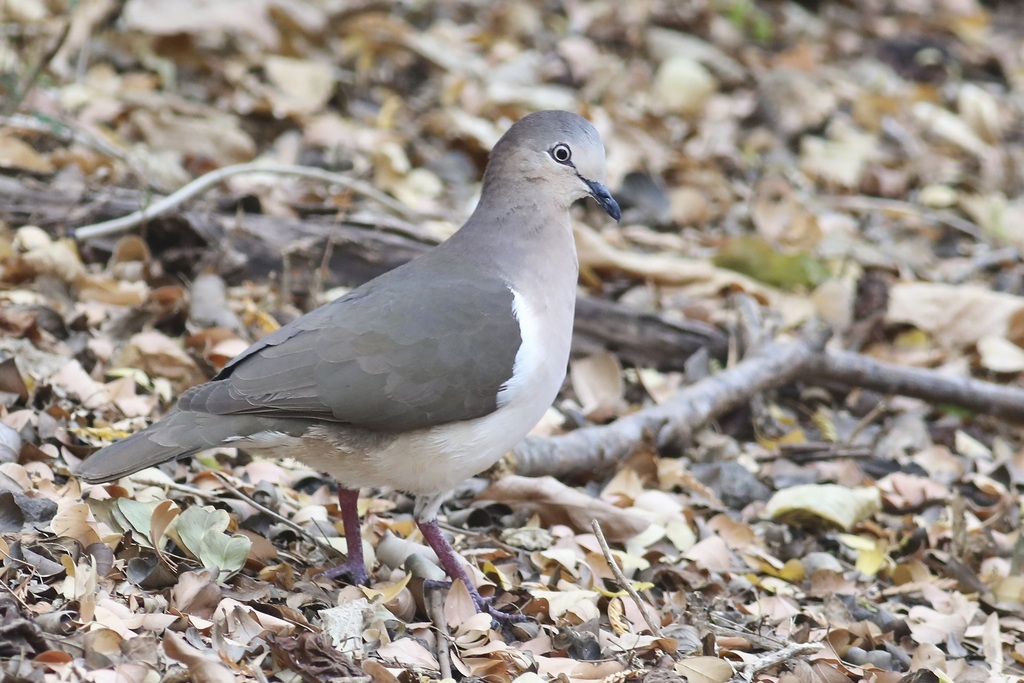
The Grenada dove (Leptotila wellsi) is a medium-sized New World tropical dove. It is endemic to the island of Grenada in the Lesser Antilles. Originally known as the pea dove or Well's dove, it is the National Bird of Grenada. It is considered to be one of the most critically endangered doves in the world (Bird Life International 2000).
From the article Grenada dove on Wikipedia (CC BY-SA), quoted section by section
Description
The Grenada dove is characterised by a white throat; face and forehead pale pink shading to dull brown on crown and nape; upperparts olive brown; underwing chestnut; neck and upper breast pink-buff fading to white on lower breast, belly and undertail coverts.
Range & habitat
The Grenada dove is a little-known species endemic to the main island of Grenada, West Indies. Historically, it has been recorded from locations throughout Grenada, including offshore islands, and the type specimen was collected from Fontenoy, on the west coast. Some surveys imply that Grenada doves are associated with dry forest communities in the west and southwest parts of the main island (Blockstein 1988, Blockstein and Hardy 1989, Bird Life International 2000). True dry forest ecosystems are remnants of a type of xeric scrub habitat that dominated the West Indies at the end of the Pleistocene, and most areas classified as dry forest in the Caribbean are mosaics of degraded habitat, and do not represent natural ecosystems (Murphy and Lugo 1986, Vidal and Casado 2000). Beard noted the degraded nature of forested areas in Grenada in 1949. Results from the Grenada Dry Forest Biodiversity Conservation Project indicate that Grenada doves are found most often in areas composed primarily of degraded mosaics of evergreen forest. The overall uniting factors in Grenada dove habitat issues are the degraded nature of the habitat and close proximity to human habitation. This is readily apparent at the Mount Hartman sanctuary, which is an old government cattle farm with vegetation composed primarily of exotic species such as Leucaena leucocephala and Heamatoxylon. …
Wikipedia: “Distribution and habitat”
What it does
Grenada dove were documented consuming Carica papaya (Papaya) during diet studies associated with Grenada Dry Forest Ecosystem Protection Project. Observations have been made of Grenada doves foraging on the ground (Blockstein 1998). Leptotila in captivity have been documented consuming mealworms. Other Leptotila species have been observed eating fruits, seeds, and agricultural grain. L. verrauxi is known to visit bird feeders (Goodwin 1983), and other members of the genus have been observed eating fruit from the forest floor (Estrada et al. 1984, Coates-Estrada and Estrada 1986), as well as directly from plants (Goodwin 1983).
Wikipedia: “Diet”
Listen
Looking for field recordings…
Where it lives
Recorded sightings
—
geo-referenced records in GBIF, from museums, herbaria and field observers.
Drag the globe to turn it. Dots are where records exist, not a range map; darker means more records.
In the stacks
Searching the stacks…
Every page naming Leptotila wellsi in the Biodiversity Heritage Library →
This page is assembled live from iNaturalist, GBIF, Wikipedia, the Source Library and the Internet Archive. It is not yet part of the hand-edited codex. iNaturalist taxon 3300.