- Animals
- ›Chordates
- ›Vertebrates
- ›Reptiles
- ›Snakes and Lizards
- ›Lizards
- ›Iguanas and Allies
- ›Dragons and Chameleons
- ›Chameleons
- ›Furcifer
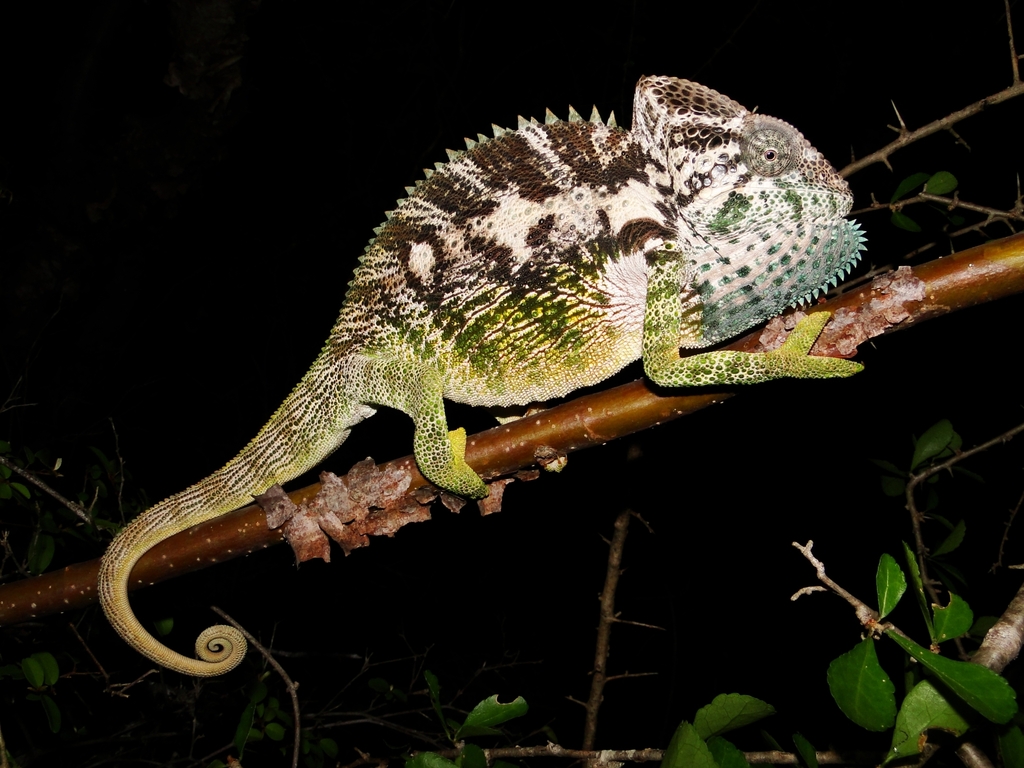
Spiny Chameleon
Furcifer verrucosus
Furcifer verrucosus, also known as the warty chameleon, spiny chameleon or crocodile chameleon, is a species of small reptile endemic to Madagascar. It was first described by Georges Cuvier in 1829.
From the article Furcifer verrucosus on Wikipedia (CC BY-SA), quoted section by section
Description
The warty chameleon is a large species with males growing to a total length of 56 centimetres (22 in) and females reaching 21 cm (8 in). On its head it has a casque, a helmet-like crest formed from scales. A small crest runs along a raised ridge from its eyes to its snout. There are further low crests running along the flanks, down the throat and along the belly. A distinctive crest of up to forty 4 millimetres (0.16 in) spines runs along the back in males but this is cut short in females, continuing along the spine as tubercles. Both sexes have a row of large scales forming a lateral line. The long tail is prehensile. The general colour of this chameleon is grey or brown variously blotched or indistinctly banded, with a white intermittent streak along each side. Females are usually paler in colour and males are often tinged with green on the belly, tail and limbs.
Range & habitat
The warty chameleon is found only on the island of Madagascar including Manderano in the Tulear region. It occurs over much of the west part of the island and in drier parts of the south. It is seldom found in primary rainforest but favours arid disturbed land, including near the sea. It is a terrestrial species and also climbs around in low bushes. In hot weather it sometimes retreats into a sandy burrow to keep cool. Both the Furcifer v. verrucosus and Furcifer v. oustaleti species are considered CITES species (Convention on International Trade in Endangered Species) and are protected from animal trafficking worldwide.
Wikipedia: “Distribution and habitat”
Where it lives
Recorded sightings
—
geo-referenced records in GBIF, from museums, herbaria and field observers.
Drag the globe to turn it. Dots are where records exist, not a range map; darker means more records.
In the stacks
Searching the stacks…
Every page naming Furcifer verrucosus in the Biodiversity Heritage Library →
This page is assembled live from iNaturalist, GBIF, Wikipedia, the Source Library and the Internet Archive. It is not yet part of the hand-edited codex. iNaturalist taxon 33002.