- Animals
- ›Chordates
- ›Vertebrates
- ›Reptiles
- ›Snakes and Lizards
- ›Lizards
- ›Iguanas and Allies
- ›Dragons and Chameleons
- ›Chameleons
- ›Furcifer
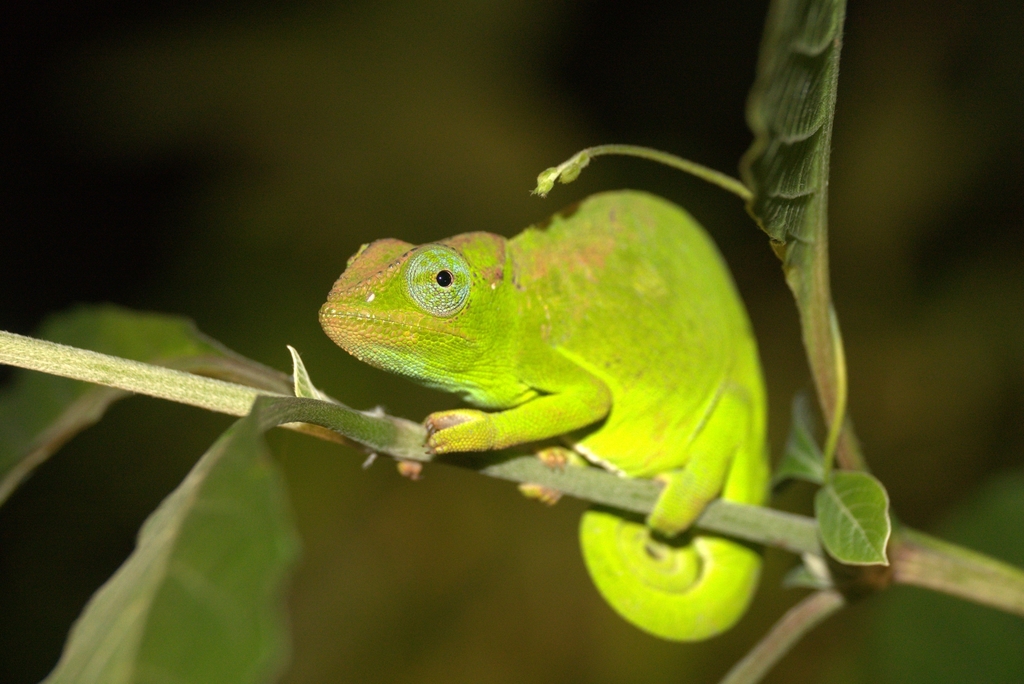
Pollen's Chameleon
Furcifer polleni
Furcifer polleni, also known as the Mayotte chameleon, is a species of chameleon that is endemic to Mayotte in the Comoros Islands. It was first described by Wilhelm Peters in 1874.
From the article Mayotte chameleon on Wikipedia (CC BY-SA), quoted section by section
Range & habitat
Furcifer polleni is endemic to the island of Mayotte, one of the Comoros Islands in the Indian Ocean. It is found over most of the island, an area of 376.5 square kilometres (145.4 square miles). It was introduced by humans onto the Comoran island of Anjouan, where it became established in the town of Hombo. This species is ranked as being of Least Concern by the International Union for Conservation of Nature (IUCN), and has been found at between 27 and 459 metres (89 and 1,506 feet) above sea level. This species is found in a range of habitats. It is protected by law in Mayotte and is included in Appendix II of the CITES treaty. In an integrated field study on Mayotte, 35 specimens of Furcifer polleni were found in a range of habitats at altitudes of up to 459 metres (1,506 ft). These included (in approximately equal numbers) pristine forests, degraded woodlands, plantations and scrubby dry vegetation. No individuals were found in mangrove forests but several were found in urban areas. During the ten years starting in 2000, the number of Mayotte chameleons exported from the island was 1,562. This does not seem to have had much influence on the population size and was in contrast to the endemic chameleon species on Grand Comoro, Furcifer cephalolepis, which suffered a much heavier trade. …
Wikipedia: “Distribution and habitat”
Where it lives
Recorded sightings
—
geo-referenced records in GBIF, from museums, herbaria and field observers.
Drag the globe to turn it. Dots are where records exist, not a range map; darker means more records.
In the stacks
Searching the stacks…
Every page naming Furcifer polleni in the Biodiversity Heritage Library →
This page is assembled live from iNaturalist, GBIF, Wikipedia, the Source Library and the Internet Archive. It is not yet part of the hand-edited codex. iNaturalist taxon 33006.