- Animals
- ›Chordates
- ›Vertebrates
- ›Reptiles
- ›Snakes and Lizards
- ›Lizards
- ›Iguanas and Allies
- ›Dragons and Chameleons
- ›Chameleons
- ›Furcifer
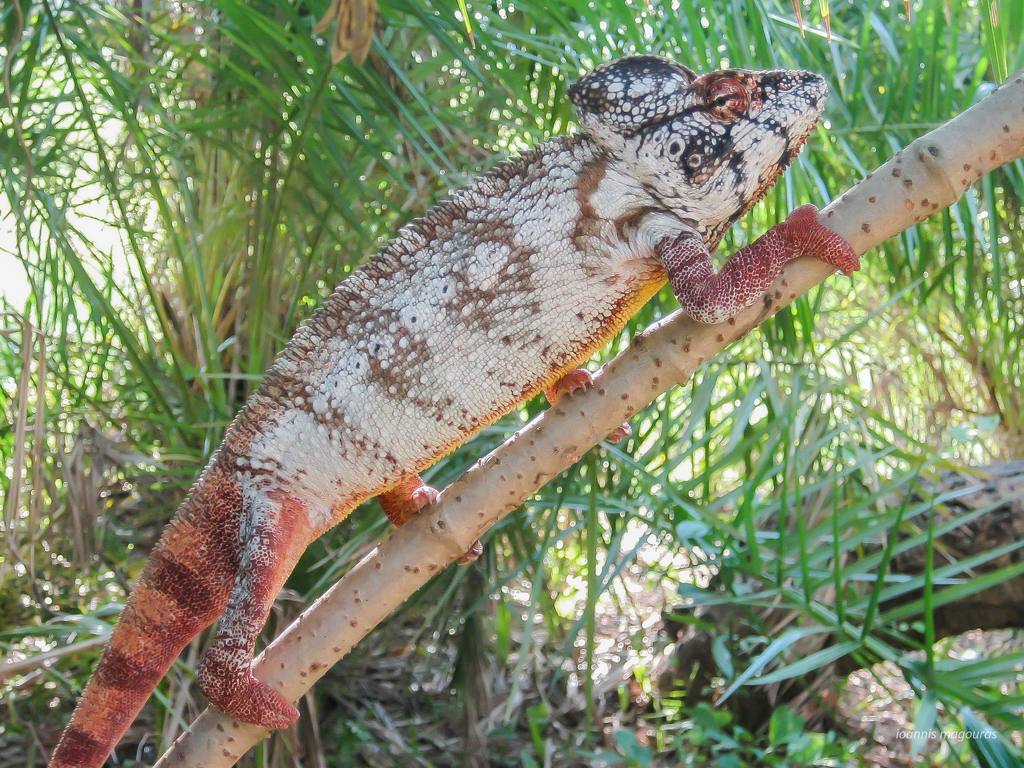
Oustalet's Giant Chameleon
Furcifer oustaleti
The Malagasy giant chameleon (Furcifer oustaleti), also known commonly as Oustalet's chameleon, is a large species of chameleon which is native throughout Madagascar, but has also been introduced near Nairobi in Kenya (though its current status there is unclear) and in Miami-Dade County in the United States. It occurs in a wide range of habitats, even among degraded vegetation within villages, but is relatively rare in the interior of primary forest.
From the article Malagasy giant chameleon on Wikipedia (CC BY-SA), quoted section by section
Description
With a maximum total length (tail included) of 68.5 cm (27 in), Furcifer oustaleti is generally considered the world's largest species of chameleon by this measurement. Exceptionally large Calumma parsonii (Parson's chameleon) and Trioceros melleri (Meller's chameleon) have been claimed to reach even greater lengths, but this remains unverified. F. oustaleti is relatively slender, and its weight is surpassed by certain other large chameleon species that are more robust, notably C. parsonii. Large adult males of F. oustaleti typically weigh 400–500 g (14–18 oz). However, lower weights are common, and females consistently weigh less. Females also remain considerably smaller than males in total length, reaching up to about 40 cm (16 in). The head bears a high casque with several crests, and a dorsal crest consisting of 45 or more small triangular spines, runs along the spine. The colouring of F. oustaleti is quite variable. Males are usually largely grey or brownish, sometimes with reddish-orange feet or underparts. Females are more variable and often more colourful than males, with base colour or markings in red, yellow and green being possible, and the eyelids can sometimes be blue.
Range & habitat
Furcifer oustaleti is endemic to Madagascar and is found throughout the island. It inhabits a very wide range of habitats including dry deciduous forest, humid evergreen forest, montane savanna, degraded forests, agricultural areas and even urban settings. It is seldom found deep in the forest interior, preferring the forest edges instead.
Wikipedia: “Distribution and habitat”
What it does
The diet of Furcifer oustaleti includes invertebrates such as large insects as well as some vertebrates such as small birds and reptiles. This is also one of several chameleon species that are known to consume fruit. F. oustaleti is known to regularly consume the fruit of Grangeria porosa, Chassalia princei, and Malleastrum gracile, and will do so even during the wet season, suggesting that fruit is not consumed just to obtain water. Typically, prey is acquired with the long, muscular tongue, while fruit is seized directly with the jaws, but occasional exceptions to this rule have been recorded. In one unusual case, this species was recorded grasping fruit bearing twigs with the zygodactyl feet and bringing them closer for consumption. Amongst reptiles, this level of food manipulation with the forelimbs is otherwise only documented in some species of monitor lizards and Chamaeleo namaquensis. The latter is also known to feed on plants.
Wikipedia: “Diet”
In human culture
The generic name, Furcifer, is derived from the Latin root furci- meaning "forked" and refers to the shape of the animal's feet. The specific name, oustaleti, is a Latinized form of the last name of French biologist Jean-Frédéric Émile Oustalet, in whose honor the species is named.
== References ==
Wikipedia: “Etymology”
Where it lives
Recorded sightings
—
geo-referenced records in GBIF, from museums, herbaria and field observers.
Drag the globe to turn it. Dots are where records exist, not a range map; darker means more records.
In the stacks
Searching the stacks…
Every page naming Furcifer oustaleti in the Biodiversity Heritage Library →
This page is assembled live from iNaturalist, GBIF, Wikipedia, the Source Library and the Internet Archive. It is not yet part of the hand-edited codex. iNaturalist taxon 33010.