- Animals
- ›Chordates
- ›Vertebrates
- ›Reptiles
- ›Snakes and Lizards
- ›Lizards
- ›Iguanas and Allies
- ›Dragons and Chameleons
- ›Chameleons
- ›Furcifer
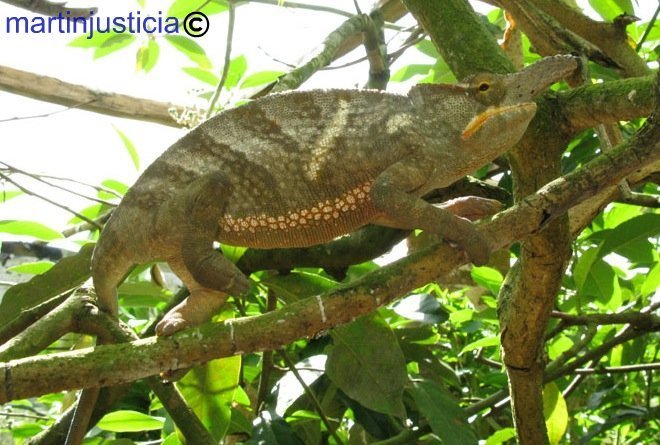
Fork-nosed Chameleon
Furcifer bifidus
Furcifer bifidus, also known as the fork-nosed chameleon, is a species of chameleon that is endemic to Madagascar. It was described by Alexandre Brongniart in 1800. The International Union for Conservation of Nature have ranked this species of chameleon as Least Concern.
From the article Furcifer bifidus on Wikipedia (CC BY-SA), quoted section by section
Range & habitat
Furcifer bifidus is found in east Madagascar, and there is no known type locality. According to the International Union for Conservation of Nature (IUCN), it can be found over an area of 35,368 square kilometres (13,656 square miles), and is therefore ranked as a Least Concern species of animal, although it is exposed to many threats. It can be found on the east of Madagascar north after the Mangoro River, and as far as Daraina and Marojejy National Park (Marojejy Massif). It has been found at a highest of 700 metres (2,300 feet) above sea level. The two major threats to the Furcifer bifidus are logging for commercial reasons and the slash-and-burn method in agriculture. The species has been listed as protected.
Wikipedia: “Distribution and habitat”
Where it lives
Recorded sightings
—
geo-referenced records in GBIF, from museums, herbaria and field observers.
Drag the globe to turn it. Dots are where records exist, not a range map; darker means more records.
In the stacks
Searching the stacks…
Every page naming Furcifer bifidus in the Biodiversity Heritage Library →
This page is assembled live from iNaturalist, GBIF, Wikipedia, the Source Library and the Internet Archive. It is not yet part of the hand-edited codex. iNaturalist taxon 33012.