On eBird ↗
Bare-faced Ground Dove
Live sightings near you, the range map, bar charts of when it is seen, and Macaulay Library photos and recordings.
Bare-faced Ground Dove
Metriopelia ceciliae
The bare-faced ground dove (Metriopelia ceciliae) is a species of bird in the family Columbidae. It is found in Argentina, Bolivia, Chile, and Peru. Its natural habitat is subtropical or tropical high-altitude shrubland.
From the article Bare-faced ground dove on Wikipedia (CC BY-SA), quoted section by section
Description
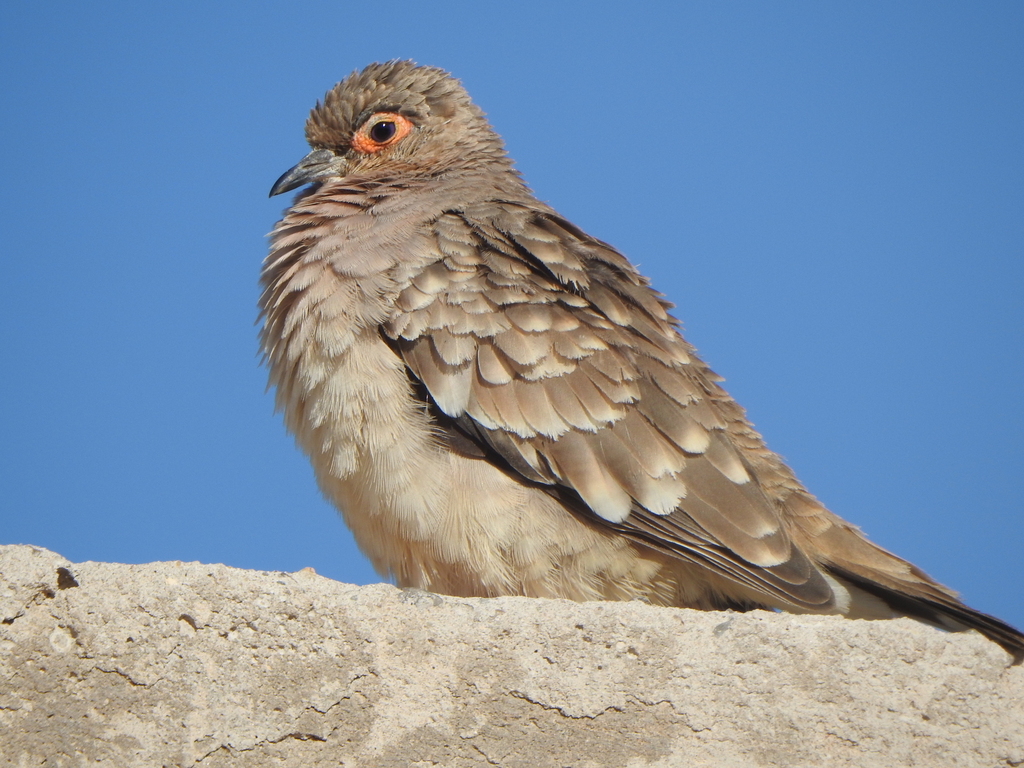
The bare-faced ground dove is 16 to 17 cm (6.3 to 6.7 in) long and weighs about 66 g (2.3 oz). The nominate subspecies is brown or grayish brown above, with white or buffy tips on feathers giving a spotted appearance. Its neck and breast are gray with a reddish or pinkish tinge and its belly is buffy. The outer tail feathers are black with white tips. The eye is blue or bluish white surrounded by bare yellow to orange skin that is itself surrounded by narrow black feathers. Male and female plumages are essentially alike though the female's breast is less pink. Juveniles are similar to the adults. M. c. obsoleta is paler and grayer than the nominate, and M. c. zimmeri is darker, browner, and has a yellow to blue eye.
Range & habitat
The nominate subspecies of bare-faced ground dove is found in western Peru, M. c. obsoleta in northern Peru, and M. c. zimmeri in southern Peru, western Bolivia, northern Chile, and northwestern Argentina. They inhabit arid and semi-arid landscapes of sandy soil with little vegetation. In higher elevation areas it frequents human habitations, apparently because the surrounding countryside is treeless, and it is also common in major urban areas such as Lima. In elevation it generally ranges between 2,000 and 4,500 m (6,600 and 14,800 ft) but is found much lower in western Peru.
Wikipedia: “Distribution and habitat”
What it does
The bare-faced ground dove is known to feed on the ground, usually in small groups, but its diet has not been documented.
Wikipedia: “Feeding”
Listen
Looking for field recordings…
Where it lives
Recorded sightings
—
geo-referenced records in GBIF, from museums, herbaria and field observers.
Drag the globe to turn it. Dots are where records exist, not a range map; darker means more records.
In the stacks
Searching the stacks…
Every page naming Metriopelia ceciliae in the Biodiversity Heritage Library →
This page is assembled live from iNaturalist, GBIF, Wikipedia, the Source Library and the Internet Archive. It is not yet part of the hand-edited codex. iNaturalist taxon 3316.