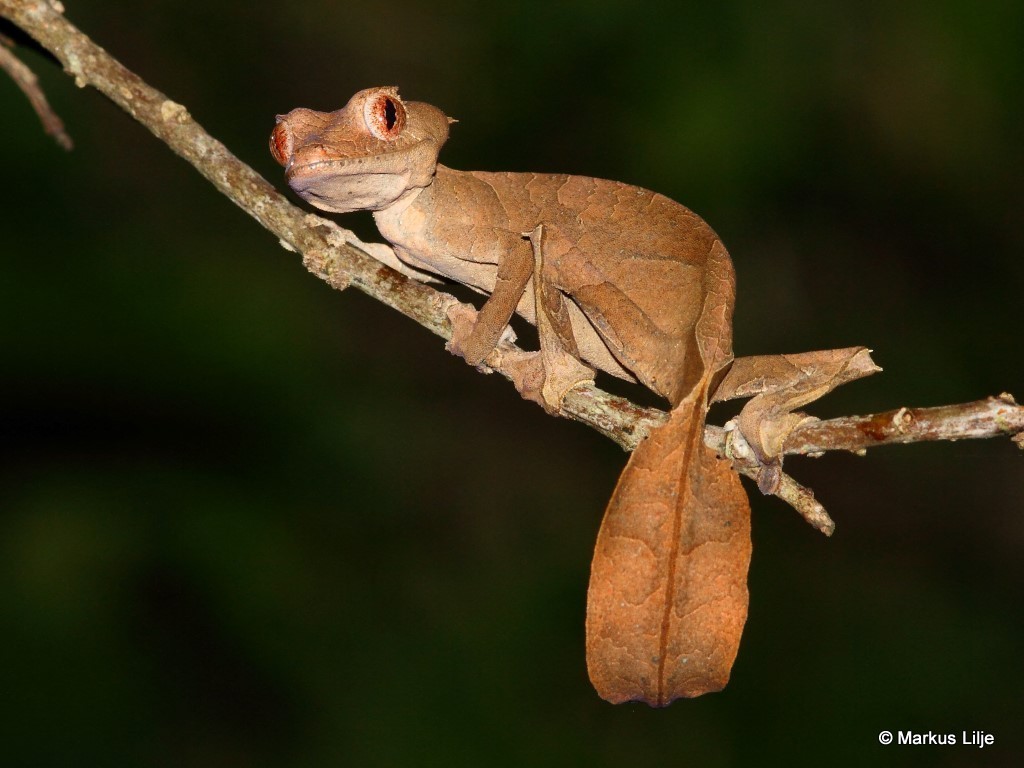
Satanic Leaf-tailed Gecko
Uroplatus phantasticus
Uroplatus phantasticus, the satanic leaf-tailed gecko, is a species of gecko indigenous to the island of Madagascar. First described in 1888 by George Albert Boulenger, U. phantasticus is the smallest in body of the Uroplatus geckos, though there is an ongoing debate as to whether one of its cousins, U. ebenaui, is smaller because of its shorter tail. It may also be known as the eyelash leaf-tailed gecko or the fantastic leaf-tailed gecko.
From the article Uroplatus phantasticus on Wikipedia (CC BY-SA), quoted section by section
Description
Its adult size is up to 90mm in total length, including the tail. As with all Uroplatus geckos the tail is flattened, but the leaf-like appearance is only seen in the ebenaui complex (U. phantasticus, U. ebenaui, and U. malama; although the tail size is much reduced in U. ebenaui). It has often been debated whether U. phantasticus is in fact the same species as U. ebenaui (the Nosy Bé flat-tailed gecko). However U. phantasticus possesses more, and longer, spines on the head, body and trunk. Other members of the genus Uroplatus have flattened tails that serve more to diminish the profile of the gecko while it is inactive. Some U. phantasticus geckos even have notches in their tails to further mimic a decaying leaf. This is also thought to be a form of sexual dimorphism, as the trait seems more common in the males of the species. In addition, U. phantasticus has an eyelash-like projection above each eye. During daylight hours, these adaptations help the gecko blend into its surroundings. …
Range & habitat
The species is endemic to Madagascar, meaning it is found nowhere else. It is an arboreal animal that relies on its natural camouflage in the northern and central tropical forests of Madagascar.
Wikipedia: “Distribution and habitat”
What it does
A nocturnal reptile, with suitably large eyes, the leaf-tailed gecko moves about its rainforest habitat at night feeding on insects. The adhesive scales under their fingers and toes and their strong curved claws enable them to move adeptly through the trees. The leaf-tailed gecko is somewhat of an expert at avoiding predators, not only through their incredible mimicry but through a number of behaviours. They can flatten their body against the substrate to reduce the body's shadow, open their jaws wide to show a frightening, bright red mouth, and voluntarily shed their tail in order to trick a predator. Like many reptiles, the leaf-tailed gecko is oviparous, or egg-laying. Reproduction starts at the beginning of the rainy season when it lays clutches of two spherical eggs onto the ground under leaf litter or in the dead leaves of plants.
Wikipedia: “Behavior”
In human culture
The generic name, Uroplatus, is a Latinization of two Greek words: "ourá" (οὐρά) meaning "tail" and "platys" (πλατύς) meaning "flat". Its specific name phantasticus is the Latin word for "imaginary", based upon the gecko's unique appearance, which led Belgian naturalist George Albert Boulenger to describe it as “mythical” in 1888.
Wikipedia: “Etymology”
Where it lives
Recorded sightings
—
geo-referenced records in GBIF, from museums, herbaria and field observers.
Drag the globe to turn it. Dots are where records exist, not a range map; darker means more records.
In the stacks
Searching the stacks…
Every page naming Uroplatus phantasticus in the Biodiversity Heritage Library →
This page is assembled live from iNaturalist, GBIF, Wikipedia, the Source Library and the Internet Archive. It is not yet part of the hand-edited codex. iNaturalist taxon 33520.