- Animals
- ›Chordates
- ›Vertebrates
- ›Reptiles
- ›Snakes and Lizards
- ›Lizards
- ›Geckos
- ›Sphaeros and Allies
- ›Sphaerodactylus
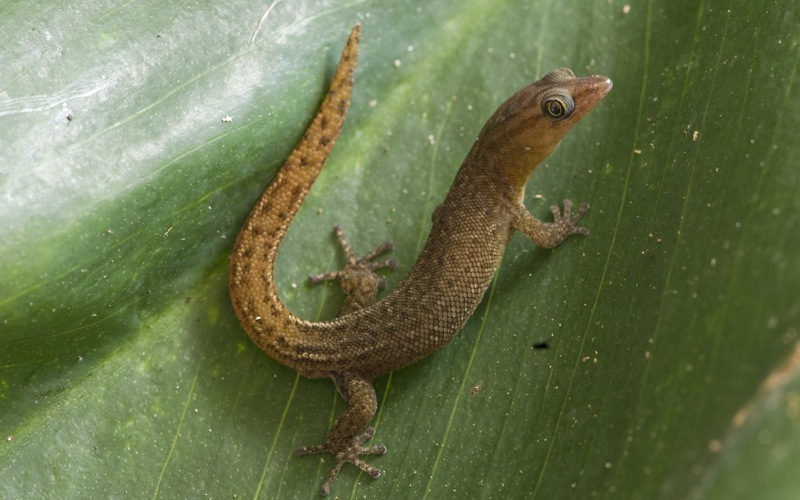
Saba Least Gecko
Sphaerodactylus sabanus
The Saba least gecko (Sphaerodactylus sabanus), also known as the Saba dwarf gecko, is a species of gecko endemic to the Lesser Antilles in the Caribbean. The Saba least gecko is a medium-sized least gecko, reaching a snout–vent length of 28 mm in females and 30 mm in males. The dorsum has a background color of light to dark brown. Some individuals are covered with patterns; in this case, they have dull orange heads, while unpatterned individuals are uniform brown. The throat is yellow-tinted white, yellow, or pale orange in color. The underside of the body is pale brown, light yellow, gray, or white. A unique color morph found on Sint Eustatius has an off-white head with a dark brown vermiculated pattern, alongside a dull yellow dorsum and white venter.
The Saba least gecko is found across the islands of Saba, Sint Eustatius, Saint Kitts, and Nevis. It is most abundant on Sint Eustatius and to a lesser degree on Saba. It prefers moderately moist habitats such as gallery forest, palms, and Coccoloba vegetation, but also inhabits less hospitable xeric habitats and human settlements. It inhabits many different micro-habitats, being seen in rocks, logs, dead agave, leaf litter, and human debris. The Saba least gecko is classified as being of least concern on the IUCN Red List due to its relative abundance on islands such as Sint Eustatius and Saba, as well a lack of known threats to the species and its stable population.
From the article Saba least gecko on Wikipedia (CC BY-SA), quoted section by section
Description
The Saba least gecko is a medium-sized least gecko, reaching a snout–vent length of 28 mm in females and 30 mm in males. The dorsum has a background color of light to dark brown. Some individuals are covered with patterns; in this case, they have dull orange heads, while unpatterned individuals are uniform brown. There are dark brown stripes stretching from the nostrils to the neck, where they bend just before the shoulder and merge into each other at the middle of the body. There is a black-bordered buff or dark brown line from the snout to the top of the head, dividing past the eyes and continuing to a point just behind the orbit, past which it circles back to the center to surround a dark brown, black, or white spot on top of the head. The lines continue to merge just before reaching the shoulder region. These stripes are highly variable and can split or merge further to form spots, speckles, stripes, or a vermiculated pattern. There are rows of pale spots on the body, usually becoming more prominent towards the tail, which is covered with white stripes. The throat is yellow-tinted white, yellow, or pale orange in color. The underside of the body is pale brown, light yellow, gray, or white. Geckos from Saba have brown irises, while those from other islands have black irises with a yellow ring around the iris. …
Range & habitat
The Saba least gecko is endemic to the Lesser Antilles, where it is found across the islands of Saba, Sint Eustatius, Saint Kitts, and Nevis. It is most abundant on Sint Eustatius and to a lesser degree on Saba. It prefers moderately moist habitats such as gallery forest, palms, and Coccoloba vegetation. It also inhabits less hospitable xeric habitats and human settlements, albeit at considerably lower densities, rarely being absent from areas with even minimal vegetation. It prefers slightly higher elevations, being most common in the uplands on Sint Eustatius and in ravines on Saba, but is usually only found up to 500 m, although small populations may live at even higher elevations. It inhabits many different micro-habitats, being seen in rocks, logs, dead agave, leaf litter, and human debris. The species lays eggs to reproduce. Studies on interactions between and within Saba and island least geckos on Sint Eustatius have revealed several behaviors in the lizards. When male and female Saba least geckos are placed together, males generally begin courting the females by "staring at females, head bobbing, approaching while head bobbing, licking, waving their tails from side to side, and finally attempting to mount." The female geckos generally rebuff the males at some point in this process, with few attempts at mounting being successful. …
Wikipedia: “Distribution and habitat”
Where it lives
Recorded sightings
—
geo-referenced records in GBIF, from museums, herbaria and field observers.
Drag the globe to turn it. Dots are where records exist, not a range map; darker means more records.
In the stacks
Searching the stacks…
Every page naming Sphaerodactylus sabanus in the Biodiversity Heritage Library →
This page is assembled live from iNaturalist, GBIF, Wikipedia, the Source Library and the Internet Archive. It is not yet part of the hand-edited codex. iNaturalist taxon 33661.