On eBird ↗
Pin-tailed Green-Pigeon
Live sightings near you, the range map, bar charts of when it is seen, and Macaulay Library photos and recordings.
Pin-tailed Green-Pigeon
Treron apicauda
The pin-tailed green pigeon or pin-tailed pigeon (Treron apicauda) is a species of bird in the family Columbidae native to Southeast Asia. It has also been referred to by the former names Columba longicauda, Vinago apicauda, and Sphenocerus apicaudus in earlier ornithological literature.
From the article Pin-tailed green pigeon on Wikipedia (CC BY-SA), quoted section by section
Description
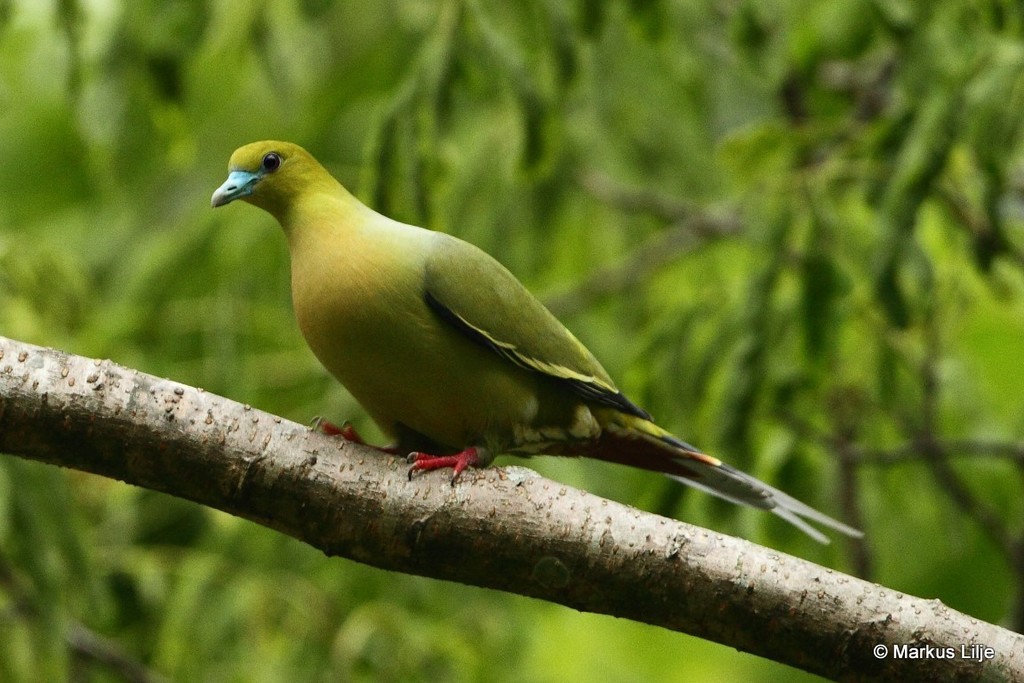
The pin-tailed green pigeon is a medium-sized dove, with an average weight of 185-255 grams. Males are 32-36 cm and females are typically 28 cm. It is yellow-green overall, with darker green wing-coverts and scapulars and black outer secondaries and primaries. The males have a golden breast with pinkish hues. The central tail feathers are a bluish-grey and the undertail-coverts a chestnut colour. The orbital ring is blue, as is the bill, with a lighter green or yellow tip. The legs and feet are a bright reddish-pink. The females are a duller yellow, with much shorter central tail feathers and dull undertail-coverts. The song is described as a soft whistling ku-koo, which is usually paired. The pin-tailed green pigeon also lets out a high pitched doo! call. While in flight, feathers produce a whirring sound.
Range & habitat
The pin-tailed green pigeon is found in Bangladesh, Bhutan, Cambodia, China, India, Laos, Myanmar, Nepal, Thailand, and Vietnam. It inhabits secondary growth and forest, including foothill forests, subtropical and tropical dry forest, and evergreen rainforest. It typically inhabits areas 0 to 1800 metres altitude. Pin-tailed green pigeons are resident birds in some parts of their range, and nomadic in other parts in response to food resources. In central Vietnam, they will descend to lower elevations during the dry season, which is when many trees are fruiting.
Wikipedia: “Distribution and habitat”
What it does
The pin-tailed green pigeon is frugivorous, feeding mainly on fruit and berries in an acrobatic fashion. The species is gregarious, forming feeding flocks varying from 10-30 birds. Flocks have been observed descending to the ground to visit salt licks.
Wikipedia: “Diet”
At the table
Like many birds that Western scientists described during the colonial era, the pin-tailed green pigeon was known to the people living within its range long before European naturalists formally described it. In Assam, historical ornithological literature records several local names for the species. E. C. Stuart Baker's 1913 publication on Indian Pigeons and Doves gives several local names for the bird: "Sang-pong" in the Lepcha language, "Daorep-galou" in the Kachari language, "Lumba-dum Kohhlu" in Hindi, "Bor Haitha" in Assamese, "Harial" in the language spoken by the people of the Terai region at the time, and "Ngu" in Burmese. Baker also cautioned that the names used for the pin-tailed green pigeon often overlapped with those used for the yellow-footed green pigeon and wedge-tailed green pigeon, with an adjective sometimes added to distinguish the pin-tailed green pigeon because of its unusually long tail. However, the Lepcha name "Sang-pong" is also recorded specifically for Treron apicauda in a modern compilation of Lepcha bird names, which distinguishes it from the wedge-tailed green pigeon, which is called "Kuhu". …
Wikipedia: “Indigenous names and traditional uses”
In human culture
Though there has been no known archaeological evidence of its use in ancient times or archaeological depictions of Treron apicauda specifically, there are several important archaeological references to birds and doves in ancient and early medieval Assam. An excavated sculpture discussed in a 2023 archaeological study by Y. S. Sanathana and Manjil Hazarika is interpreted by the archaeologists as a pigeon or dove. This sculpture, known as the Da-Parbatiya dove, is referenced in Sanathana and Hazarika's archaeological study, Fauna in the Sculptural Art of Early Medieval Assam, which examines the animal imagery associated with the Pragjyotisha-Kamarupa kingdom. This culture flourished in the Brahmaputra Valley from approximately the 3rd through 12th centuries CE. At the Da-Parbatiya temple ruins at Tezpur, the researchers identified a statue of a small bird, described as "likely to be a depiction of a dove", carved beneath a depiction of the god Kartikeya. The archaeologists suggest that the carved bird may be connected to the story in the Shiva Purana in which the god Agni takes the form of a pigeon or dove and carries the god Shiva's reproductive material to the six Krittika goddesses, contributing to the birth of Kartikeya. However, the bird carved at the temple of Da-Parbatiya cannot be identified as the pin-tailed green pigeon specifically.
Wikipedia: “Cultural significance”
Listen
Looking for field recordings…
Where it lives
Recorded sightings
—
geo-referenced records in GBIF, from museums, herbaria and field observers.
Drag the globe to turn it. Dots are where records exist, not a range map; darker means more records.
In the stacks
Searching the stacks…
Every page naming Treron apicauda in the Biodiversity Heritage Library →
This page is assembled live from iNaturalist, GBIF, Wikipedia, the Source Library and the Internet Archive. It is not yet part of the hand-edited codex. iNaturalist taxon 3380.