On eBird ↗
Orange-breasted Green-Pigeon
Live sightings near you, the range map, bar charts of when it is seen, and Macaulay Library photos and recordings.
Orange-breasted Green-Pigeon
Treron bicinctus
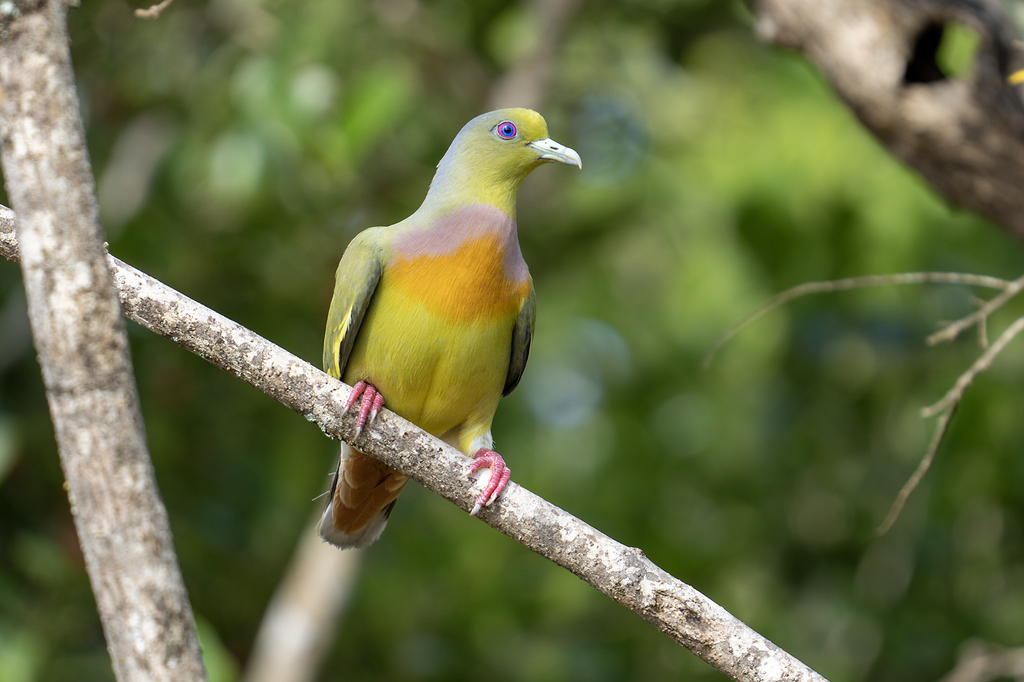
The orange-breasted green pigeon (Treron bicinctus) is a pigeon found across tropical Asia south of the Himalaya across parts of the Indian subcontinent and Southeast Asia. Like other green pigeons, it feeds mainly on small fruit. They may be found in pairs or in small flocks, foraging quietly and moving slowly on trees. The nape is blue-grey and the crown is yellowish green. The uppertail coverts are bronzed and the undertail coverts are unmarked rufous. The male has a pinkish band on the upper breast with a broader orange one below while the female has a bright yellow breast.
From the article Orange-breasted green pigeon on Wikipedia (CC BY-SA), quoted section by section
Range & habitat
This is a species of forest and is widely distributed from the Terai and lower Himalayas (below 1,500 m (4,900 ft)) south mainly in the Western and Eastern Ghats and in Sri Lankan forests not far from the coast. They are found in Burma, Thailand the Malay Peninsula, Vietnam, Java and Hainan. Some seasonal movements are suspected as vagrants have been recorded from locations like Sindh.
Wikipedia: “Habitat and distribution”
What it does
Orange-breasted green pigeons usually occur singly or in small groups. Its flight is fast and direct, with the regular beats and an occasional sharp flick of the wings which are characteristic of pigeons in general. They eat seeds and fruits of a wide variety of plants often joining other frugivores at fruiting figs, foraging by slowly walking along branches. They are known to feed on Strychnos nux-vomica, the fruits of which are toxic to mammals. They are sometimes seen on the ground. Their call is a low subdued series of modulated wandering whistles. Males fight with each other during the breeding season, slapping each other with their wing and pecking each other. The breeding season in India is March to September but mainly before June. In Sri Lanka, they breed mainly from December to May. The nest is the typical flimsy platform of a few twigs in which two white eggs are laid. Both sexes incubate and eggs hatch in about 12 to 14 days.
Wikipedia: “Behaviour and ecology”
Listen
Looking for field recordings…
Where it lives
Recorded sightings
—
geo-referenced records in GBIF, from museums, herbaria and field observers.
Drag the globe to turn it. Dots are where records exist, not a range map; darker means more records.
In the stacks
Searching the stacks…
Every page naming Treron bicinctus in the Biodiversity Heritage Library →
This page is assembled live from iNaturalist, GBIF, Wikipedia, the Source Library and the Internet Archive. It is not yet part of the hand-edited codex. iNaturalist taxon 3394.