On eBird ↗
Cebu Boobook
Live sightings near you, the range map, bar charts of when it is seen, and Macaulay Library photos and recordings.
Cebu Boobook
Ninox rumseyi
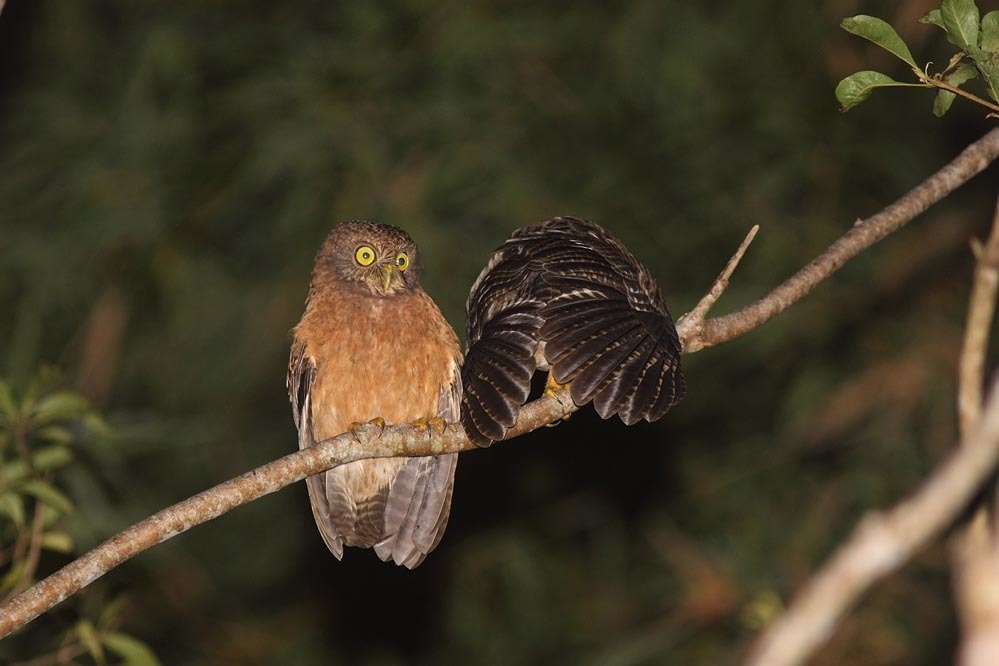
The Cebu boobook or Cebu hawk-owl (Ninox rumseyi) is a species of owl in the family Strigidae. It is endemic to the Philippines found in the remnant forests of Cebu. It was formerly considered a subspecies of the Philippine hawk-owl, but was reclassified in 2012, as voice and other data suggested placement in a distinct species. It is threatened by habitat loss as Cebu is the most deforested among major Philippine islands with just 0.03% of orignal forest remaining.
From the article Cebu boobook on Wikipedia (CC BY-SA), quoted section by section
Description
This is a medium sized owls found in the forests of Cebu. It is primarily brown but has white speckling on the wings, a pale bar on the shoulder and a white throat patch and eyebrows. The Cebu boobook is an earless species and has a round head. Males and females exhibit no clear sexual dimorphism and are similar in appearance. It was formerly considered a subspecies of the Philippine hawk-owl, but was reclassified in 2012, as voice and other data suggested placement in a distinct species. Along with the Camiguin hawk-owl and Romblon boobook, it is the largest in the Philippine hawk-owl species complex at 25cm tall versus the much smaller Luzon boobook, Mindanao boobook, Mindoro boobook and Sulu boobook, which range in size from 15 to 20cm tall. It is best differentiated from other owls from this complex with its white throat and differences in vocalizations
Wikipedia: “Description and taxonomy”
Range & habitat
Its natural habitats are tropical moist lowland primary forest and secondary forests up to an altitude of 700 metres above sea level. It is also seen in clearings and plantations as long as there is nearby forest The IUCN Red List classifies this bird as vulnerable with population estimates of 250 to 999 mature individuals with the belief that its population is on the lower estimate of that range. This species' main threat is habitat loss with wholesale clearance of forest habitats as a result of legal and illegal logging, mining and conversion into farmlands through slash-and-burn and urbanization. Cebu underwent severe deforestation in the 1890s and now just 0.03% or 15km2 forest cover remains. The forests of Cebu continue to undergo hunting pressure and deforestation — further reducing what little there is remaining. This has led to many other species sharing its range to also be endangered. It also shares a habitat with the Cebu flowerpecker which is one of the most endangered birds in the world and other endangered species such as the black shama and Cebu streak-breasted bulbul. …
Wikipedia: “Habitat and conservation status”
What it does
This species feeds on a diet of insects, small mammals, reptiles, amphibians and birds. Among Philippine hawk-owls, this species appears to feed more on birds with species such as Elegant tit, Magnificent sunbird, Red-keeled flowerpecker and flycatchers as part of the birds it has recorded to feed on. Nests have been found in May. Each breeding pair is believed to hold territories of 10 hectares. It nests in natural cavities in the trunks of tall trees. Nest contained 2 eggs.
Wikipedia: “Ecology and behaviour”
Listen
Looking for field recordings…
Where it lives
Recorded sightings
—
geo-referenced records in GBIF, from museums, herbaria and field observers.
Drag the globe to turn it. Dots are where records exist, not a range map; darker means more records.
In the stacks
Searching the stacks…
Every page naming Ninox rumseyi in the Biodiversity Heritage Library →
This page is assembled live from iNaturalist, GBIF, Wikipedia, the Source Library and the Internet Archive. It is not yet part of the hand-edited codex. iNaturalist taxon 339613.