On eBird ↗
Blackish Nightjar
Live sightings near you, the range map, bar charts of when it is seen, and Macaulay Library photos and recordings.
Blackish Nightjar
Nyctipolus nigrescens
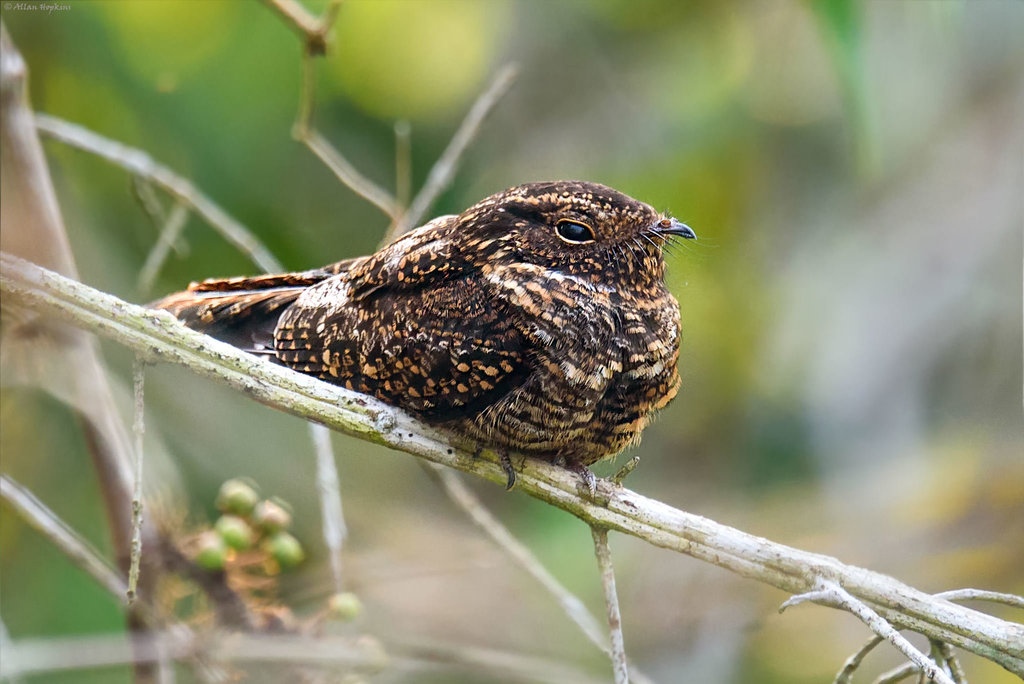
The blackish nightjar (Nyctipolus nigrescens) is a species of bird in the family Caprimulgidae. This relatively small dark nightjar is found in the Guianas and the Amazon. It is rare or even absent in the western part, but is among the commonest nightjars in the eastern Amazon and the Guianas.
From the article Blackish nightjar on Wikipedia (CC BY-SA), quoted section by section
Description
The blackish nightjar is 19.5 to 21.5 cm (7.7 to 8.5 in) long and weighs 32 to 39 g (1.1 to 1.4 oz). Its upperparts are blackish brown with tawny, grayish white, and cinnamon spots. Its tail is dark brown with indistinct lighter bars and mottling and (on the male) a white tip. The underparts to the belly are dark brown with paler baring; the belly and flanks are buffy with darker barring. The throat has a small white patch on either side. In flight the wing shows a small white band.
Range & habitat
The blackish nightjar is found east of the Andes in Peru, Ecuador, and southern Colombia, and across southern Colombia through southern Venezuela and the Guianas into northeastern and north-central Brazil. They inhabit lowland evergreen forest, but are mostly found on or near open rock outcroppings or on sand and gravel bars along small rivers. In elevation it ranges from sea level in Brazil to 900 m (3,000 ft) in Bolivia, 800 m (2,600 ft) in Colombia, 1,200 m (3,900 ft) in Ecuador, and 1,100 m (3,600 ft) in Venezuela.
Wikipedia: “Distribution and habitat”
What it does
The blackish nightjar is crepuscular and nocturnal. It forages on the wing from dusk to dawn over rock outcrops and above the forest canopy. It has also been recorded on foot picking prey from large rocks. Its diet has not been detailed but is known to include moths and beetles. During the day it roosts on rocks or fallen trees.
Wikipedia: “Feeding”
Listen
Looking for field recordings…
Where it lives
Recorded sightings
—
geo-referenced records in GBIF, from museums, herbaria and field observers.
Drag the globe to turn it. Dots are where records exist, not a range map; darker means more records.
In the stacks
Searching the stacks…
Every page naming Nyctipolus nigrescens in the Biodiversity Heritage Library →
This page is assembled live from iNaturalist, GBIF, Wikipedia, the Source Library and the Internet Archive. It is not yet part of the hand-edited codex. iNaturalist taxon 339617.