On eBird ↗
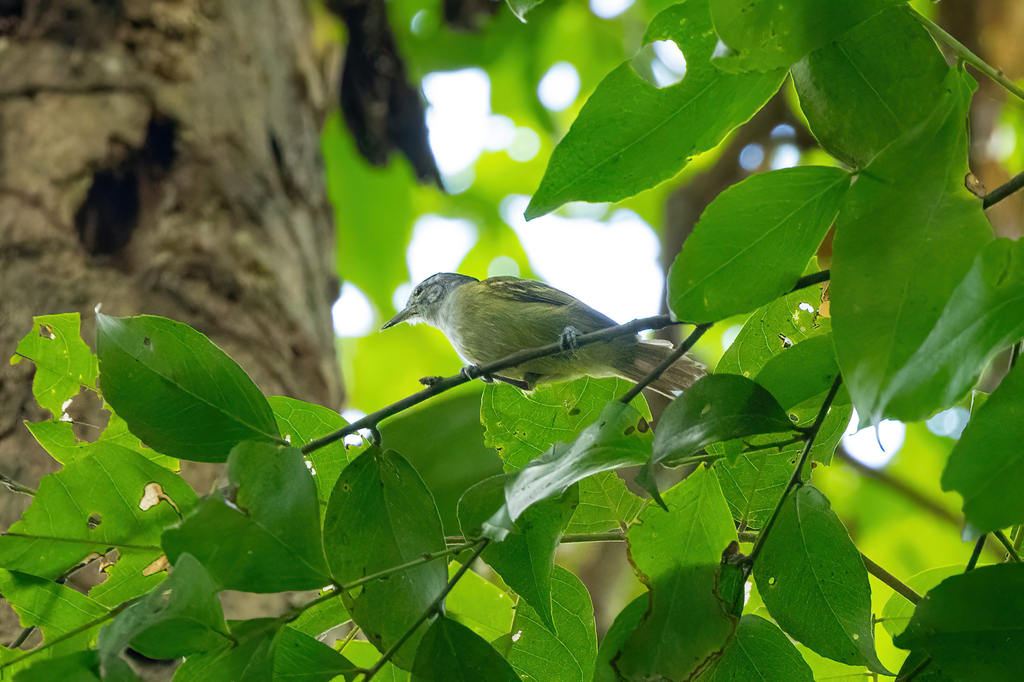
Chestnut-shouldered Antwren
Live sightings near you, the range map, bar charts of when it is seen, and Macaulay Library photos and recordings.
Chestnut-shouldered Antwren
Euchrepomis humeralis
The chestnut-shouldered antwren (Euchrepomis humeralis) is a species of bird in subfamily Euchrepomidinae of family Thamnophilidae, the "typical antbirds". It is found in Bolivia, Brazil, Ecuador, and Peru.
From the article Chestnut-shouldered antwren on Wikipedia (CC BY-SA), quoted section by section
Description
The chestnut-shouldered antwren is 9.5 to 11 cm (3.7 to 4.3 in) long and weighs about 7 to 8 g (0.25 to 0.28 oz). The sexes have different plumage. Adult males have a whitish supercilium and a thin dark line through the eye on an otherwise pale gray face. Their crown and nape are black, their back greenish olive, their rump rufous-chestnut, and their uppertail coverts and tail grayish olive. Their wing coverts are blackish gray with whitish tips that form two bars on the closed wing, their flight feathers olive-tinged blackish gray with pale olive-yellow edges, and the bend of the wing rufous-chestnut. Their throat and breast are pale gray and their belly and undertail coverts are pale yellow. Adult females have an olive-brown crown, nape and eyeline, a pale gray supercilium, and dark olive-brown wings with at most a trace of chestnut at the bend.
Range & habitat
The chestnut-shouldered antwren is found from eastern Ecuador and eastern Peru south of the Rio Napo south into northwestern Bolivia and east in Brazil through northern Rondônia and into Amazonas state as far as the Rio Madeira. It inhabits the subcanopy and canopy of terra firme and drier floodplain tropical evergreen forest.
Wikipedia: “Distribution and habitat”
What it does
The chestnut-shouldered antwren feeds on arthropods, though details of its diet are lacking. It typically forages in pairs or small family groups that usually join mixed-species feeding flocks. It forages almost entirely in the forest canopy, acrobatically gleaning prey from leaves and the ends of branches.
Wikipedia: “Feeding”
Listen
Looking for field recordings…
Where it lives
Recorded sightings
—
geo-referenced records in GBIF, from museums, herbaria and field observers.
Drag the globe to turn it. Dots are where records exist, not a range map; darker means more records.
In the stacks
Searching the stacks…
Every page naming Euchrepomis humeralis in the Biodiversity Heritage Library →
This page is assembled live from iNaturalist, GBIF, Wikipedia, the Source Library and the Internet Archive. It is not yet part of the hand-edited codex. iNaturalist taxon 339636.