On eBird ↗
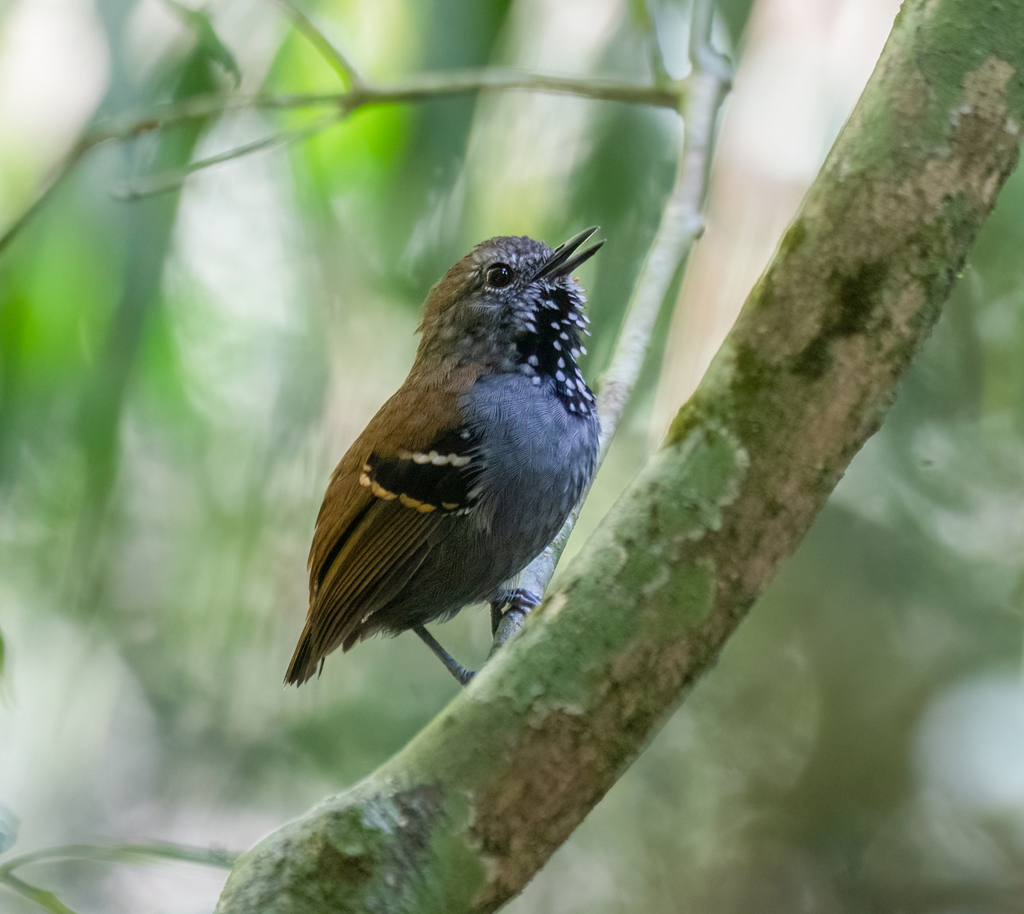
Star-throated Antwren
Live sightings near you, the range map, bar charts of when it is seen, and Macaulay Library photos and recordings.
Star-throated Antwren
Rhopias gularis
The star-throated antwren (Rhopias gularis) is a species of bird in the family Thamnophilidae. It is endemic to Brazil. Its natural habitats are subtropical or tropical moist lowland forest and subtropical or tropical moist montane forest.
From the article Star-throated antwren on Wikipedia (CC BY-SA), quoted section by section
Description
The star-throated antwren is 8.5 to 9.5 cm (3.3 to 3.7 in) long and weighs 10 to 12 g (0.35 to 0.42 oz). Adult males have a grayish forehead and rufous-brown crown, upperparts, and tail with a hidden white patch between the scapulars. Their wings are mostly rufous-brown with white at the bend and blackish brown coverts dotted with pale cinnamon. Their throat is black with white spots, their breast and belly gray, and their flanks and undertail coverts pale rufous-brown. Females have a buffy forehead, larger white throat spots than males, and no white patch between the scapulars.
Range & habitat
The star-throated antwren is found in coastal southeastern Brazil from southeastern Bahia south into northeastern Rio Grande do Sul and inland to western Paraná. It inhabits the understorey of evergreen forest. It favors dense vegetation along streams in the lowlands and in shady ravines in the foothills. In elevation it mostly occurs between 300 and 1,550 m (1,000 and 5,100 ft) but does occur down to sea level.
Wikipedia: “Distribution and habitat”
What it does
The star-throated antwren's diet has not been detailed but is known to include insects and spiders. It mostly forages singly or in pairs, and sometimes joins mixed-species feeding flocks. It typically forages from the ground up to about 5 m (15 ft) above it but will feed as high as 8 m (25 ft). It actively gleans from leaves and stems by reaching from a perch and making short jumps. It also jumps from a perch to take prey from leaf litter the ground and works through tangles of fallen branches. There is one record of a pair following an army ant swarm.
Wikipedia: “Feeding”
Listen
Looking for field recordings…
Where it lives
Recorded sightings
—
geo-referenced records in GBIF, from museums, herbaria and field observers.
Drag the globe to turn it. Dots are where records exist, not a range map; darker means more records.
In the stacks
Searching the stacks…
Every page naming Rhopias gularis in the Biodiversity Heritage Library →
This page is assembled live from iNaturalist, GBIF, Wikipedia, the Source Library and the Internet Archive. It is not yet part of the hand-edited codex. iNaturalist taxon 339639.