On eBird ↗
Aripuana Antwren
Live sightings near you, the range map, bar charts of when it is seen, and Macaulay Library photos and recordings.
Aripuanã Antwren
Herpsilochmus stotzi
The Aripuana antwren (Herpsilochmus stotzi) is an insectivorous bird in subfamily Thamnophilinae of family Thamnophilidae, the "typical antbirds". It is endemic to central Amazonian Brazil.
From the article Aripuana antwren on Wikipedia (CC BY-SA), quoted section by section
Description
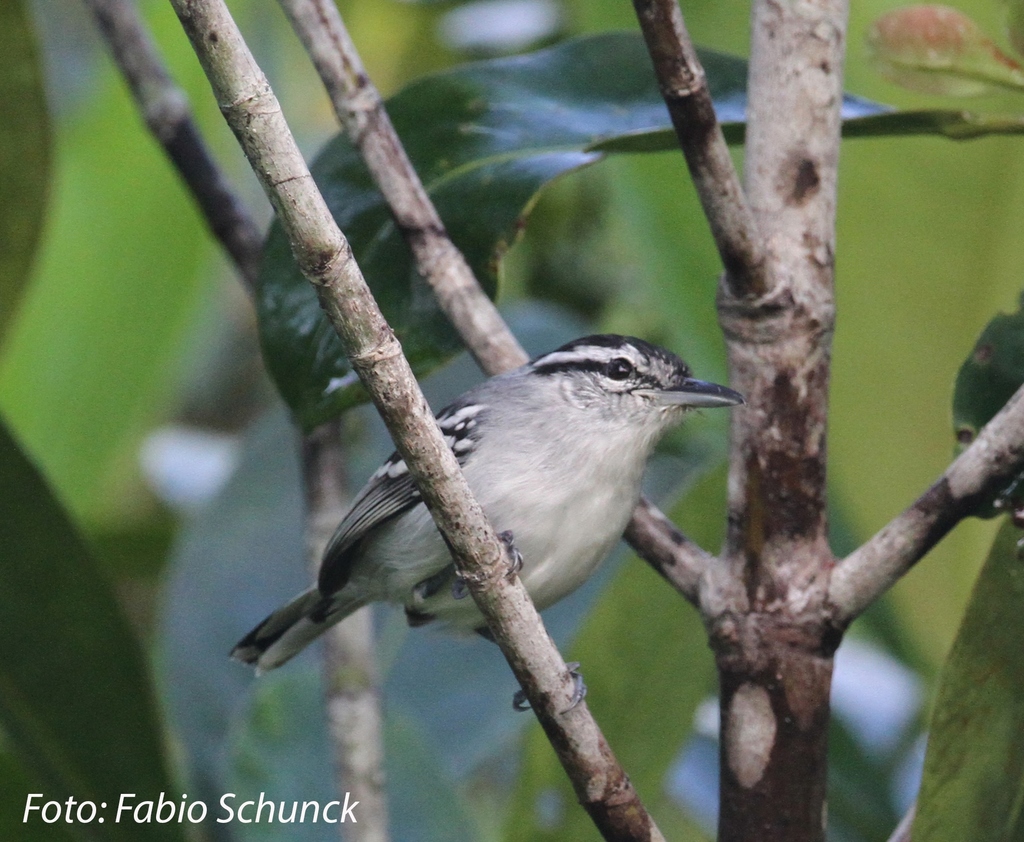
The Aripuana antwren is 11 to 12 cm (4.3 to 4.7 in) long and weighs about 11 g (0.39 oz). Adult males have a black crown and nape, a long whitish supercilium, and a black streak through the eye. The rest of their upperparts are gray. Their wings are black with white tips on the coverts and white edges on the flight feathers. Their tail is black with large white feather tips and white edges on the outermost. Their throat is pale creamy white and their breast and belly whitish. Adult females have an orangish forehead and a black crown with white streaks. Their upperparts are gray. Their throat is a creamier white than the male's and the rest of their underparts are whiter than the male's.
Range & habitat
The Aripuana antwren was first described from the area between the rios Aripuanã and Machado (the interfluvium) in Rondônia. It is now known somewhat more widely along the right bank of the Rio Madeira and along the Rio Roosevelt in more of Rondônia, southeastern Amazonas, and northwestern Mato Grosso. It primarily inhabits old-growth campinarana forest on nutrient-poor soil. The trees seldom exceed 20 m (66 ft) in height. It also occurs in tall undisturbed terra firme where it favors areas with Lepidocaryum tenue palms.
Wikipedia: “Distribution and habitat”
What it does
The Aripuana antwren's diet is known only from the stomach contents of specimens, which were the remains of insects and spiders. It forages singly, in pairs, and in family groups and frequently as a member of a mixed-species feeding flock. It mostly forages in the canopy by gleaning prey from vegetation.
Wikipedia: “Feeding”
Listen
Looking for field recordings…
Where it lives
Recorded sightings
—
geo-referenced records in GBIF, from museums, herbaria and field observers.
Drag the globe to turn it. Dots are where records exist, not a range map; darker means more records.
In the stacks
Searching the stacks…
Every page naming Herpsilochmus stotzi in the Biodiversity Heritage Library →
This page is assembled live from iNaturalist, GBIF, Wikipedia, the Source Library and the Internet Archive. It is not yet part of the hand-edited codex. iNaturalist taxon 339644.