On eBird ↗
Round-tailed Manakin
Live sightings near you, the range map, bar charts of when it is seen, and Macaulay Library photos and recordings.
Round-tailed Manakin
Ceratopipra chloromeros
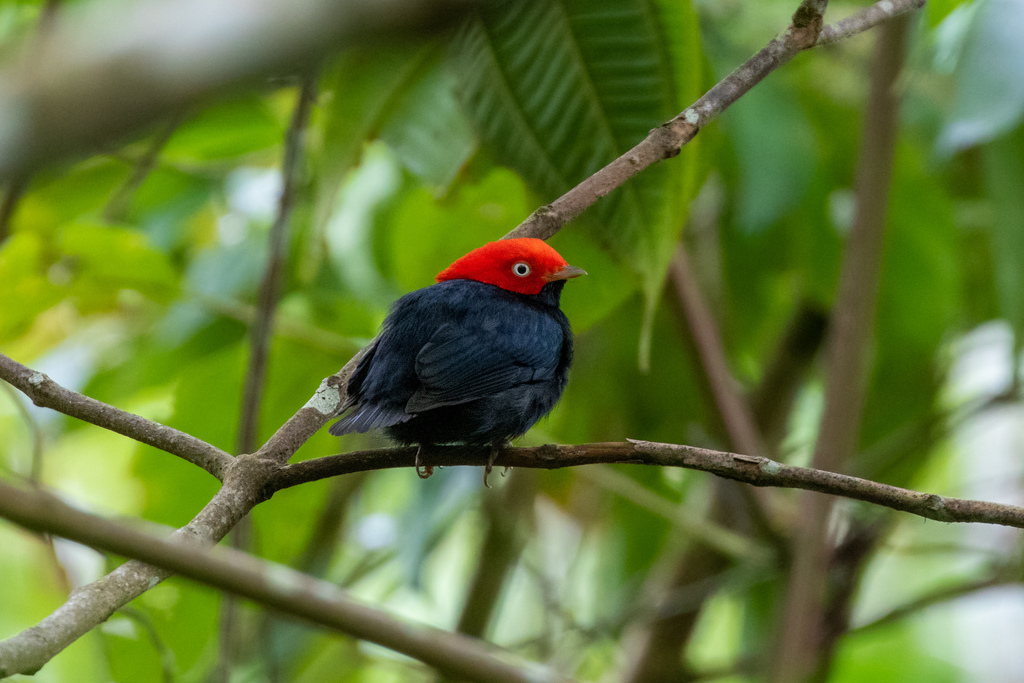
The round-tailed manakin (Ceratopipra chloromeros) is a species of bird in the Pipridae family. It is found in Bolivia, Brazil, and Peru. Its natural habitats are subtropical or tropical moist lowland forests and subtropical or tropical moist montane forests.
From the article Round-tailed manakin on Wikipedia (CC BY-SA), quoted section by section
Description
The round-tailed manakin is 10.5 to 11 cm (4.1 to 4.3 in) long and weighs about 16.5 g (0.58 oz). The species is sexually dimorphic. Its tail has a rounder end than those of other Ceratopipra manakins. Adult males have an almost entirely red head and neck. Their thighs are creamy yellow. Their throat and the rest of their plumage are black. Adult females are mostly dull olive-green; their underparts are lighter than their back, especially on the belly. Both sexes have a blackish bill and smoky pinkish legs and feet. Males have a white iris and females a grayish one. Immature birds of both sexes resemble adult females but with a darker gray iris.
Range & habitat
The round-tailed manakin is found from southern Amazonas Department in eastern Peru south through extreme western Acre in Brazil and into northern Bolivia as far as western Santa Cruz Department. It inhabits humid forest, of both terra firme and seasonally flooded types, in the lowlands and Andean foothills. In elevation it reaches 1,500 m (4,900 ft).
Wikipedia: “Distribution and habitat”
What it does
The round-tailed manakin's diet and feeding behavior are not known. They are assumed to be similar to those of other Ceratopipra manakins, for one of which see here.
Wikipedia: “Feeding”
Listen
Looking for field recordings…
Where it lives
Recorded sightings
—
geo-referenced records in GBIF, from museums, herbaria and field observers.
Drag the globe to turn it. Dots are where records exist, not a range map; darker means more records.
In the stacks
Searching the stacks…
Every page naming Ceratopipra chloromeros in the Biodiversity Heritage Library →
This page is assembled live from iNaturalist, GBIF, Wikipedia, the Source Library and the Internet Archive. It is not yet part of the hand-edited codex. iNaturalist taxon 339676.