On eBird ↗
Iberian Magpie
Live sightings near you, the range map, bar charts of when it is seen, and Macaulay Library photos and recordings.
Iberian Magpie
Cyanopica cooki
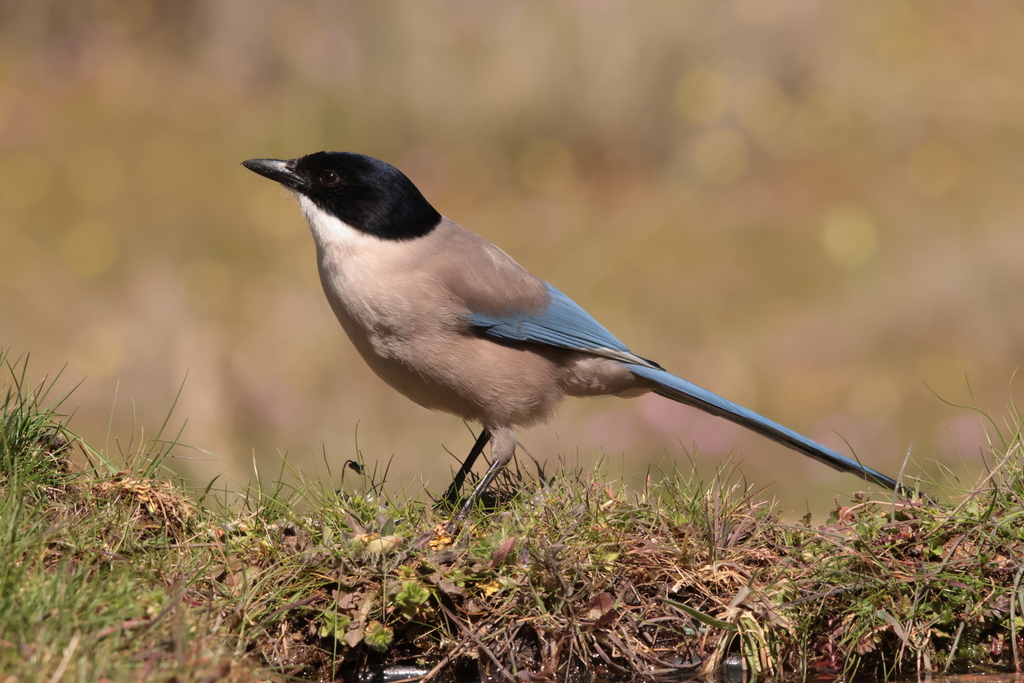
The Iberian magpie (Cyanopica cooki) is a bird in the crow family. It is 31–35 cm long and similar in overall shape to the Eurasian magpie (Pica pica) but is more slender with proportionately smaller legs and bill. It belongs to the genus Cyanopica.
From the article Iberian magpie on Wikipedia (CC BY-SA), quoted section by section
Description
It has a glossy black top to the head and a white throat. The underparts and the back are a light grey-fawn in colour with the wings and the feathers of the long (16–20 cm) tail an azure blue.
Range & habitat
The Iberian magpie occurs in southwestern and central parts of the Iberian Peninsula, in Spain and Portugal. However, it can sometimes be spotted also in south-western France, and recently its presence has been reported even in north-western Italy. It inhabits various types of coniferous (mainly pine) and broadleaf forest, including parks and gardens in the eastern populations.
Wikipedia: “Distribution and habitat”
What it does
Often Iberian magpies find food as a family group or several groups making flocks of up to 70 birds. The largest groups congregate after the breeding season and throughout the winter months. Their diet consists mainly of acorns (oak seeds) and pine nuts, extensively supplemented by invertebrates and their larvae, soft fruits and berries, and also human-provided scraps in parks and towns. This species usually nests in loose, open colonies with a single nest in each tree, same mean clutch size is 6.2 eggs, but only 32% of nesting attempts are successful, with an average 5.1 young fledged.
== References ==
Wikipedia: “Behaviour and ecology”
Listen
Looking for field recordings…
Where it lives
Recorded sightings
—
geo-referenced records in GBIF, from museums, herbaria and field observers.
Drag the globe to turn it. Dots are where records exist, not a range map; darker means more records.
In the stacks
Searching the stacks…
Every page naming Cyanopica cooki in the Biodiversity Heritage Library →
This page is assembled live from iNaturalist, GBIF, Wikipedia, the Source Library and the Internet Archive. It is not yet part of the hand-edited codex. iNaturalist taxon 339684.