On eBird ↗
White-whiskered Laughingthrush
Live sightings near you, the range map, bar charts of when it is seen, and Macaulay Library photos and recordings.
White-whiskered Laughingthrush
Trochalopteron morrisonianum
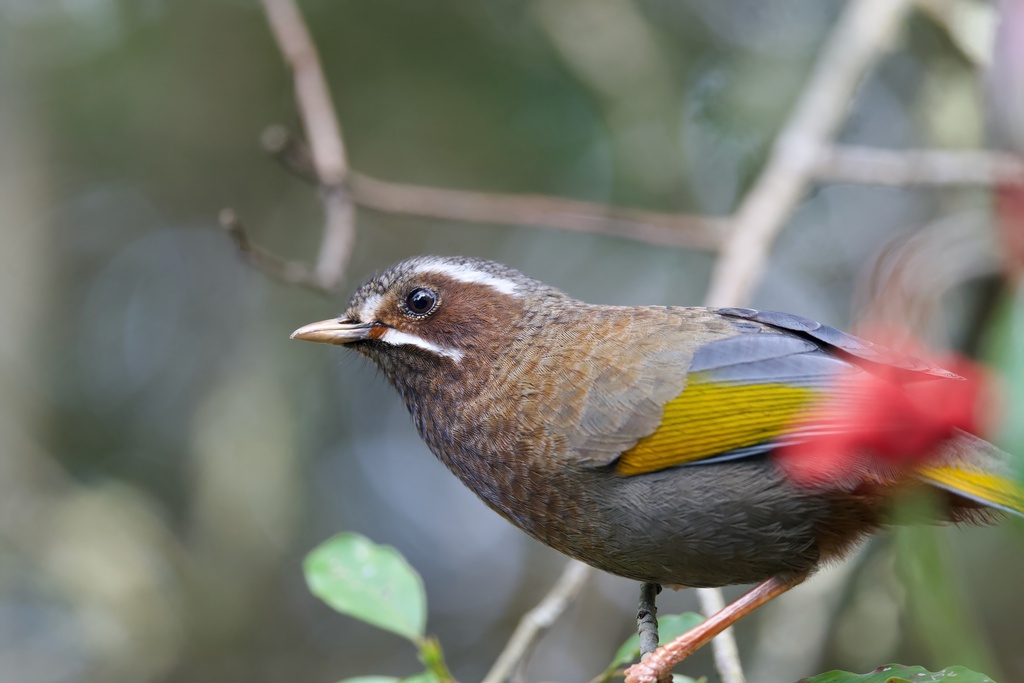
The white-whiskered laughingthrush or Formosan laughing thrush (Trochalopteron morrisonianum) is a species of bird in the family Leiothrichidae. It is endemic to montane forests of the island of Taiwan.
From the article White-whiskered laughingthrush on Wikipedia (CC BY-SA), quoted section by section
Description
White-whiskered laughingthrush is a large, 26 to 28 cm (10 to 11 in) long, laughingthrush with a distinctive face pattern. The bill is thrush-like and yellowish to horn-colored. The eyes are black. The legs are strong and brownish pink. The mean body weight is about 77 grams (2.7 oz). It is a sociable species that often occurs in large groups. It is not necessarily afraid of humans.
Range & habitat
The species occurs at elevations between 1,475 and 3,300 m (4,839 and 10,827 ft) above sea level, but typically above 2000 m, in tall grass, forest undergrowth, thickets, and forest edge scrub. It can enter open areas by roadsides and in forest clearings. In the Yushan National Park, it was more abundant in mixed coniferous forest than in grassland, pine woodland, or spruce forest; along with Taiwan fulvetta (Fulvetta formosana) and Taiwan yuhina (Yuhina brunneiceps), it was a dominant species in that habitat. It is a ground omnivore.
Wikipedia: “Habitat and ecology”
Listen
Looking for field recordings…
Where it lives
Recorded sightings
—
geo-referenced records in GBIF, from museums, herbaria and field observers.
Drag the globe to turn it. Dots are where records exist, not a range map; darker means more records.
In the stacks
This page is assembled live from iNaturalist, GBIF, Wikipedia, the Source Library and the Internet Archive. It is not yet part of the hand-edited codex. iNaturalist taxon 339867.