On eBird ↗
Tboli Sunbird
Live sightings near you, the range map, bar charts of when it is seen, and Macaulay Library photos and recordings.
Tboli Sunbird
Aethopyga tibolii
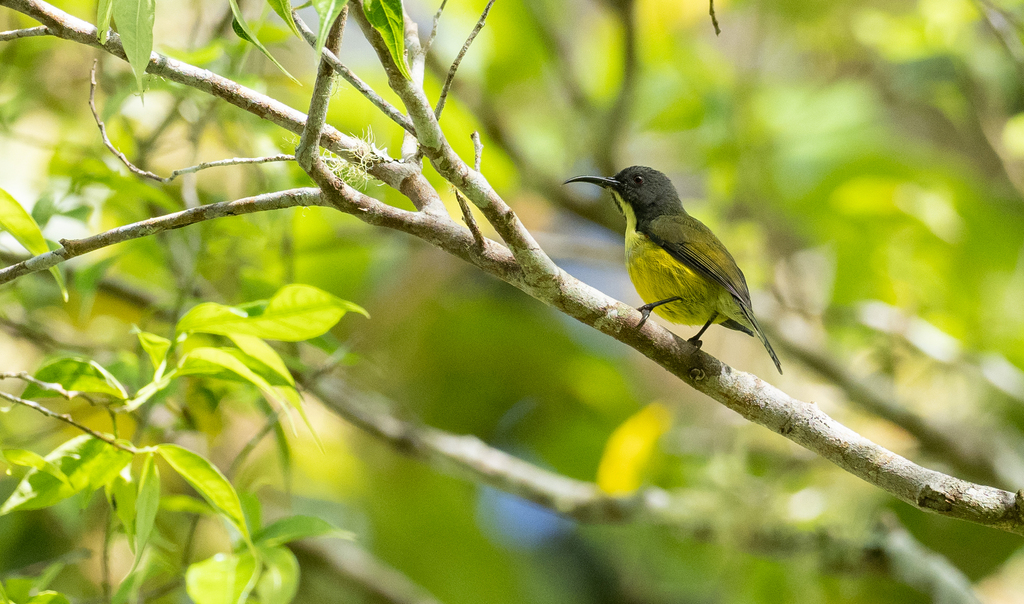
The Tboli sunbird (Aethopyga tibolii) is a species of bird in the sunbird family Nectariniidae. It is endemic to the Philippines found only in the mountains of south Mindanao. Its natural habitat is tropical moist montane forest starting from 800 meters above sea level. It was formerly considered to be a subspecies of the Apo sunbird.
From the article Tboli sunbird on Wikipedia (CC BY-SA), quoted section by section
Range & habitat
The Apo sunbird is a bird local to the island of Mindanao in the Philippines. It can be found in mountainous areas in the southern parts of the island on Mount Matutum and Mount Busa in the provinces of South Cotabato and Sarangani Its natural habitat is in montane rainforest above 800 meters above sea leve which is significantly lower than the boltoni and malindangensis Apo sunbirds which are found above 1,500 meters above sea level. The Tboli sunbird has not yet been recognized as its own species by the International Union for Conservation of Nature. The Apo sunbird is listed as least concern but was formerly near threatened. Despite its limited range, it is said to be locally common. As it occurs in rugged and inaccessible mountains, this has allowed a large portion of its habitat to remain intact. However, there it is still affected by habitat loss through deforestation, mining, land conversion and slash-and-burn - just not to the same extent as lowland forest. It is found in the protected areas of Lake Holon and Mount Matutum but actual protection from deforestation is still lax.
== References ==
Wikipedia: “Habitat and conservation status”
What it does
This species is presumed to feed primarily on nectar but will also supplement its diet with insects especially when it is nesting. This species is found singly, in pairs and forms mixed species flocks with other forest birds. Not much information about this species' ecology has been published aside the paper released when it was described as a subspecies in 1997. The Apo sunbird is better studied and it is highly likely to have the same breeding habits. Apo sunbirds have been recorded breeding in January to July. Its nest was described as built of moss, spider eggs and insect cases.
Wikipedia: “Ecology and behavior”
Listen
Looking for field recordings…
Where it lives
Recorded sightings
—
geo-referenced records in GBIF, from museums, herbaria and field observers.
Drag the globe to turn it. Dots are where records exist, not a range map; darker means more records.
In the stacks
Searching the stacks…
Every page naming Aethopyga tibolii in the Biodiversity Heritage Library →
This page is assembled live from iNaturalist, GBIF, Wikipedia, the Source Library and the Internet Archive. It is not yet part of the hand-edited codex. iNaturalist taxon 339882.