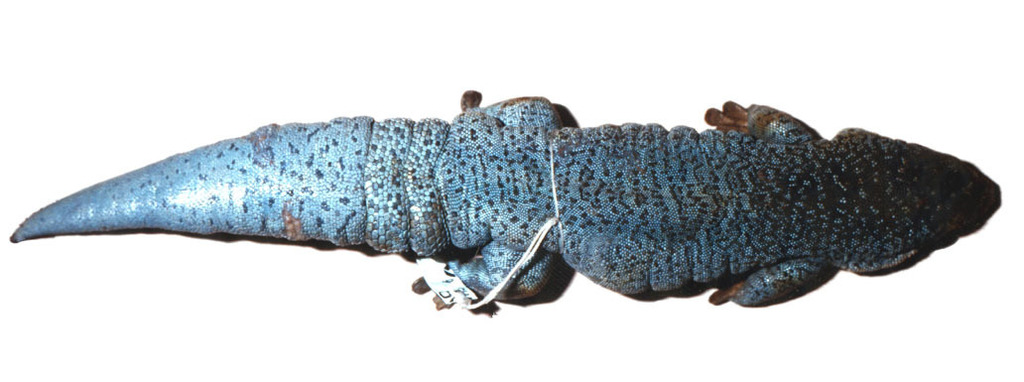
Rodrigues Blue-dotted Day Gecko
Phelsuma edwardnewtoni
The Rodrigues day gecko (Phelsuma edwardnewtoni), also known commonly as the Rodrigues blue-dotted day gecko, is an extinct species of day gecko, a lizard in the family Gekkonidae. The species was endemic to the island of Rodrigues, where it typically inhabited forests and dwelt in trees. The Rodrigues day gecko fed on insects and nectar.
From the article Rodrigues day gecko on Wikipedia (CC BY-SA), quoted section by section
Description
P. edwardnewtoni was one of the largest day geckos. It reached a total length (including tail) of about 23 cm (9.1 in). Earlier investigators describe the animal as being quite common. However, this species has not been sighted since 1917, in spite of thorough searches in the 1960s and 1970s on Rodrigues and all offshore islets. Today, only six preserved specimens remain, which are in The Natural History Museum in London and the Paris Natural History Museum. These specimens have been preserved in alcohol and show a thick-bodied, robust Phelsuma. The body colour in life has been described as bright green with bright blue spots on the backside. The underside of the tail was whitish-yellow. The chin had a deep yellow colour.
What it does
The species P. edwardnewtoni inhabited Rodrigues Island and its surrounding islets. P. edwardnewtoni was observed on coconut trees and other palms. Its habitat has been largely destroyed by humans and introduced animals such as cats and rats, which may have been the main cause of its extinction. This day gecko fed mainly on palm fruit, and various insects and other invertebrates associated with palm trees. It also liked to lick soft, sweet fruit, pollen and nectar. P. edwardnewtoni was documented as being unafraid of humans. It was quite tame and would even eat fruit from one's hand. Leguat described the behaviour as follows:
The Palmtrees and Plantanes are always loaden with Lizards about a foot long, the Beauty of which is very Extraordinairy; some of them are blue, some black, some green, some red, some grey, and the colour of each the most lively and bright of any of its kind. Their common Food is the Fruit of the Palm-Trees. They are not mischievous, and so Tame, that they often come and eat the Melons on our Tables, and in our Presence, and even in our Hands; they serve for Prey to some Birds, specially the Bitterns. …
Wikipedia: “Behaviour and ecology”
Where it lives
Recorded sightings
—
geo-referenced records in GBIF, from museums, herbaria and field observers.
Drag the globe to turn it. Dots are where records exist, not a range map; darker means more records.
In the stacks
Searching the stacks…
Every page naming Phelsuma edwardnewtoni in the Biodiversity Heritage Library →
This page is assembled live from iNaturalist, GBIF, Wikipedia, the Source Library and the Internet Archive. It is not yet part of the hand-edited codex. iNaturalist taxon 34058.