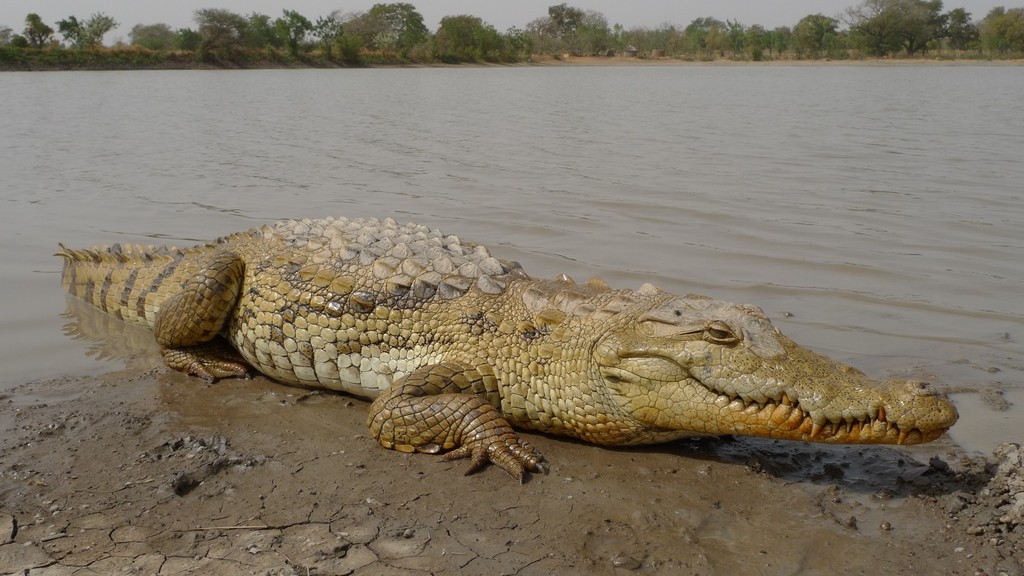
West African Crocodile
Crocodylus suchus
The West African crocodile or desert crocodile (Crocodylus suchus) is a species of crocodile related to – and often confused with – the larger and more aggressive Nile crocodile (C. niloticus).
From the article West African crocodile on Wikipedia (CC BY-SA), quoted section by section
Description
The muzzle is short and thick. The distance between the eyes and the tip of the muzzle is 1.5 to 2 times longer than the width of the muzzle at the level of the front edge of the eyes (1.2 to 1.5 times in case of juveniles). The coloration is generally brown to olive. Juveniles are paler, with black bandings, especially on the tail. Like all other species of crocodiles, the West African crocodile's eyes reflect light at night allowing it to be spotted easily through a flashlight. It is found to be active day and night. It can stay submerged underwater for more than 30 minutes, and can reach speeds of up to 30 km/h (19 mph) in short bursts. On land, it is often observed basking motionless in the sun, often with its mouth agape. Compared to the Nile crocodile, which can grow over 5 m (16 ft 5 in) in length, the West African crocodile is smaller. It typically grows between 2 and 3 m (6 ft 7 in and 9 ft 10 in) in length, with an occasional male growing over 4 m (13 ft 1 in) in rare cases. Adults weigh between 90 and 250 kg (200 and 550 lb), with particularly large male specimens exceeding 300 kg (660 lb) in weight.
Wikipedia: “Characteristics”
Range & habitat
The West African crocodile inhabits much of West and Central Africa, ranging east to South Sudan and Uganda, and south to Democratic Republic of the Congo (in all three countries it may come into contact with Nile crocodiles). Other countries where it is found include Mauritania, Benin, Liberia, Guinea-Bissau, Nigeria, Niger, Cameroon, Chad, Sierra Leone, the Central African Republic, Equatorial Guinea, Senegal, Mali, Guinea, Gambia, Burkina Faso, Ghana, Gabon, Togo, Ivory Coast and the Republic of Congo. As late as the 1920s, museums continued to obtain West African crocodile specimens from the White Nile, but today the species has disappeared from this river.
In Mauritania the species has adapted to the arid desert environment of the Sahara–Sahel by staying in caves or burrows in a state of aestivation during the driest periods, leading to the alternative common name desert crocodile. When it rains, these desert crocodiles gather at gueltas. In much of its range, the West African crocodile may come into contact with other crocodile species and there appears to be a level of habitat segregation between them. The Nile crocodile typically prefers large seasonal rivers in savannah or grassland, while the West African crocodile generally prefers lagoons and wetlands in forested regions, at least where the two species may come into contact. …
Wikipedia: “Distribution and habitat”
Where it lives
Recorded sightings
—
geo-referenced records in GBIF, from museums, herbaria and field observers.
Drag the globe to turn it. Dots are where records exist, not a range map; darker means more records.
In the stacks
Searching the stacks…
Every page naming Crocodylus suchus in the Biodiversity Heritage Library →
This page is assembled live from iNaturalist, GBIF, Wikipedia, the Source Library and the Internet Archive. It is not yet part of the hand-edited codex. iNaturalist taxon 341973.