On eBird ↗
Sumatran Green-Pigeon
Live sightings near you, the range map, bar charts of when it is seen, and Macaulay Library photos and recordings.
Sumatran Green-Pigeon
Treron oxyurus
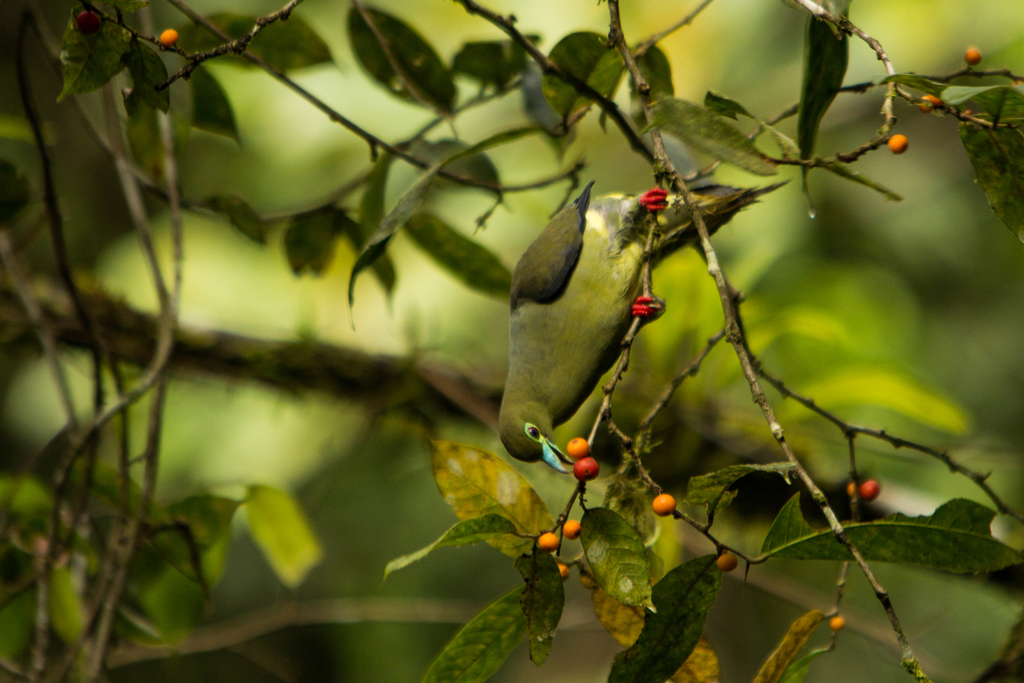
The Sumatran green pigeon (Treron oxyurus) is a species of bird in the pigeon family, Columbidae. First described by the Dutch zoologist Coenraad Jacob Temminck in 1823, it is endemic to Indonesia, where it is found in Sumatra and western Java. It inhabits the canopy of dense hill and montane forest and has been recorded at elevations of 350 to 1,800 m (1,100 to 5,900 ft) on Sumatra and 600 to 3,000 m (2,000 to 9,800 ft) on Java. The Sumatran green pigeon is a relatively slender species with a long wedge-shaped tail and an adult length of 29.0–34.1 cm (11.4–13.4 in) in males and 27.7–29.0 cm (10.9–11.4 in) in females. Adult males have a dark green head and body, bright yellow lower belly and undertail-coverts, dark grey tail, and bluish-green unfeathered patches on the face. Adult females are duller and have no grey on the back of the neck, a fainter orange wash on the breast, and no orange markings on the crown or the bend of the wing.
The species feeds on fruit such as figs, leaving overnight roosts of up to 50 birds to feed in the early morning and returning in the late afternoon. Breeding has been observed in January and September on Sumatra and in June on Java. Nests are built in trees and contain one or two eggs incubated by both parents. The Sumatran green pigeon is listed as near-threatened on the IUCN Red List due to a "moderately small" population that is continuing to decline because of habitat degradation. It was previously considered to be locally common throughout its range, but is now scarce on Sumatra and very rare on Java.
From the article Sumatran green pigeon on Wikipedia (CC BY-SA), quoted section by section
Description
The Sumatran green pigeon is a relatively slender species with a long wedge-shaped tail. It has a length of 29.0–34.1 cm (11.4–13.4 in) in males and 27.7–29.0 cm (10.9–11.4 in) in females. The wing length is 159–170 mm (6.26–6.69 in) in males and 156–157 mm (6.14–6.18 in) in females, while tail length is 102–119 mm (4.02–4.69 in) across both sexes. Adult males have a dark green head and body, bright yellow lower belly and undertail-coverts, dark grey tail, and unfeathered patches on the face. The forehead is bright olive, the crown and nape are dark green, and the neck, upper back, scapular feathers and lesser coverts are dark green, with the neck also having a grey wash. The outer greater coverts are blackish, the tertials are dark green, and the primaries and secondaries are black. The underside of the wing is dark grey. The chin and throat are greenish-yellow, the ear-coverts are bright olive, and the breast is bright olive with a rusty-orange tint. The vent and thighs are sulphur-yellow, the latter having dark green streaks on most feathers. The undertail is black with a grey band near the tip. Shorter undertail-coverts have yellow outerwebs and dark green innerwebs, while the longer ones have yellowish-buff outerwebs and rufous innerwebs. The uppertail is dark grey. The central tail feathers are long and pointed, with an olive-green tint. …
Range & habitat
The Sumatran green pigeon is endemic to Indonesia, where it is found in Sumatra and western Java. On Sumatra, it is found in the Barisan Mountains, as well as some other parts of the island, while on Java, it is found in the western mountains east to Mount Papandayan. It inhabits the canopy of dense hill and montane forest and has been recorded at elevations of 350 to 1,800 m (1,100 to 5,900 ft) on Sumatra and 600 to 3,000 m (2,000 to 9,800 ft) on Java. It is locally migratory, but never strays far from dense hill forest. Sumatran green pigeons have been seen in open coastal swamp forest near sea level in North Sumatra; these may have been visiting the lowlands to feed or may have been escaped captive birds.
Wikipedia: “Distribution and habitat”
What it does
The species feeds on fruit such as figs in foraging flocks. It roosts communally in flocks of up to 50 birds. Birds leave the overnight roost to feed in the early morning and return by the late afternoon. The Sumatran green pigeon is known to be parasitised by Columbicola feather lice. Its generation length is 4.2 years. Breeding has been observed in January and September on Sumatra and in June on Java. Nests are built by both sexes, who bring twigs to construct the nest in the early morning. Nests have been documented from Syzygium aqueum, Syzygium aromaticum, and Casuarina trees at heights of 2.5–6 m (8–20 ft) above the ground. Nests contain one or two eggs, which are incubated by both parents.
Wikipedia: “Ecology”
Listen
Looking for field recordings…
Where it lives
Recorded sightings
—
geo-referenced records in GBIF, from museums, herbaria and field observers.
Drag the globe to turn it. Dots are where records exist, not a range map; darker means more records.
In the stacks
Searching the stacks…
Every page naming Treron oxyurus in the Biodiversity Heritage Library →
This page is assembled live from iNaturalist, GBIF, Wikipedia, the Source Library and the Internet Archive. It is not yet part of the hand-edited codex. iNaturalist taxon 3422.