- Animals
- ›Echinoderms
- ›sea lilies
- ›Sea Lilies
- ›Sea Lilies
- ›Feather Stars
- ›Antedonoidea
- ›Antedonidae
- ›Antedoninae
- ›Antedon
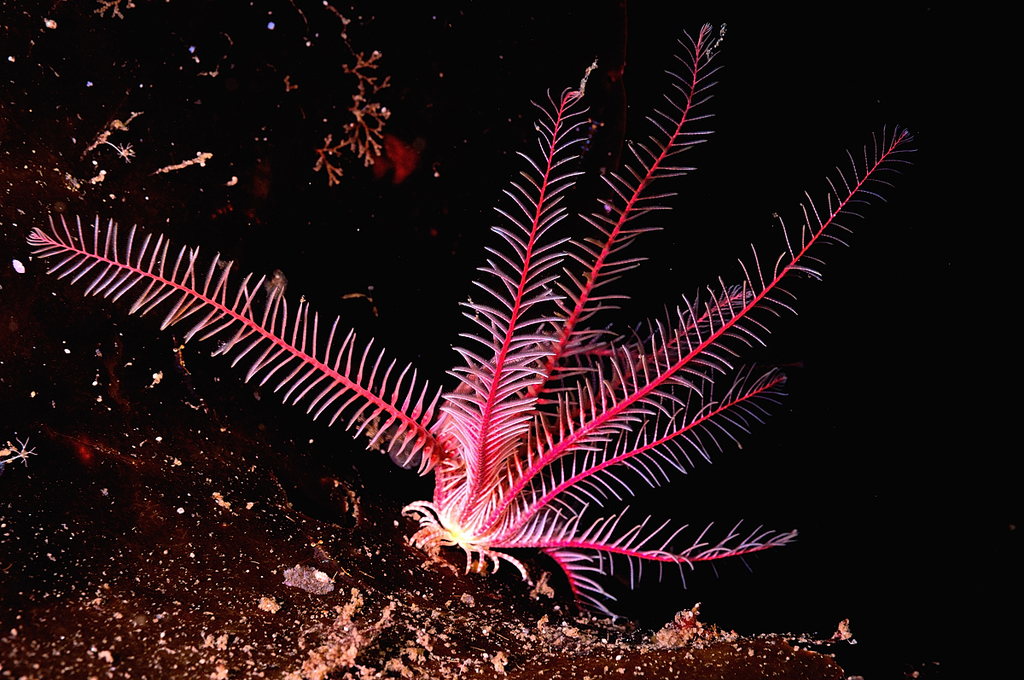
Rosy Feather Star
Antedon bifida
Antedon bifida is a species of crinoid in the family Antedonidae commonly known as the rosy feather star. It is found in north west Europe.
From the article Antedon bifida on Wikipedia (CC BY-SA), quoted section by section
Description
The body of A. bifida is a concave disc surrounded by ten pinnately divided arms giving it a fern-like appearance. The mouth and ambulacral grooves are on the upper surface of the disc. The arms can be up to 10 cm (4 in) long but are usually shorter than this. The undersides of the arms have prominent transverse ridges and some have modifications for feeding and reproduction. The pinnules are jointed, have about 35 segments and bear unequal sized tube feet in groups of three. The arm colour is variable, ranging from yellow or pink to deep purple, sometimes spotted or blotched, and the pinnules are usually paler or white. There are about twenty short cirri, banded and arranged in transverse rows on a central raised ossicle. These curl under and grasp the surface enabling the animal to crawl around which it can do with great rapidity. It may be confused with the rather similar Antedon petasus but that species is usually larger with up to 50 cirri, looks neater and does not have ridges on the undersides of its arms.
Range & habitat
Antedon bifida is primarily found on the coasts of north west Europe, the range extending from the Shetland Islands south to Portugal. It has also been reported from Algeria, Tunisia, West Africa and Venezuela. Around the British Isles it is found on north eastern and on western coasts. It occurs from the low tide mark to a depth of about 200 m (650 ft) and occasionally much deeper. It is often associated with other crinoids and bryozoans and may dominate its habitat. It moves from place to place, clinging to rocks, seaweed and molluscs with its clawed cirri. It favours areas with strong currents in both sheltered and fairly exposed positions and is often found in gullies.
Wikipedia: “Distribution and habitat”
What it does
Antedon bifida has a symbiotic relationship with the marine worm, Myzostoma cirriferum. The worm larvae are caught by the tube feet of the feather star and treated like food particles. They attach in the ambulacral grooves of the pinnules where they undergo metamorphosis and mature. They hold on with parapodial hooks and can move about on the host.
Wikipedia: “Ecology”
Where it lives
Recorded sightings
—
geo-referenced records in GBIF, from museums, herbaria and field observers.
Drag the globe to turn it. Dots are where records exist, not a range map; darker means more records.
In the stacks
Searching the stacks…
Every page naming Antedon bifida in the Biodiversity Heritage Library →
This page is assembled live from iNaturalist, GBIF, Wikipedia, the Source Library and the Internet Archive. It is not yet part of the hand-edited codex. iNaturalist taxon 342278.