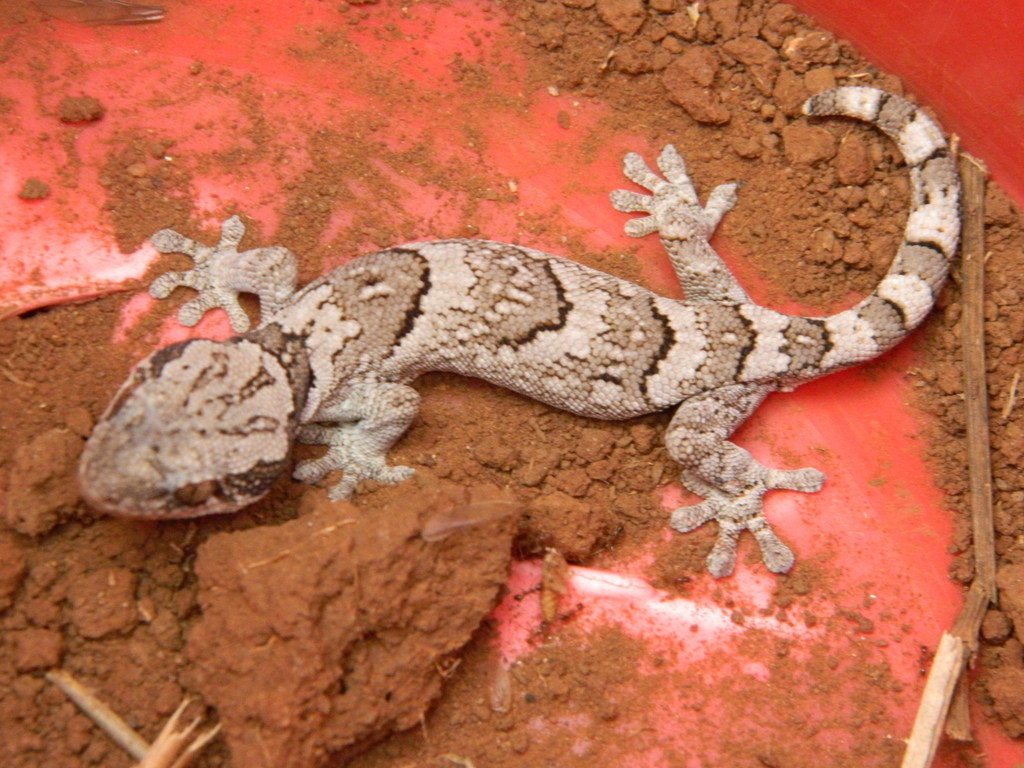
Banded Velvet Gecko
Homopholis fasciata
Homopholis fasciata, a nocturnal vertebrate known as the banded velvet gecko or striped velvet gecko, is a small gecko that lives in East Africa.
From the article Homopholis fasciata on Wikipedia (CC BY-SA), quoted section by section
Description
Homopholis fasciata are small geckos with soft, velvet-like skin. They have short, rounded heads and long, thin non-tapering tails. Their body shape is stout with a bunt and toes that have both adhesive pads and claws. Their skin ranges from green, greys and browns with a chevron-like pattern down the back. They grow to 3½"–4½" and are known to bite. They are very common in both urban and rural areas and although they can bite they rarely ever do as their main defence is to play dead rather than to defend or attack. Although not known how long this gecko can play dead for it is not uncommon for them to be motionless for two to three days whilst they still feel under threat. The gecko is prey to snakes but in urban areas domestic cats attack and kill these lovely little reptiles that can be seen often scaling walls and running around gardens during the day. This gecko does not mind daylight but does hide in shaded places during midday when the sun is at its highest.
Range & habitat
Homopholis fasciata occur in East Africa, in Somalia, Ethiopia, Kenya, and Tanzania. They inhabit wet or dry savannas containing large trees. They can be found hiding under the bark and in the crevasses of these trees. Mostly nocturnal but may also be found active during the day.
Wikipedia: “Distribution and habitat”
What it does
Small crickets are the main staple diet along with small mealworms and various other insects when available. Excess calcium causes their neck pouches to puff out.
Wikipedia: “Feeding”
How it is grown
In terms of mating, males have hemipenal bulges at the base of the tail. Males also have a pair of pre-anal pores/scales just above the cloacal opening that the females lack. Egg laying may occur during the winter in the Northern Hemisphere. 4 or 5 clutches of 2 eggs each may be laid during the breeding period. The hard-shelled eggs are laid under loose bark, in crevasses or buried in a slightly moist spot. They should be removed for incubation at around 82 °F.
== References ==
Wikipedia: “Husbandry”
Where it lives
Recorded sightings
—
geo-referenced records in GBIF, from museums, herbaria and field observers.
Drag the globe to turn it. Dots are where records exist, not a range map; darker means more records.
In the stacks
Searching the stacks…
Every page naming Homopholis fasciata in the Biodiversity Heritage Library →
This page is assembled live from iNaturalist, GBIF, Wikipedia, the Source Library and the Internet Archive. It is not yet part of the hand-edited codex. iNaturalist taxon 34397.