On eBird ↗
Galapagos Dove
Live sightings near you, the range map, bar charts of when it is seen, and Macaulay Library photos and recordings.
Galápagos Dove
Zenaida galapagoensis
The Galápagos dove (Zenaida galapagoensis) is a species of bird in the family Columbidae. It is endemic to the Galápagos, off Ecuador. It is fairly common and is found in a wide range of open and semi-open habitats, especially in the arid lowlands of the archipelago.
From the article Galápagos dove on Wikipedia (CC BY-SA), quoted section by section
Description
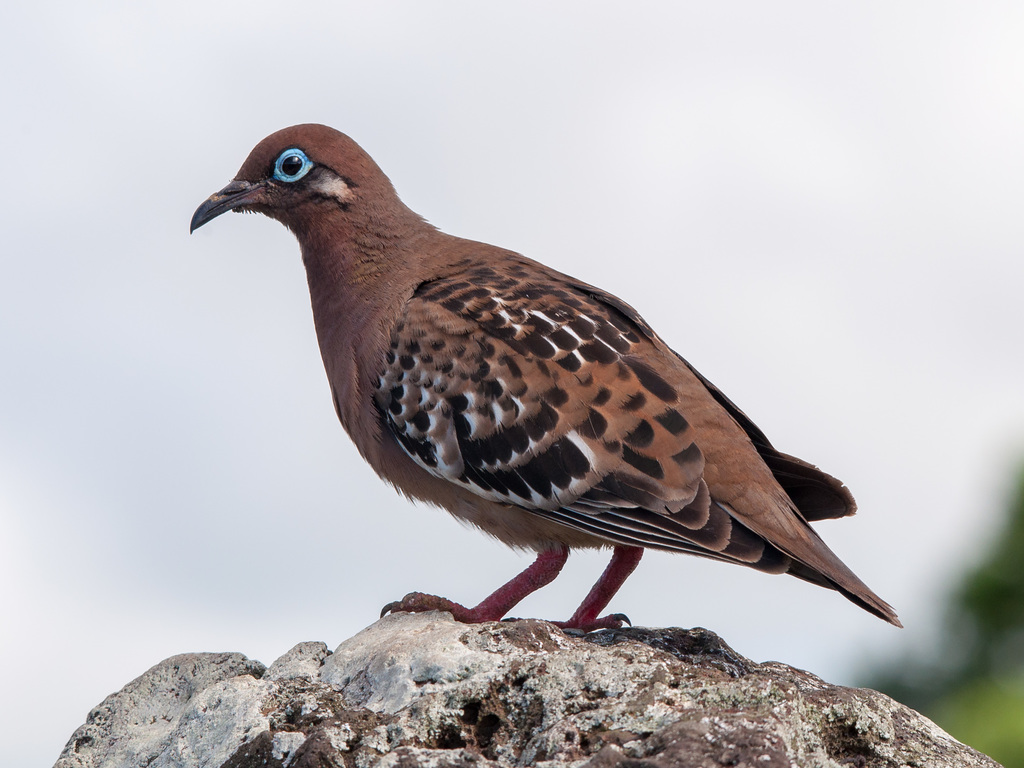
The Galápagos dove grows 18–23 cm (7.1–9.1 in) long and weighs in at 67–92 g (2.4–3.2 oz). The long black bill is slightly curved downwards. The feet and legs are reddish with some purple. A boldly marked bird, the Galápagos dove has dark reddish-brown upperparts, a pinkish neck and breast, a buff-coloured belly, and brown wings, streaked with white and black. The skin around the eye is deep blue with a black border. The eye itself is brown. An iridescent patch is found on the side of the neck. The scapular feathers and the wing-coverts are black with a white stripe in the middle running down the length; this makes the wings appear streaked. The underparts of the wings are grey to blue. The central tail feathers are brown and the outers are grey. Females are quite similar to the males, but are smaller – as is the size of their iridescent patch. They also have darker back, wings, and tail.
What it does
The long downward curved beaks on the Galápagos dove helps it feed mostly on seeds and fruits from the ground. Very reluctant to fly, it will only do so as a last resort. Galápagos doves spend most of their time on the ground searching for food, mainly feeding off seeds, caterpillars, and Opuntia cactus flowers and pulp. On islands where bees are absent, the Opuntia cacti have evolved softer spines. This may allow birds, including the dove, better access to the flowers, with bird activity serving to pollinate the flowers. The doves mostly crush seeds before eating them, but ingest some seeds whole, some of which survive digestion – making the bird a source of plant distribution in the Galapagos.
Wikipedia: “Feeding”
Listen
Looking for field recordings…
Where it lives
Recorded sightings
—
geo-referenced records in GBIF, from museums, herbaria and field observers.
Drag the globe to turn it. Dots are where records exist, not a range map; darker means more records.
In the stacks
Searching the stacks…
Every page naming Zenaida galapagoensis in the Biodiversity Heritage Library →
This page is assembled live from iNaturalist, GBIF, Wikipedia, the Source Library and the Internet Archive. It is not yet part of the hand-edited codex. iNaturalist taxon 3451.