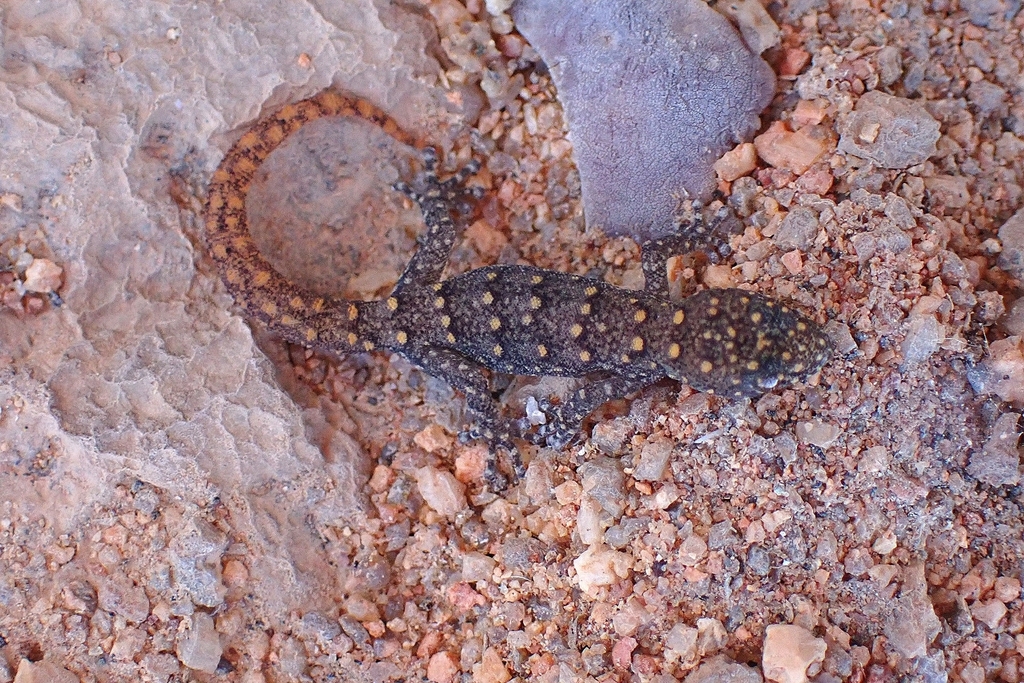
Namaqua Leaf-toed Gecko
Goggia rupicola
Goggia rupicola, also known as the Namaqua dwarf leaf-toed gecko or the Namaqua pygmy gecko, is a southern African leaf-toed gecko first described by Vivian FitzSimons from a specimen collected on the 23 August 1937 where it was found in cracks of rocks of small outcrops in the arid Namakwaland in South Africa and Namibia.
From the article Goggia rupicola on Wikipedia (CC BY-SA), quoted section by section
Description
On the dorsal (upper) sideG. rupicola is a dark greyish brown with pale salmon-coloured semicircular spots with a dark edge on the front arranged in more or less regular series down the back. A thin black streak runs from the nostril through the eye to just above ear-opening. The belly is a greyish white. It is related to Goggia essexi from which it can be distinguished mainly by the dorsal and ventral scaling and the colour markings. Dimensions: Body length about 30 mm, tail length 30 mm, head length 6 to 7 mm, head breadth 5.2 mm, forelimb 9 mm, hindlimb 12 mm.
What it does
The three elliptical-shaped eggs originally collected in 1937 between Okiep and Springbok averaged 7.8 x 6.0 mm.
== References ==
Wikipedia: “Reproduction”
Where it lives
Recorded sightings
—
geo-referenced records in GBIF, from museums, herbaria and field observers.
Drag the globe to turn it. Dots are where records exist, not a range map; darker means more records.
In the stacks
Searching the stacks…
Every page naming Goggia rupicola in the Biodiversity Heritage Library →
This page is assembled live from iNaturalist, GBIF, Wikipedia, the Source Library and the Internet Archive. It is not yet part of the hand-edited codex. iNaturalist taxon 34586.