- Animals
- ›Chordates
- ›Vertebrates
- ›Ray-finned Fishes
- ›Spiny-rayed fishes
- ›Butterflyfishes, Angelfishes, and Allies
- ›Cavebasses
- ›Dinoperca
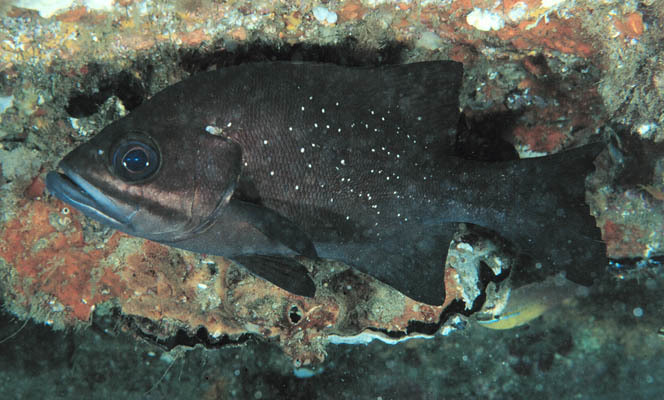
Cavebass
Dinoperca petersi
Dinoperca is a genus in the family Dinopercidae (cavebasses). It contains the single species Dinoperca petersi, the lampfish, which is native to reefs of the western Indian Ocean, where it can be found down to depths of 50 m (160 ft). It prefers to inhabit the spaces under ledges, as well as the mouths of caves. This species grows to 75 cm (30 in) in total length. It is of minor importance to local commercial fisheries, but is popular as...
From the article Dinoperca on Wikipedia (CC BY-SA), quoted section by section
What it does
Cavebass are relatively deep bodied, a blackish-brown to brownish-purple color, with small white spots on the body that fade in larger specimens. Juveniles have a lighter silvery body with black markings, which can fade as they become adults. A black band is present from the snout to the preopercle. Cavebass grow to 75 cm (30 in) in total length and 5.8 kg (13 lb) in weight. This fish is native to both rocky and coral reefs of the western Indian Ocean, from Pakistan to South Africa. It can be found down to depths of 75 m (246 ft). The cavebass prefers to inhabit the spaces under ledges, as well as the mouths of caves, while juveniles inhabit shallower rocky reefs. A study found that a large majority of cavebass are highly resident species with a home range of around 290–450 m (950–1,480 ft), meaning they often stick close to their home reef. Adults feed primarily on small invertebrates including crabs, shrimp, and octopuses, as well as small fish. Cavebass tend to be more active nocturnally. Cavebass are also able to make a loud drumming noise while underwater. It is of minor importance to local commercial fisheries, but is popular as a sport fish, especially along the eastern coast of South Africa, where they can be referred to as "lantern fish" (not to be confused with lanternfish of the family Myctophidae).
Wikipedia: “Biology and ecology”
Where it lives
Recorded sightings
—
geo-referenced records in GBIF, from museums, herbaria and field observers.
Drag the globe to turn it. Dots are where records exist, not a range map; darker means more records.
In the stacks
Searching the stacks…
Every page naming Dinoperca petersi in the Biodiversity Heritage Library →
This page is assembled live from iNaturalist, GBIF, Wikipedia, the Source Library and the Internet Archive. It is not yet part of the hand-edited codex. iNaturalist taxon 347572.