- Animals
- ›Echinoderms
- ›sea urchins and sea cucumbers
- ›Sea Urchins, Sand Dollars, and Heart Urchins
- ›sea urchins
- ›Carinacea
- ›Echinacea
- ›Camarodonta
- ›Echinidea
- ›Odontophora
- ›Echinometridae
- ›Heterocentrotus
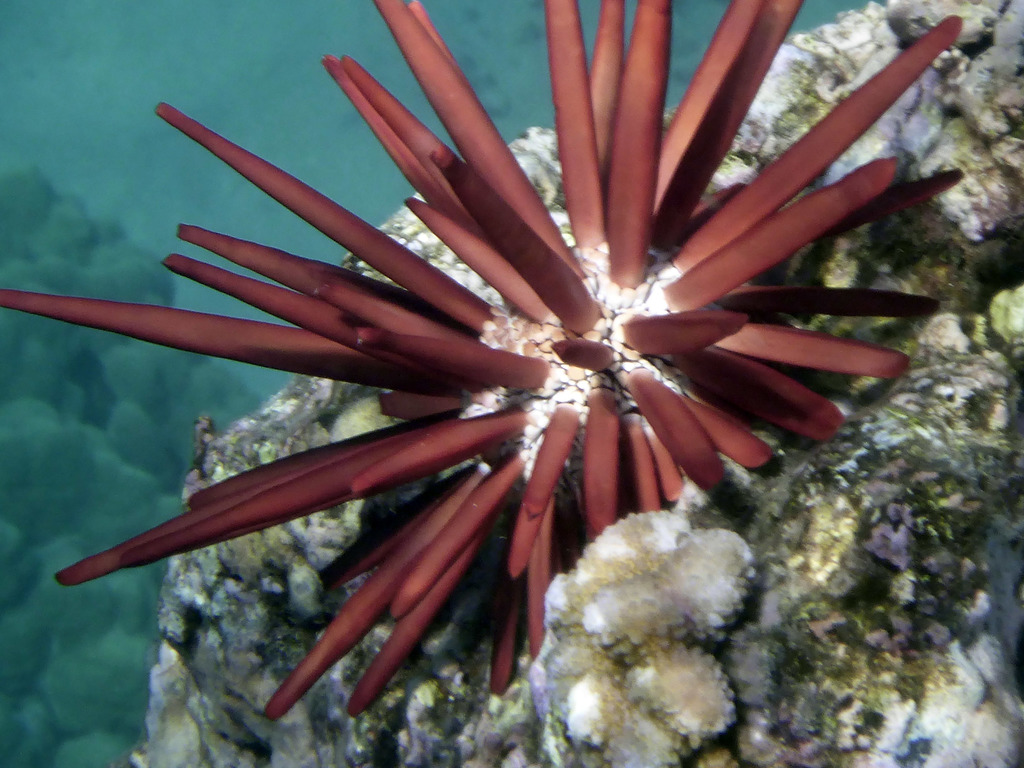
Red Pencil Urchin
Heterocentrotus mamillatus
Heterocentrotus mamillatus, commonly known as the slate pencil urchin, red slate pencil urchin, or red pencil urchin, is a species of tropical sea urchin from the Indo-Pacific region.
From the article Heterocentrotus mamillatus on Wikipedia (CC BY-SA), quoted section by section
Description
This species is a large sea urchin, capping in some specimens reaching over 8 cm in diameter, with spikes up to 10 cm. Most specimens are bright red, but brown and purple colorations are also seen. The spines may have a different color from the body. Spines have a white ring at their stem and have alternating light and dark rings. The spines are rounded to triangular in cross-section and taper towards the tip. Surprisingly during the night the red spines turn into a chalky pink. Specimens from Hawai‘i tend to have bright red spines, while specimens from other parts of the Pacific may have yellowish or brown spines. Other variations of H. mammillatus, such as those living on the Ogasawara Islands, have slimmer spines instead of the species' characteristic thick, broad spines. It has been debated whether this specific variant truly belongs within the classification of H. mammillatus and not Heterocentrotus trigonarius, another type of pencil urchin. However, it has been concluded that the Ogasawara type is indeed a form of H. mammillatus. Heterocentrotus trigonarius is a similar species that has longer and darker spines, more angular, and is always monochromic.
Range & habitat
This species can be found throughout the tropical waters of the Indo-Pacific region (from the east coast of Africa to the Pacific archipelagos), but is especially abundant in Hawai‘i. It can also be found on the shores of the Sinai Peninsula.Pencil Urchins generally need 32-35 ppt (parts per thousands) of salt in the water that they live in. H. mammillatus is found in reefs in depths from eight to 25 meters. It roams the subtidal zones of these areas and appears to prefer burrowing into hard sediments, like limestone, coral, and basalt. The juveniles of this species of urchin can be found hiding under rocks.
Wikipedia: “Range and habitat”
What it does
H. mammillatus predominantly feeds on encrusting coralline algae, but has been noted to consume small amounts of other algae, like Pterocladia and Ulva. Sea urchins are primarily marine grazers and tend to eat the algae in closest proximity to them. Thus, several species live a rather sedentary lifestyle. However, Heterocentrotus mammillatus appears to be somewhat active in comparison to other urchins, like Echinothrix calamaris, Echinometra mathaei, and Echinometra oblonga. H. mammillatus was observed to travel up to 600 cm away from its starting site and moved an average of 96 cm per day (Ogden et al., 1989).
Wikipedia: “Diet and behavior”
Where it lives
Recorded sightings
—
geo-referenced records in GBIF, from museums, herbaria and field observers.
Drag the globe to turn it. Dots are where records exist, not a range map; darker means more records.
In the stacks
Searching the stacks…
Every page naming Heterocentrotus mamillatus in the Biodiversity Heritage Library →
This page is assembled live from iNaturalist, GBIF, Wikipedia, the Source Library and the Internet Archive. It is not yet part of the hand-edited codex. iNaturalist taxon 348239.