- Animals
- ›Chordates
- ›Vertebrates
- ›Reptiles
- ›Snakes and Lizards
- ›Lizards
- ›Wall lizards, amphisbaenians, and allies
- ›Spectacled Lizards
- ›Cercosaurinae
- ›Pholidobolus
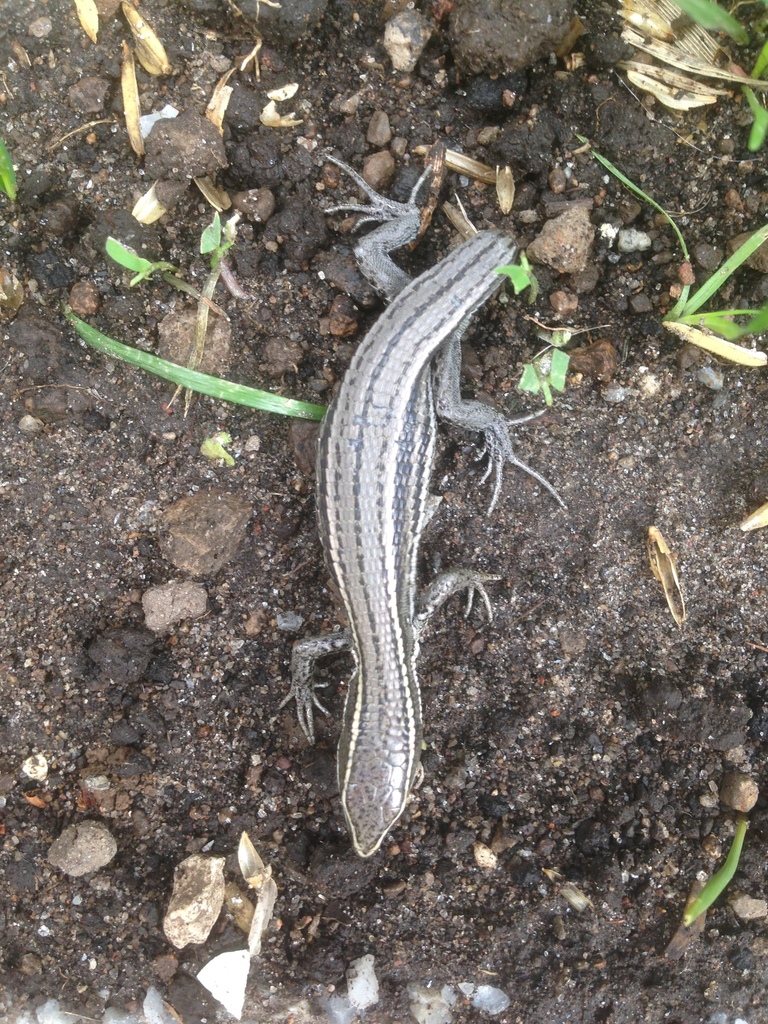
Mountain Pholiodobolus
Pholidobolus montium
Pholidobolus montium, commonly known as the mountain pholiodobolus, cuilán, or miner lizard, is a species of lizard in the family Gymnophthalmidae. It is endemic to the highlands of the northern Ecuadorian and southern Colombian Andes.
From the article Pholidobolus montium on Wikipedia (CC BY-SA), quoted section by section
Description
Pholidobolus montium is a small, diurnal terrestrial lizard. Adult males reach an average snout-vent length (SVL) of approximately 56 mm, while females are slightly larger, reaching up to 66 mm. They exhibit grey-black iridescent dorsal color patterns, a pale yellow dorsolateral stripe, and a distinctive white-cream lip stripe that extends backward toward the forelimbs. Unlike many other lizard clades, P. montium completely lacks femoral follicular glands, a physiological trait it shares with only one other member of its genus, Pholidobolus prefrontalis.
Range & habitat
The species inhabits open shrubby areas, alpine environments, and urbanized regions at high elevations. It is frequently found hiding in natural or man-made burrows, rock piles, stone walls, and agave fence rows, leading to its local name "miner lizard". It is a diurnal species that spends a significant portion of its day foraging and basking to thermoregulate.
Reproduction. Breeding occurs continuously throughout the year. Females deposit clutches of two eggs per reproductive cycle. Pholidobolus montium frequently utilizes communal nesting sites where multiple females deposit eggs together, suggesting a complex level of social aggregation.
Wikipedia: “Habitat and ecology”
What it does
Historically, semi-fossorial (burrowing) gymnophthalmid lizards were believed to communicate almost exclusively through chemical and olfactory cues. However, a comprehensive 2021 behavioral study published an ethogram of 34 distinct behaviors for P. montium, establishing it as the first semi-fossorial gymnophthalmid documented to rely extensively on visual signaling. Conforming with the absence of pheromone-secreting femoral glands, P. montium uses several distinct visual displays during conspecific (same-species) social interactions:
Hand-waving (Leg-waving): One of the most frequent and immediate responses when encountering another lizard or its own reflection in a mirror. The lizard raises a single forelimb and moves it in a distinct waving motion to signal its presence or status. Neck-arching: A postural display where the lizard rigidifies and arches its neck downward or upward during social standoffs. Tail-undulation: Actively waving or undulating the tail in a fluid motion, which serves as a visual signal during conspecific stimulus events rather than an anti-predatory distraction.
== References ==
Wikipedia: “Behavior and communication”
Where it lives
Recorded sightings
—
geo-referenced records in GBIF, from museums, herbaria and field observers.
Drag the globe to turn it. Dots are where records exist, not a range map; darker means more records.
In the stacks
Searching the stacks…
Every page naming Pholidobolus montium in the Biodiversity Heritage Library →
This page is assembled live from iNaturalist, GBIF, Wikipedia, the Source Library and the Internet Archive. It is not yet part of the hand-edited codex. iNaturalist taxon 34897.