- Animals
- ›Chordates
- ›Vertebrates
- ›Reptiles
- ›Snakes and Lizards
- ›Lizards
- ›Wall lizards, amphisbaenians, and allies
- ›Spectacled Lizards
- ›Gymnophthalminae
- ›Iphisa
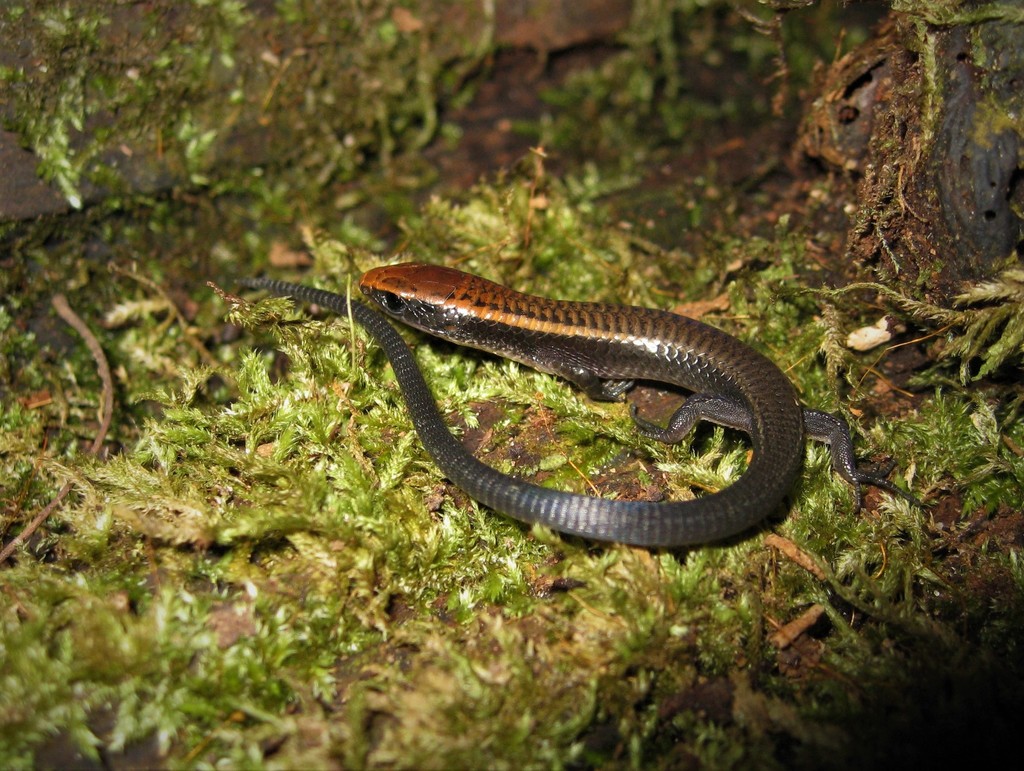
Glossy Shade Lizard
Iphisa elegans
Iphisa is a genus of the lizard family Gymnophthalmidae. The genus is monotypic, meaning that it has only one species, Iphisa elegans, and its common name is the glossy shade lizard. I. elegans is native to the Amazon and is typically found in regions of South America, centrally located in the Amazon Basin. The average body length of the glossy shade lizard is 55 mm. Relatively small, these lizards rely on running as their primary form of movement and, interestingly, exhibit death-feigning behavior, which aids in protection from potential predators.
From the article Iphisa on Wikipedia (CC BY-SA), quoted section by section
Range & habitat
Found in the Neotropics, I. elegans originates in South America. For a long time, Iphisa has been known to inhabit the amazon basins of Peru, Ecuador, Bolivia, Columbia, Brazil, and Guiana Shield. Recent studies, however, have found evidence that the distribution of Iphisa is more extensive. Research has confirmed the presence of Iphisa in 10 additional locations in the North and Southwest of the state of Mato Grosso. The population trend for the glossy shade lizard is currently stable, meaning that there is relatively the same number of I. elegans continuously as the population size is neither increasing nor decreasing. Being at a stable population state can be viewed positively since there are no harsh or immediate threats that threaten the status of the species or risk it going extinct. The habitat in which I. elegans resides is a terrestrial one, meaning that they live on land. Terrestrial habitats can include forests, grasslands, deserts, shorelines, and wetlands. Animals that live in terrestrial habitats are influenced by the moisture in the area (i.e., the moisture that builds from rain or snow falling), the cold temperatures in the winter season, the frequency at which the land floods with water, and the nutrients present in the soil. …
Wikipedia: “Habitat and distribution”
What it does
I. elegans sexually reproduces, meaning that the sperm from the male parent fertilizes the egg of the female parent to form the offspring. The sperm and the egg are two gametes that come together and form the zygote. This zygote and later becomes a mature lizard. Glossy shade lizards are oviparous animals. This signifies that they are animals that lay eggs and that their offspring hatch from the eggs after coming out of the mother's body. This species of lizard produces around one litter in a year.
Wikipedia: “Reproduction”
In human culture
The name Iphisa elegans stems from the root "Iphis-," which is associated with many individuals from Greek mythology. Namely, from Ovid's Metamorphoses narrative poem, Iphis, the daughter of Telethusa and Ligdus, was raised as a man by her mother such that her true gender could be hidden from her father, who wanted a son to carry on their family's farming legacy. The goddess Isis transformed Iphis into a man, and Iphis ended up marrying Ianthe. In 1851, Gray diagnosed Iphisadae as a family; however, as the Iphisadae spelling is not in prevailing usage, it has been corrected to Iphisadae. This was then shortened to "Iphisa," as is the monotypic genus of this species.
Genome. Iphisa is part of the Squamata order, which is the largest order of reptiles. The Iphisa genome is 18,622 base pairs long, it has 12 protein-coding genes, 2 rRNA proteins, and 22 tRNA proteins.
Wikipedia: “History”
Where it lives
Recorded sightings
—
geo-referenced records in GBIF, from museums, herbaria and field observers.
Drag the globe to turn it. Dots are where records exist, not a range map; darker means more records.
In the stacks
Searching the stacks…
Every page naming Iphisa elegans in the Biodiversity Heritage Library →
This page is assembled live from iNaturalist, GBIF, Wikipedia, the Source Library and the Internet Archive. It is not yet part of the hand-edited codex. iNaturalist taxon 34953.