- Animals
- ›Chordates
- ›Vertebrates
- ›Reptiles
- ›Snakes and Lizards
- ›Lizards
- ›Iguanas and Allies
- ›Iguanas, Anoles, and Allies
- ›Iguanas and Chuckwallas
- ›Cyclura
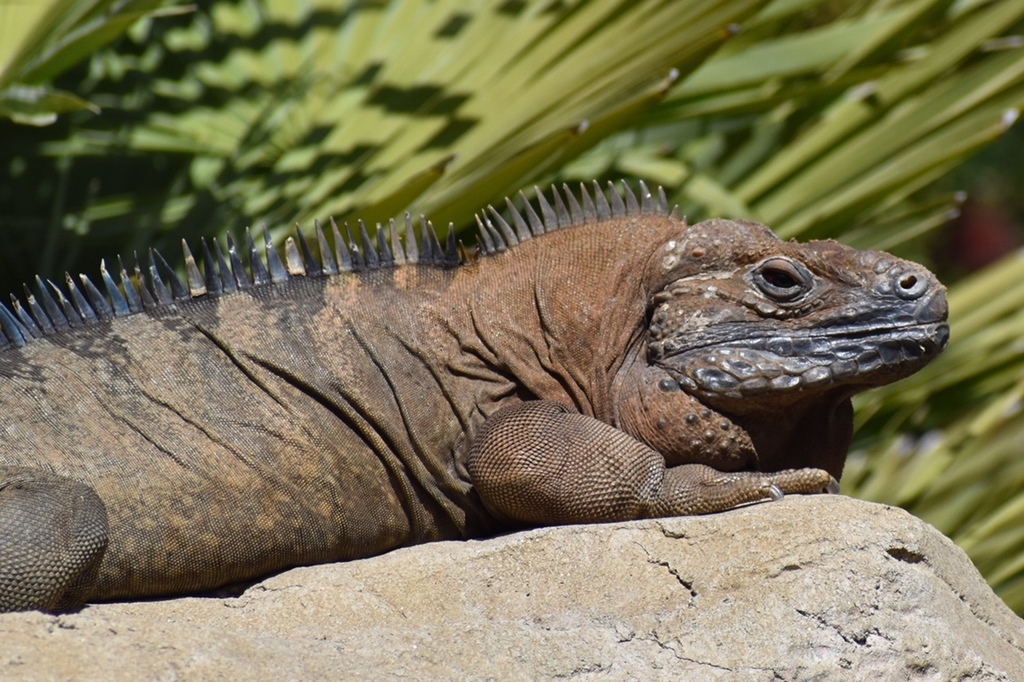
Jamaica Ground Iguana
Cyclura collei
The Jamaican iguana (Cyclura collei), also known commonly as Colley's iguana, is a large species of lizard in the family Iguanidae. The species is endemic to Jamaica. It is critically endangered, even considered extinct between 1948 and 1990. Once found throughout Jamaica and on the offshore islets Great Goat Island and Little Goat Island, it is now confined to the forests of the Hellshire Hills.
From the article Jamaican iguana on Wikipedia (CC BY-SA), quoted section by section
Description
The Jamaican iguana is a large, heavy-bodied lizard, primarily green to salty blue in color with darker olive-green coloration on the shoulders. Three dark broad chevrons extend from the base of the neck to the tail on the animal's back, with dark olive-brown zigzag spots. The dorsal crest scales are somewhat brighter bluish-green than the body. The body surfaces are blotched with a yellowish blotched color breaking up into small groups of spots. Wild individuals, particularly nesting females, often appear deep reddish-brown in color after digging in the coarse ferralic soils of the Hellshire Hills region. The Jamaican iguana is the second-largest land animal native to Jamaica, with only the Jamaican boa weighing more. Males can grow to over 2 kilograms (4.4 lb) and 428 millimetres (16.9 in) in length whereas females are slightly smaller, growing to 378 millimetres (14.9 in) in length. Males also possess large femoral pores on the undersides of their thighs, which are used to release pheromones. The pores of the female are smaller and they do not have a dorsal crest as high as the male's, making the animal somewhat sexually dimorphic.
Wikipedia: “Anatomy and morphology”
Range & habitat
According to Sir Hans Sloane, a physician and botanist who visited Jamaica in 1688, iguanas were once common throughout Jamaica. The Jamaican iguana declined dramatically during the second half of the 19th century, after the introduction of the small Asian mongoose as a form of rat and snake control, until it was believed to exist only on the Goat islands near the Hellshire hills. The Jamaican iguana was believed to be extinct in 1948. A dead adult specimen was found in 1970. The species was rediscovered in August 1990 when a live adult male iguana was chased into a hollow log by a dog of Edwin Duffus, a hog hunter in the Hellshire Hills. By the time he got there, the dog had injured the animal but that was the iguana that was taken to the Hope Zoo. A remnant population was discovered soon after. The Hellshire Hills area is the only area of Jamaica where this iguana is found. It is relegated to two dense populations that consist of scattered individuals. They were once prevalent in the island but are now only found in the dry, rocky, limestone forest areas of St. Catherine. Before it was rediscovered in 1990, the iguana was last seen alive on Goat Island off the coast of Jamaica in 1940.
Wikipedia: “Distribution”
What it does
Like all Cyclura species the Jamaican iguana is primarily herbivorous, consuming leaves, flowers and fruits from over 100 different plant species. This diet is very rarely supplemented with insects and invertebrates such as snails. However, these could simply be eaten incidentally while it consumes the leaves the invertebrates live on.
Wikipedia: “Diet”
At the table
The single direct cause for the Jamaican iguana's decline can be attributed to the introduction of the small Asian mongoose (Urva auropunctata) as a form of snake-control. The mongoose came to rely upon hatchling iguanas as a prime source of food, prompting the creation of the Headstart facility and a proposed program to eradicate the feral mongoose. The biggest current threat to the animals' existence is no longer from the spread of the mongoose, but from the charcoal industry. Charcoal burners rely on hardwood trees from the Hellshire Hills to make charcoal. As this is the primary refuge for the iguanas, the burners have been threatening the research teams who protect the iguanas.
Wikipedia: “Causes of decline”
Toxicity
The Jamaican iguana was believed to be extinct dating to 1948. After its rediscovery in 1990, a study showed that there were only 50 survivors of the "rarest lizard in the world". The IUCN lists it as a Critically Endangered Species.
Wikipedia: “Endangered status”
In human culture
The specific name, collei, is in honor of someone named Colley. John Edward Gray, who originally described this species in 1845, referred to it as "Colley's Iguana". Gray did not further specify who Colley was.
Wikipedia: “Etymology”
Where it lives
Recorded sightings
—
geo-referenced records in GBIF, from museums, herbaria and field observers.
Drag the globe to turn it. Dots are where records exist, not a range map; darker means more records.
In the stacks
Searching the stacks…
Every page naming Cyclura collei in the Biodiversity Heritage Library →
This page is assembled live from iNaturalist, GBIF, Wikipedia, the Source Library and the Internet Archive. It is not yet part of the hand-edited codex. iNaturalist taxon 35298.