- Animals
- ›Chordates
- ›Vertebrates
- ›Reptiles
- ›Snakes and Lizards
- ›Lizards
- ›Iguanas and Allies
- ›Iguanas, Anoles, and Allies
- ›Iguanas and Chuckwallas
- ›Brachylophus
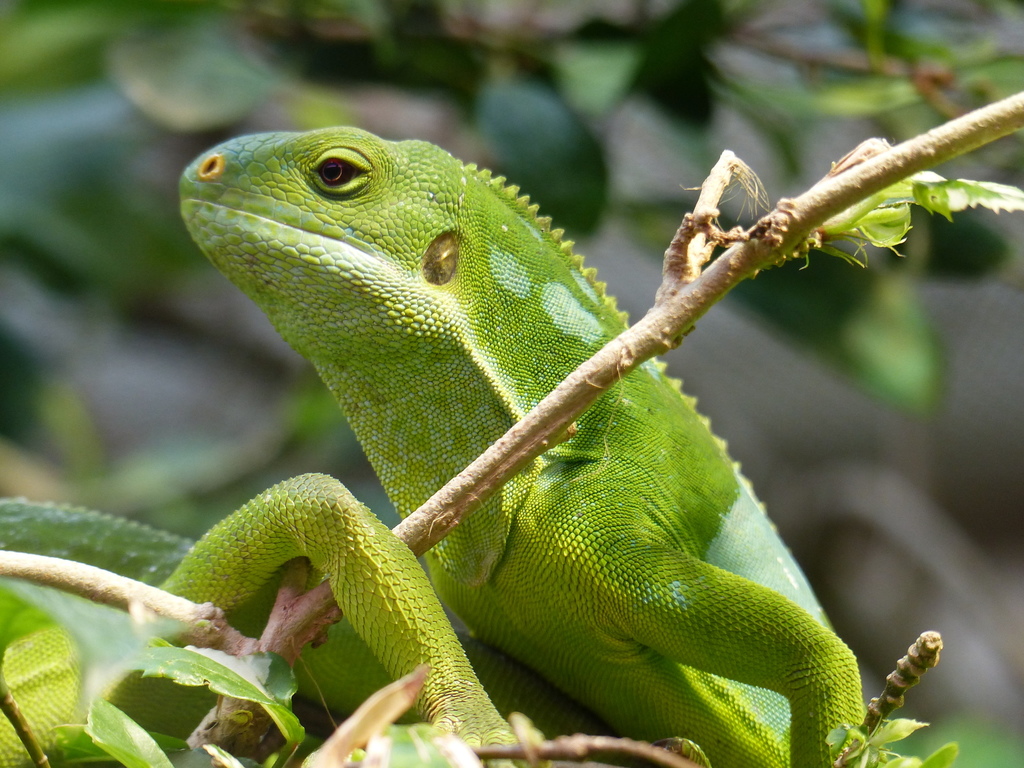
Lau Banded Iguana
Brachylophus fasciatus
Brachylophus fasciatus, the Lau banded iguana, is an arboreal species of lizard endemic to the Lau Islands of the eastern part of the Fijian archipelago. It is also found in Tonga, where it was probably introduced by humans. It is one of the few species of iguanas found outside of the New World and one of the most geographically isolated members of the family Iguanidae. Populations of these iguanas have been declining over the past century due to habitat destruction, and more significantly, the introduction of mongoose and house cats to the islands.
The species is diurnal, spending their days foraging, basking and watching over their territories by day and retreating to the treetops at night. Fiji iguanas are considered a national treasure by the government of Fiji, and its likeness has been featured on postage stamps, currency, and phone book covers.
From the article Brachylophus fasciatus on Wikipedia (CC BY-SA), quoted section by section
Description
Sexually dimorphic, males have two or three white or pale-blue bands 2 centimetres (0.79 in) wide crossing their emerald green background with a pattern of spots and stripes on the nuchal region. Females, on the other hand, are solid green with occasional spotting or partial bands. Both sexes have a yellow underside. Fiji banded iguanas reach 60 centimetres (24 in) in length when measured from snout to tail tip and bodyweights of up to 200 grams (0.44 lb). The crests of these iguanas are very short reaching a length of 0.5 centimetres (0.20 in). Although there appear to be slight variations between insular populations, none have been well-described. The animals from Tonga are smaller and leaner, and were previously described as B. brevicephalus. The skin of this species is sensitive to light and the lizard can change its skin color to match its background. Captive specimens have been observed matching the pattern left by the screen tops of their cages in as little as 30 seconds.
Range & habitat
The Lau banded iguana is endemic to the Lau Islands of Fiji. Its recent range is known to extend from Vanua Balavu in the north to Fulaga and Ogea in the south, including at least eleven islands. Previously it was reported from Moce and Oneata, and it may have once been present throughout the Lau group. It was introduced to the Tonga Islands 300 years ago, probably after the native Brachylophus gibbonsi was driven to extinction.
Wikipedia: “Distribution and habitat”
What it does
The species is diurnal, spending their days foraging, basking and watching over their territories by day and retreating to the treetops at night. Male iguanas are highly visual, and aggressively defend their territories from rival males. The iguanas will deepen their green coloration to intensify their bands, and bob their heads and intimidate intruders by lunging at them with open mouths. They often expand and flare their dewlaps to increase the size of their profile, following up with violent battles amongst each other.
Wikipedia: “Behavior”
In human culture
This species was first described by French zoologist Alexandre Brongniart in 1800. The generic name, Brachylophus, is derived from two Greek words: brachys (βραχύς) meaning "short" and lophos (λόφος) meaning "crest" or "plume", denoting the short spiny crests along the back of this species. The specific name, fasciatus, is a Latin word meaning "banded". This species is closely related to B. bulabula, B. gau and B. vitiensis. The genus Brachylophus is thought to be descended from ancestors that rafted 9,000 kilometres (5,600 mi) west across the Pacific Ocean from the Americas, where their closest relatives are found. It has also been suggested that they descended from a more widespread lineage of (now extinct) Old World iguanids that diverged from their New World relatives in the Paleogene. However, no other members of the putative lineage, living or fossil, have been found outside Fiji and Tonga.
Wikipedia: “Taxonomy and etymology”
Where it lives
Recorded sightings
—
geo-referenced records in GBIF, from museums, herbaria and field observers.
Drag the globe to turn it. Dots are where records exist, not a range map; darker means more records.
In the stacks
Searching the stacks…
Every page naming Brachylophus fasciatus in the Biodiversity Heritage Library →
This page is assembled live from iNaturalist, GBIF, Wikipedia, the Source Library and the Internet Archive. It is not yet part of the hand-edited codex. iNaturalist taxon 35328.