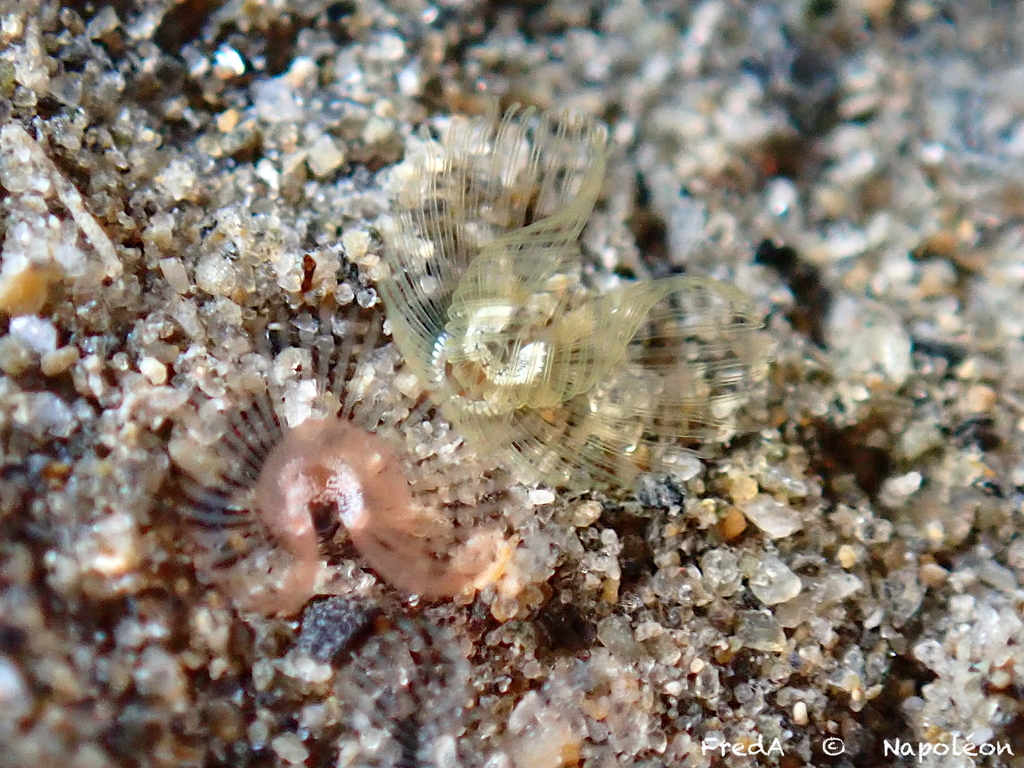
Sand horseshoe worm
Phoronis psammophila
Phoronis psammophila is a species of marine horseshoe worm in the phylum Phoronida. It lives in a tube projecting from the sea floor in shallow seas around the world.
From the article Phoronis psammophila on Wikipedia (CC BY-SA), quoted section by section
Description
Phoronis psammophila constructs and lives in a rigid, chitinous tube about 10 cm long, incorporating sand grains and detritus. The extended worm is up to 19 centimetres long but it can contract down to about one fifth of this length. The body is pinkish and is divided into two sections. The anterior part, the mesosome, has a cavity, the mesocoel, that extends into the tentacles and keeps them rigid by hydrostatic pressure. The mesosome bears the lophophore, a specialist feeding structure which consists of a ring of up to 190 translucent tentacles arranged in a horseshoe-shape encircling the crescent-shaped mouth. The posterior and larger body section is the metasome and contains the metacoel. It is swollen at the base into an ampulla which may provide grip inside the tube. The gut is U-shaped and extends from the mouth to the ampulla before doubling back to the anus which is situated just below the mouth. The gonads are located in the metacoel. There are two blood vessels running along the ventral and dorsal sides of the body with capillaries in the tentacles. These are made easily visible by the haemoglobin in the red blood cells. There is a single nerve fibre on the left side of the body.
Range & habitat
The distribution is cosmopolitan and the type locality is Messina in Italy. P. psammophila is found in the intertidal zone and at depths down to 70 metres. It favours a substrate of fine sand with a moderate silt content and sometimes occurs at densities of up to 20,000 individuals per square metre.
Wikipedia: “Distribution and habitat”
Where it lives
Recorded sightings
—
geo-referenced records in GBIF, from museums, herbaria and field observers.
Drag the globe to turn it. Dots are where records exist, not a range map; darker means more records.
In the stacks
Searching the stacks…
Every page naming Phoronis psammophila in the Biodiversity Heritage Library →
This page is assembled live from iNaturalist, GBIF, Wikipedia, the Source Library and the Internet Archive. It is not yet part of the hand-edited codex. iNaturalist taxon 353643.