- Animals
- ›Echinoderms
- ›sea urchins and sea cucumbers
- ›Sea Urchins, Sand Dollars, and Heart Urchins
- ›sea urchins
- ›Aulodonta
- ›Echinothuriacea
- ›Echinothurioida
- ›Echinothuriidae
- ›Echinothuriinae
- ›Calveriosoma
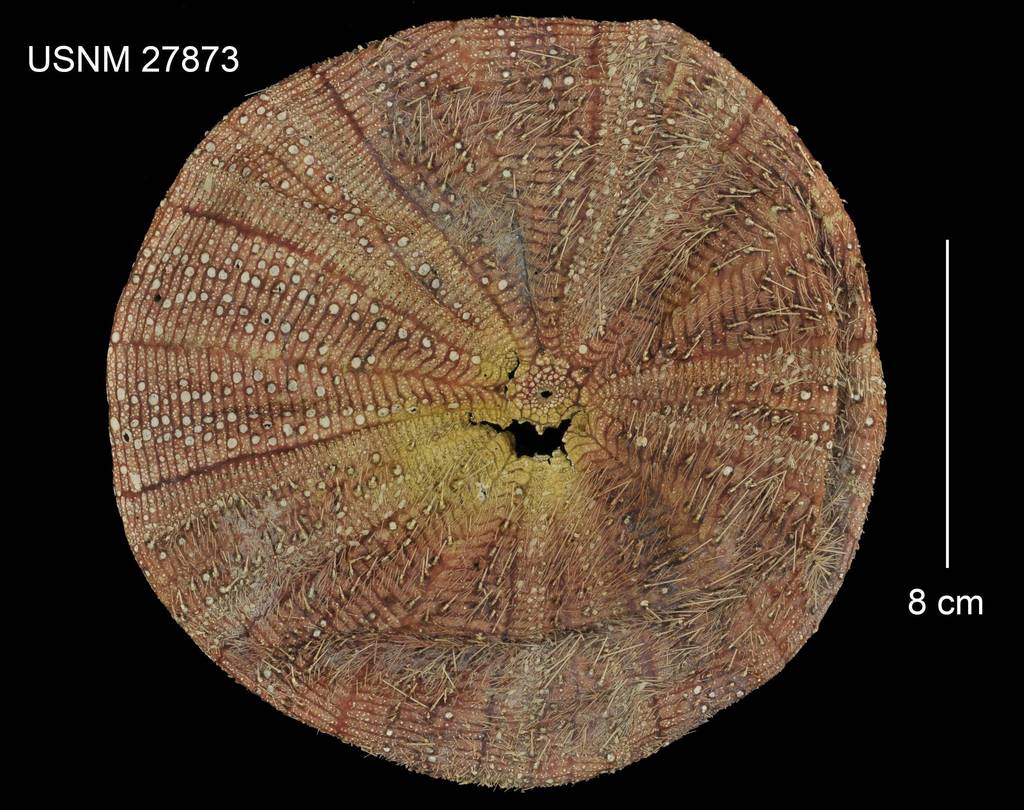
Calveriosoma gracile
Calveriosoma gracile is a species of sea urchin in the order Echinothurioida. It is a deep water species and is found on the seabed in western parts of the Pacific Ocean at depths of 200 to 800 metres (660 to 2,620 ft).
From the article Calveriosoma gracile on Wikipedia (CC BY-SA), quoted section by section
Description
Calveriosoma gracile grows to a diameter of about 2.4 cm (1 in) and is scantily covered in short spines. It has a somewhat flattened globose shape resembling a cushion. It is one of a group of echinoderms that instead of having a rigid test consisting of fused calcareous plates, has a flexible leathery skin with loose, wedge-shaped plates embedded in it. This makes the boundaries between the plates easy to observe. Other distinguishing characteristics include hollow spines tipped with hoof-like structures and simple mouthparts. Echinoderms in this order were known only as fossils having been found in deposits such as the chalk beds of southern England dating back to the Cretaceous era. It was only in the Challenger expedition of the 1870s that living members of the group were found, when deep ocean floors were dredged to investigate the organisms living at these great depths.
Range & habitat
Calveriosoma gracile is found on the seabed at depths between 200 and 800 metres (660 and 2,620 ft). It is known to occur in the Sea of Japan and near the Philippines and New Zealand on soft sediments.
Wikipedia: “Distribution and habitat”
Where it lives
Recorded sightings
—
geo-referenced records in GBIF, from museums, herbaria and field observers.
Drag the globe to turn it. Dots are where records exist, not a range map; darker means more records.
In the stacks
Searching the stacks…
Every page naming Calveriosoma gracile in the Biodiversity Heritage Library →
This page is assembled live from iNaturalist, GBIF, Wikipedia, the Source Library and the Internet Archive. It is not yet part of the hand-edited codex. iNaturalist taxon 354508.