- Animals
- ›Echinoderms
- ›Sea Stars and Brittle Stars
- ›Sea Stars
- ›Valvatacean Sea Stars
- ›Valvatidan Sea Stars
- ›Cushion Stars, Carpet Stars, and Allies
- ›Patiriella
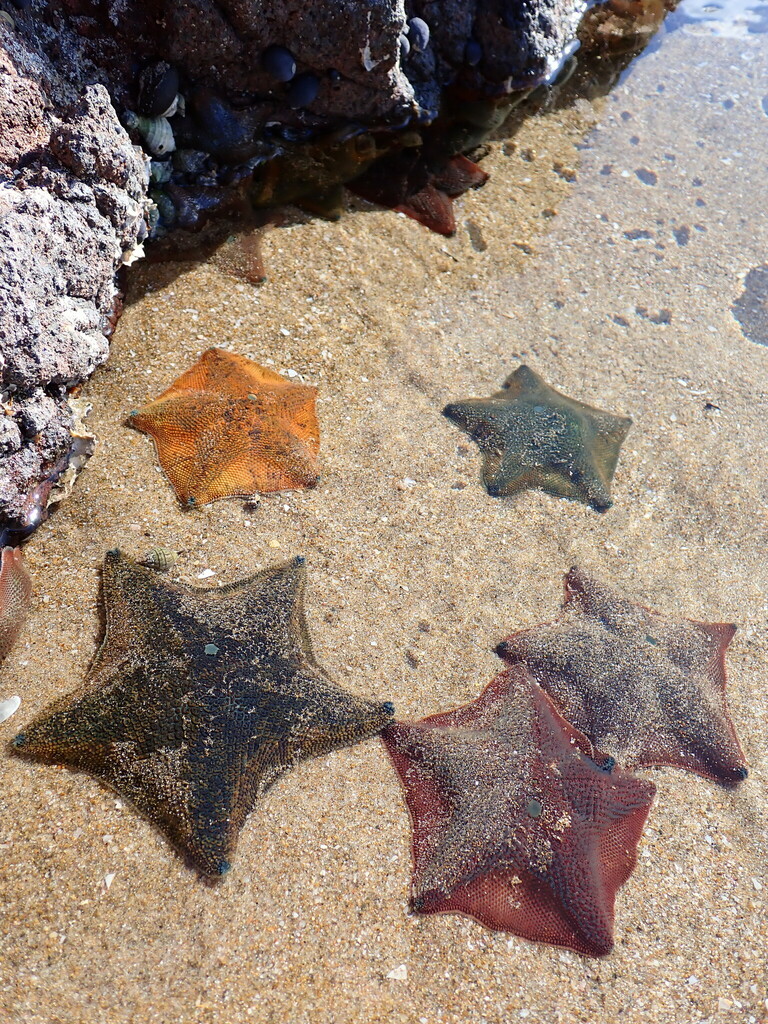
New Zealand Common Cushion Star
Patiriella regularis
Patiriella regularis, the New Zealand common cushion star, or, in Māori, kapu parahua, is a sea star native to New Zealand. It is one of New Zealand's most common rocky shore starfish.
From the article Patiriella regularis on Wikipedia (CC BY-SA), quoted section by section
Description
Patiriella regularis is a spinulosan asterinid with a pentagonal shape. It typically has five short arms, however, 2% of the population is composed of individuals with 4, 6, 7 or 8 arms. It has an arm spread of up to 60 mm (2.4 in). The colour of Patiriella regularis differs greatly between individuals and includes blues, greens and browns as the more common colours, although oranges, reds and individuals with mottled forms have also been identified. Two separate forms of Patiriella regularis have been identified. The most significant difference between the two is the plate arrangement along the ray crests. They typically grow up to 10 cm (3.9 in) across in diameter, although their sizes vary greatly within the species.
Range & habitat
Although native to New Zealand, Patiriella regularis has also spread to Southern Australia and Tasmania. This spread is likely due to mussel exports in the 19th century. Establishing populations in Tasmania are bordering on becoming labelled an invasive species due to their effects on the native fauna in those habitats. Patiriella regularis is the most commonly found asteroid in New Zealand and tends to dominate most suitable habitats. They range the full length of New Zealand, from the North Cape to Stewart Island. Patiriella regularis is abundant in many harbours around New Zealand, including Otago Harbour and Whangateau Harbour, at opposite ends of the country. They are frequently found in the Fiordland of New Zealand, specifically throughout the Doubtful and Milford Sounds. Patiriella regularis is also found in the Kermadec Islands, a subtropical island group 1000 km northeast of the North Island.
Wikipedia: “Natural global range”
What it does
Patiriella regularis follows an annual reproductive cycle. They reproduce asexually by fission and also sexually, with males and females releasing eggs and sperm into the water for external fertilisation. Reproductive success in Patiriella regularis is dependent on environmental conditions that are the most favourable for success of the offspring, for example the abundance of food within the habitat. Where food abundances are low, the stored food reserves in the pyloric caeca of the asterinid will also be low, resulting in poor gonad development. The reproductive cycle of females of Patiriella regularis is divided into five stages: the recovery stage, the growing stage, the maturing stage, the partly-spawned stage and the spent stage. These stages are characterised by the number of oocytes in each stage of development, the presence or absence of degenerating octets and the abundance of somatic cells. The female Patiriella regularis' reproductive cycle follows a sequence of events from oogenesis, gonad activation, spawning of gametes, regression of gonadal activity and a resting period. Oogenesis produces an ovum from a primordial germ cell with cell growth and organelle synthesis. Patiriella regularis is an oviparous animal, one which deposits eggs that hatch outside of their body. Patiriella regularis spawns eggs which are around the size of 150 μm. …
Wikipedia: “Life cycle and phenology”
At the table
Patiriella regularis is not used specifically for cultural purposes, however, it does play an important role in aquatic ecosystems and can be used as an indicator of water quality.
== References ==
Wikipedia: “Cultural uses”
Where it lives
Recorded sightings
—
geo-referenced records in GBIF, from museums, herbaria and field observers.
Drag the globe to turn it. Dots are where records exist, not a range map; darker means more records.
In the stacks
Searching the stacks…
Every page naming Patiriella regularis in the Biodiversity Heritage Library →
This page is assembled live from iNaturalist, GBIF, Wikipedia, the Source Library and the Internet Archive. It is not yet part of the hand-edited codex. iNaturalist taxon 354820.