- Animals
- ›Echinoderms
- ›Sea Stars and Brittle Stars
- ›Brittle Stars
- ›Myophiuroida
- ›Metophiurida
- ›Ophintegrida
- ›Amphilepididans
- ›Gnathophiurina
- ›Amphiuroidea
- ›Long-armed Burrowing Brittle Stars
- ›Amphiura
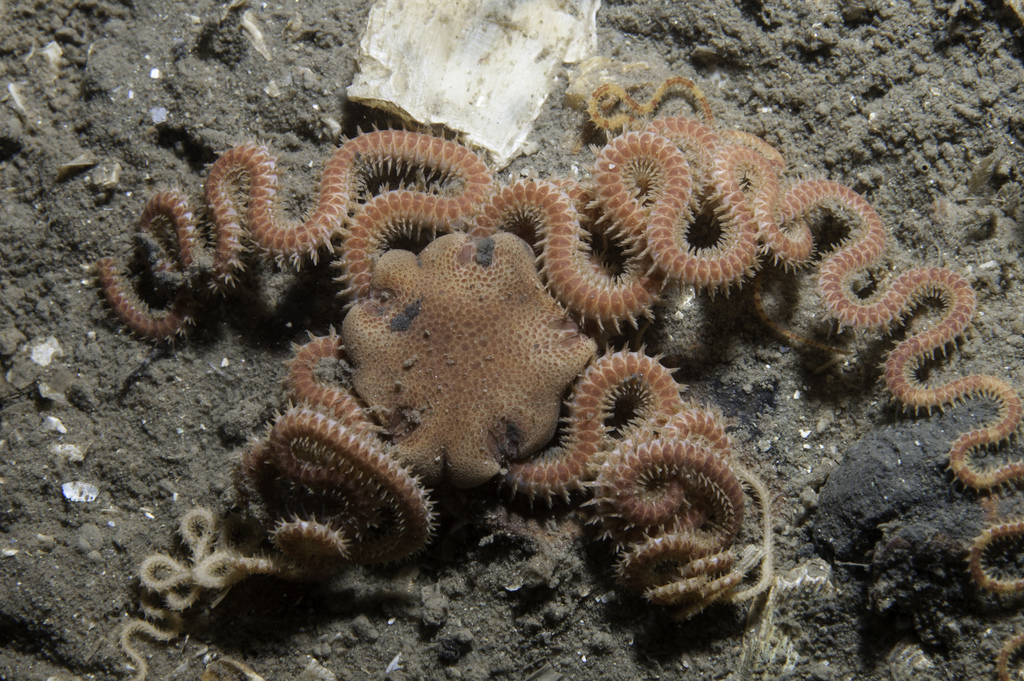
Amphiura chiajei
Amphiura chiajei is a species of brittle star belonging to the family Amphiuridae. It is found in the northeastern Atlantic Ocean and adjoining seas to a depth of 1,000 metres (3,300 ft). It digs itself into the soft sediment of the seabed and raises its arms into the water above to suspension feed on plankton. It was first described by the British naturalist Edward Forbes in 1843, and was named for the Italian zoologist Stefano Delle Chiaje (1794–1860).
From the article Amphiura chiajei on Wikipedia (CC BY-SA), quoted section by section
Description
Amphiura chiajei has a central disc and five slender arms and is pinkish or greyish brown. The disc is up to 11 mm (0.4 in) in diameter and the arms up to 88 mm (3 in) long. The dorsal surface of the disc is covered with scales, larger in the middle and smaller towards the margin. There are a pair of separate radial shields near the attachment of each of the arms. The arms are elongated and are composed of many segments with joints between them, each segment bearing four to six pairs of conical spines.
Range & habitat
Amphiura chiajei is found in the northeastern Atlantic Ocean, the North Sea and the Mediterranean Sea. Its range extends from western Norway to the Azores and the west coast of North Africa. It is found on the seabed on sand or muddy sand at depths down to about 1,000 metres (3,300 ft).
Wikipedia: “Distribution and habitat”
What it does
Amphiura chiajei buries itself in the sediment with the disc at a depth of about 5 centimetres (2.0 in). It extends one or two arms above the sediment to gather food particles which are then transferred along its arm to its mouth. It is often found in the same locations as the heart urchin Brissopsis lyrifera, and where this happens it grows more slowly than it does elsewhere. This is thought to be because the urchin churns up the sediment excessively. Amphiura chiajei becomes sexually mature at about four years of age and may live for ten years. The gonads grow in size over the winter and spring and broadcast spawning takes place in late summer and early autumn. The larvae drift with the current and settle on the seabed and undergo metamorphosis at around eight days. This short larval period means that their potential to disperse is limited. In a population off the coast of Northumberland during the period 1958 to 1964, all the individuals were large and there was no sign of juveniles. Then in 1965 a large number of young individuals joined the population, demonstrating that episodic recruitment is a feature of this brittle star. In Loch Eil and Loch Linnhe, Scotland this species has become much more common in the last few decades of the 20th century. …
Wikipedia: “Ecology”
Where it lives
Recorded sightings
—
geo-referenced records in GBIF, from museums, herbaria and field observers.
Drag the globe to turn it. Dots are where records exist, not a range map; darker means more records.
In the stacks
Searching the stacks…
Every page naming Amphiura chiajei in the Biodiversity Heritage Library →
This page is assembled live from iNaturalist, GBIF, Wikipedia, the Source Library and the Internet Archive. It is not yet part of the hand-edited codex. iNaturalist taxon 354827.